Refrigerator Making a Loud Noise? Causes for Bend, OR Homes
A refrigerator making a loud noise is telling you something — the trick is knowing whether it is normal operation or a cry for help. This guide breaks down every common fridge sound, what causes it, and when to call a technician.

Start Here: Your Fridge Is Supposed to Make Noise
Every refrigerator makes noise. Compressors hum, fans whir, refrigerant gurgles, ice makers clunk, defrost timers click. A modern refrigerator cycles through a whole soundtrack of normal sounds every day, and most of them mean the machine is working exactly as designed.
The question is never “why is my fridge making noise” — it is “is this noise normal?” A refrigerator making a loud noise that is new, getting louder, or different in character from its usual sounds deserves attention. The sound itself is diagnostic: humming points one direction, clicking another, grinding somewhere else entirely.
This guide teaches you to read those sounds. You will learn which noises to ignore, which ones have simple DIY fixes, and which ones mean a component is failing and needs a technician. It is written for homeowners in Bend, Oregon, with notes on the local conditions — dust, hard water, temperature swings — that make certain fridge noises more common here.
One important distinction: this guide is about noise. If your refrigerator is not cooling properly, that is a different problem with different causes — though the two sometimes overlap, since a failing compressor is both loud and ineffective. Noise with normal cooling usually means a fan, leveling, or minor issue. Noise with poor cooling means the cooling system itself needs professional attention.
A final note on age: refrigerators get louder as they age, and that is normal up to a point. A ten-year-old compressor hums more than it did at year two, because bearings wear and mounts soften. The key word is gradual. A slow increase over years is aging. A sudden change over weeks is a problem developing. If you can point to when the noise started or when it got noticeably worse, that timeline is valuable information — write it down before you call, because the technician will ask.
Table of Contents — Tap to Jump to a Section
- 01 Introduction
- 02 Noise Decoder Table
- 03 How Cooling Works
- 04 Normal vs Warning Sounds
- 05 Condenser Fan & Coils
- 06 Compressor Issues
- 07 Evaporator Fan & Ice
- 08 Ice Maker Noises
- 09 Leveling & Vibration
- 09 DIY Diagnosis Steps
- 10 Stay Quiet Long-Term
- 11 When to Call a Pro
- 12 FAQ
- 13 Bend & Redmond Service
- 14 Final Takeaway
The Fridge Noise Decoder
Find your sound in the table, then jump to the matching section for the full story.
| The Sound | Likely Cause | Normal or Problem |
|---|---|---|
| Steady humming | Compressor running its cycle | Normal — unless louder than usual |
| Buzzing from the back | Dirty condenser fan or coils | Problem — clean them |
| Clicking every few minutes | Start relay failing | Problem — needs a technician |
| Occasional clicks | Defrost timer, controls cycling | Normal |
| Rattling or vibrating | Not level, loose parts, drain pan | Often DIY — level and secure |
| Grinding or scraping in freezer | Evaporator fan hitting ice | Problem — defrost issue likely |
| Squealing or chirping | Worn fan motor bearings | Problem — motor wearing out |
| Gurgling or bubbling | Refrigerant moving through coils | Normal |
| Knocking from lower back | Compressor mounts worn | Problem — needs diagnosis |
| Brief buzzing then ice drops | Ice maker filling and ejecting | Normal |
How Your Refrigerator Cools (in 60 Seconds)
Understanding the cooling cycle makes every noise in this guide click into place. Here is the whole system in plain terms.
Your refrigerator does not create cold — it moves heat. Refrigerant, a fluid that boils at very low temperatures, circulates in a sealed loop through four stages. First, the compressor squeezes the refrigerant gas, which makes it hot and high-pressure. That hot gas flows through the condenser coils — the black grid on the back or bottom of the fridge — where it releases its heat into your kitchen and condenses into a liquid.
Next, the liquid refrigerant passes through a tiny restriction called the expansion device, which drops its pressure suddenly. Low pressure makes it cold — very cold. That frigid refrigerant flows through the evaporator coils inside the freezer, absorbing heat from the air around them. The evaporator fan blows that chilled air into the freezer and refrigerator compartments. Finally, the now-warmer refrigerant gas returns to the compressor, and the cycle repeats.
Two fans keep this loop efficient. The condenser fan at the bottom back blows room air across the hot condenser coils so they can shed heat. The evaporator fan inside the freezer circulates the cold air where it is needed. When either fan struggles — dust on the condenser fan, ice on the evaporator fan — you hear it, and cooling suffers.
The defrost system runs on a timer, typically every 6 to 12 hours. A small heater warms the evaporator coils just enough to melt accumulated frost, and the meltwater drains to a pan underneath where it evaporates. That is the clicking you hear every several hours, and the occasional sizzling as water hits the warm heater. When any part of the defrost system fails, frost builds unchecked until the evaporator fan starts grinding against it — the exact symptom covered in the evaporator section above.
Now the noise map makes sense: humming lives at the compressor, buzzing at the condenser fan, grinding at the evaporator fan, clicking at the defrost timer and start relay, and gurgling in the refrigerant lines themselves. Every sound has an address, and now you know the neighborhood.
Normal Sounds vs Warning Sounds
Before you worry, learn the normal soundtrack. These sounds are part of healthy refrigerator operation, and “fixing” them would mean breaking something that works.
Normal: a low steady hum that cycles on and off — that is the compressor doing its job. Occasional gurgling or bubbling as refrigerant moves through the system. Clicking every several hours as the defrost timer switches modes. Brief buzzing when the ice maker water valve opens to fill the tray, followed by the clunk of ice ejecting. Hissing or sizzling during defrost as meltwater hits the warm defrost heater. Popping as plastic interior parts expand and contract with temperature changes.
Warning: any sound that is new, or an old sound getting steadily louder. Clicking that repeats every few minutes — especially a click followed by a brief hum, then another click — usually means the compressor start relay is failing to start the compressor. Grinding or scraping from the freezer means the evaporator fan is hitting ice. Squealing or chirping means fan motor bearings are wearing out. Loud knocking from the lower back suggests the compressor is moving on worn mounts. A hum that keeps getting louder week after week points to a compressor working too hard, often because of dirty coils.
The simplest triage rule: if the noise is new or worsening, investigate. If it has always sounded like that and cooling is fine, it is probably normal. Refrigerators do get louder with age — a ten-year-old fridge hums more than it did at year two — but the change should be gradual over years, not sudden over weeks.
When noise meets poor cooling, escalate. A loud fridge that still cools is usually a fan, leveling, or maintenance issue. A loud fridge that is also losing temperature is a cooling-system problem — compressor, refrigerant, or controls — and needs a technician promptly, since food safety is on the line.
Condenser Fan and Dirty Coils: The Most Common Culprit
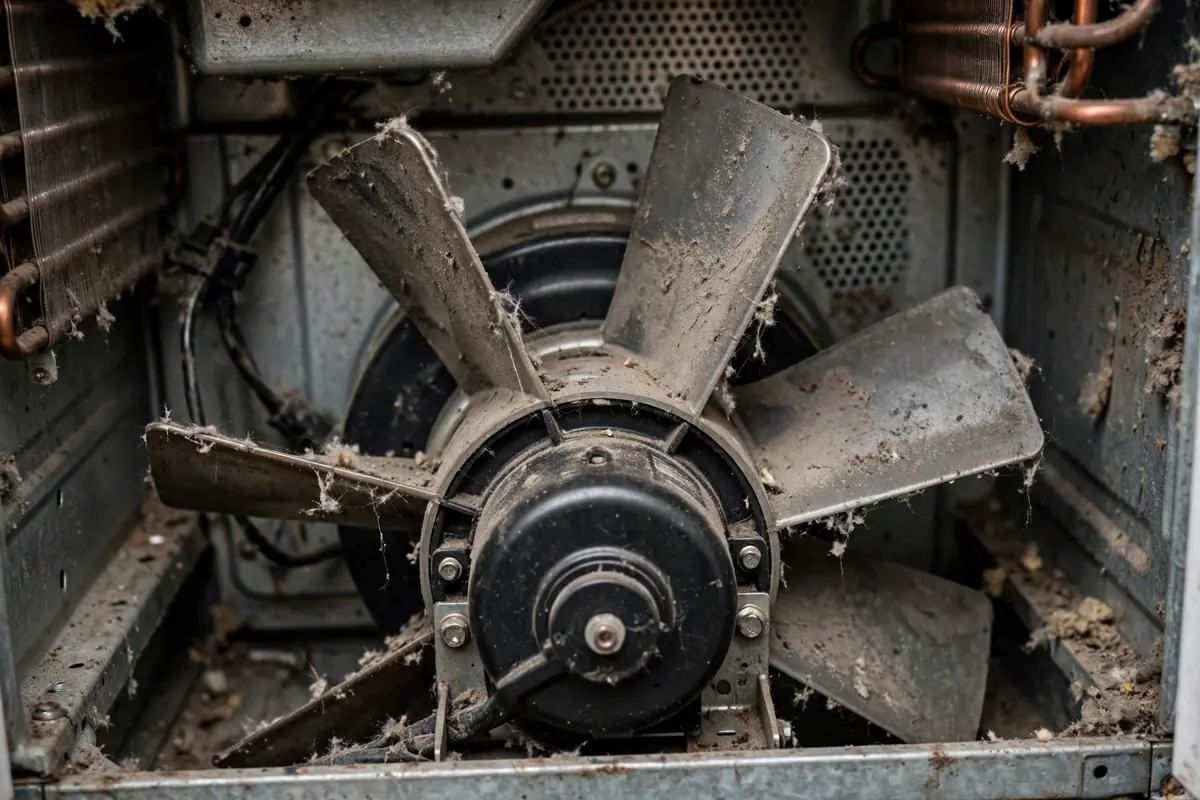
If the noise is loudest near the floor or behind the fridge, start here. Down at the bottom back of most refrigerators sits the condenser fan, which blows air across the condenser coils to release heat. When dust, pet hair, and kitchen grease coat the fan blades and coils, the fan works harder and louder — a normal whoosh becomes an annoying buzz or roar.
Dirty coils do double damage. They make the fan loud, and they force the compressor to run longer and hotter to achieve the same cooling. That extra compressor strain adds its own louder hum on top of the fan noise. In Central Oregon, where high-desert dust is a constant, this is the single most common cause of a refrigerator making a loud noise — and the easiest to fix.
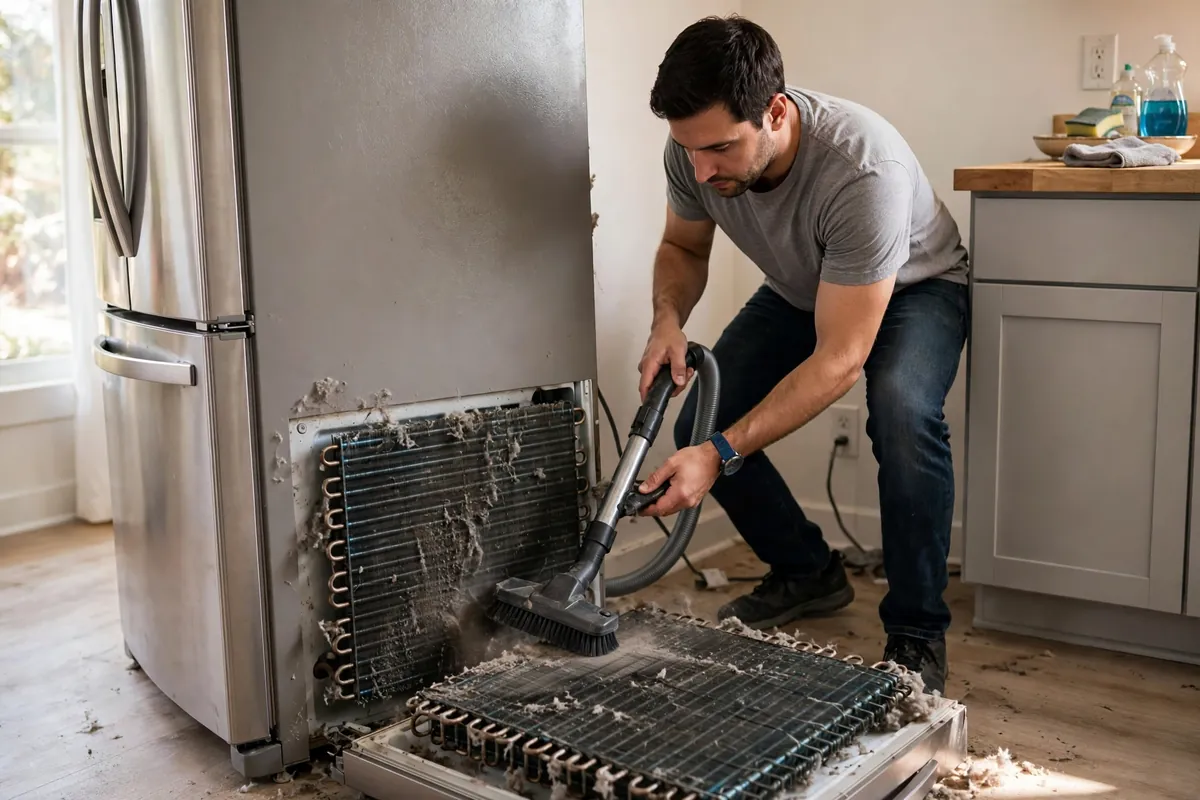
The fix: unplug the refrigerator, pull it out, and vacuum the coils and fan area with a brush attachment. A coil brush reaches between the fins where the vacuum cannot. Do this twice a year here — spring and fall — rather than the annual cleaning recommended in less dusty climates. When you are done, push the fridge back with a few inches of clearance behind it for airflow.
You should notice the difference within a day: the fridge cycles off sooner, runs quieter, and the back panel feels less hot. If the buzz persists after a thorough cleaning, the fan motor itself may be wearing out — a squealing or chirping quality to the noise points that way, and fan motor replacement is a technician job.
Compressor Noises: Hum, Knock, and Click
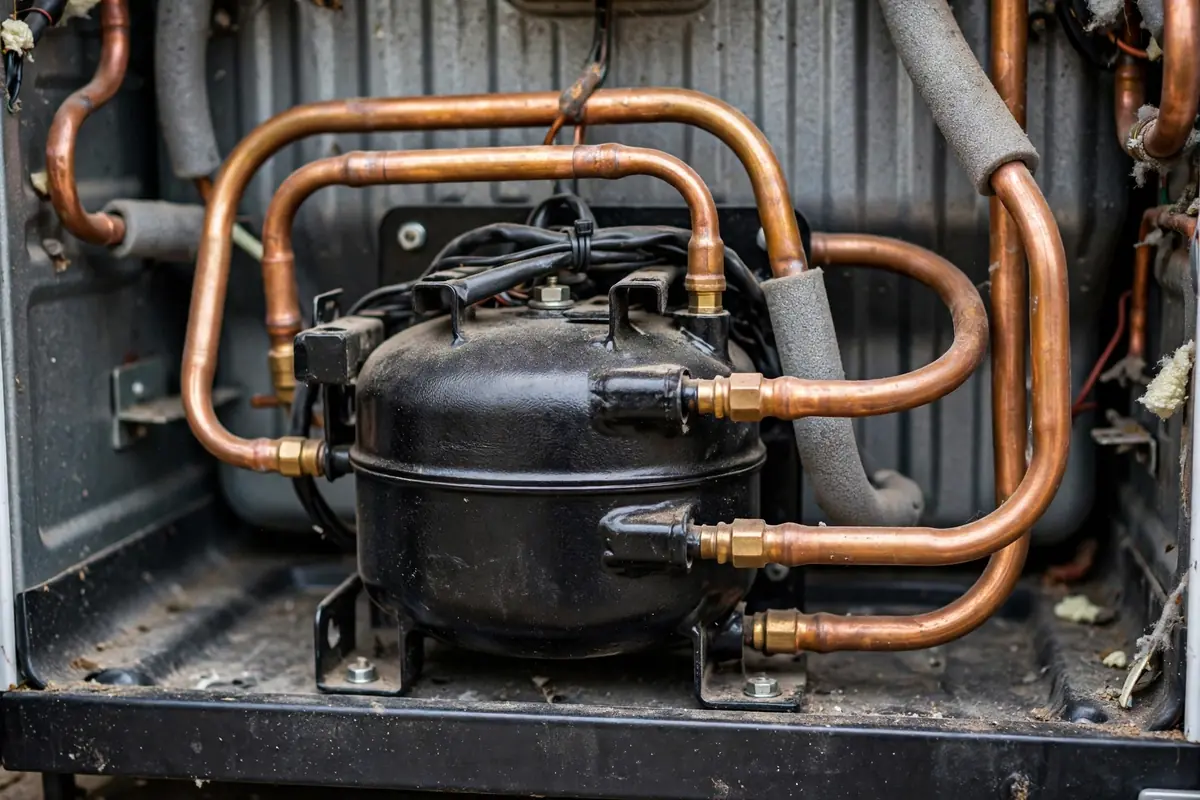
The compressor is the heart of the refrigerator — a sealed pump that circulates refrigerant. Every compressor hums; that is normal. But changes in that hum tell a story, and some compressor sounds are serious.
A hum getting steadily louder usually means the compressor is working harder than it should. The most common reason is dirty condenser coils (see above) — clean them first before suspecting the compressor itself. If the coils are clean and the hum keeps climbing, the compressor may be wearing internally.
Knocking or thumping from the lower back often means the compressor’s mounting springs or rubber mounts have worn. Inside its sealed case, the compressor motor hangs on springs that absorb vibration. When those wear out, the motor knocks against the case with every cycle. This does not fix itself and gets worse — it needs professional diagnosis.
Clicking every few minutes is the classic failing start relay. The relay’s job is to kick the compressor on; when it fails, you hear a click as it tries, a brief hum as the compressor attempts to start, then another click as the overload trips. This click-hum-click cycle repeating every few minutes is one of the most distinctive refrigerator sounds, and it means the compressor is not starting. A start relay is an inexpensive part, but the diagnosis matters — because the same symptom can mean a seized compressor, which is a replace-the-fridge situation.
A loud buzz that never stops combined with poor cooling can indicate the compressor is running continuously without achieving temperature — possibly low refrigerant or a failing compressor. This is firmly technician territory: sealed-system work requires specialized equipment and certification.
Do not ignore compressor sounds. The compressor is the most expensive component in the refrigerator. Catching a start relay early is a small repair; letting a struggling compressor run for months can turn it into a terminal failure. If you hear the click-hum-click cycle, call sooner rather than later.
Evaporator Fan: Grinding and Scraping in the Freezer
The evaporator fan lives inside the freezer compartment, circulating cold air over the evaporator coils and into both the freezer and refrigerator sections. When it runs into trouble, you hear it — usually as grinding, scraping, or rhythmic clicking from inside the freezer.
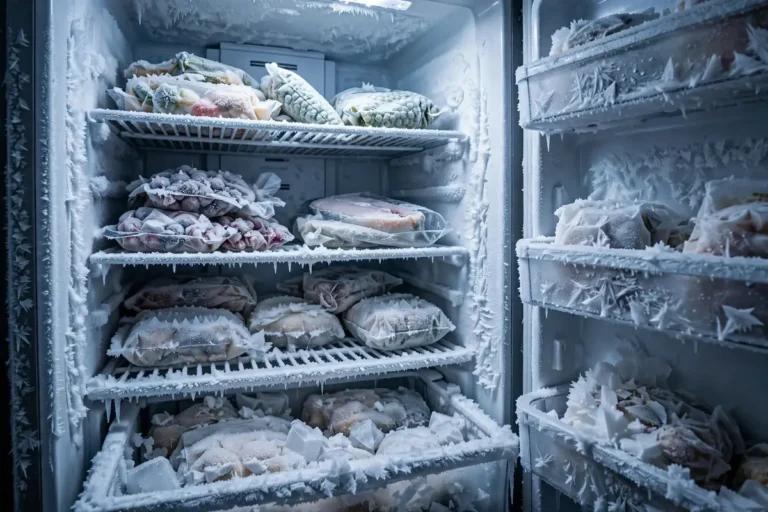
The most common cause is ice. If the freezer door gets left ajar, or the defrost system is not working properly, frost builds up on the evaporator coils and the fan blades. Each rotation drags the blade across the frost, producing a grinding or scraping sound. The noise often fades after a defrost cycle clears the ice, then returns within a day or two — that on-off pattern is the signature of a defrost problem.
You can confirm it with a simple test: open the freezer door. On most models, the evaporator fan stops when the door switch is pressed. If the grinding stops the moment you open the door, you have found your culprit — it is the evaporator fan, not the compressor or condenser fan.
For a one-time ice buildup — say, after the door was left open — unplugging the fridge and letting it defrost fully for several hours can resolve it. But if the ice returns quickly, the defrost heater, defrost thermostat, or control board is not doing its job, and that needs professional service. A squealing or chirping from the same area, rather than grinding, points to worn fan motor bearings — also a technician repair, since it requires opening the freezer’s interior panel.

Ice Maker Noises: Buzzing, Clunking, and Rattling
Ice makers are noisy by nature, and most of their sounds are normal. The trick is knowing the ice maker’s normal cycle so you can spot when it deviates.
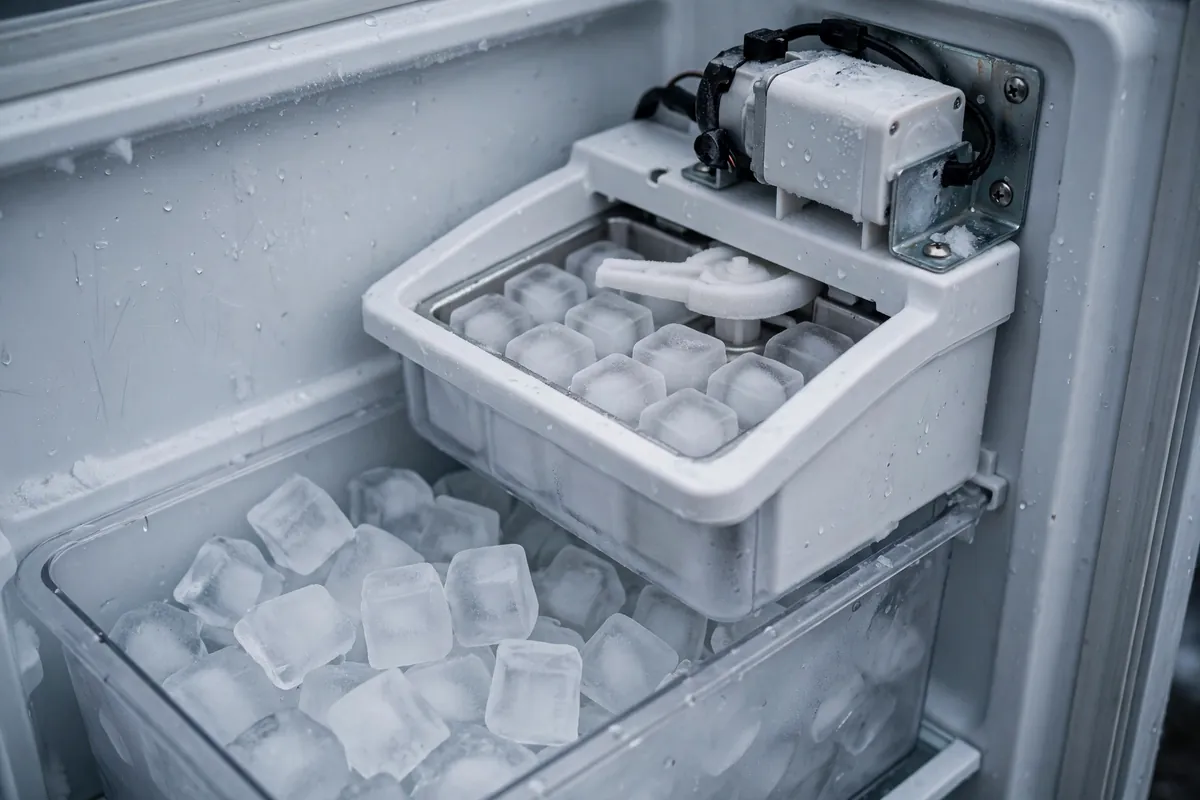
Brief buzzing every couple of hours is the water inlet valve opening to fill the ice tray. It lasts a few seconds and stops. That is normal. Buzzing that runs without stopping, however, means the valve is stuck open or the water line is under pressure with nowhere to go — both need attention, since a stuck valve can flood the freezer.
Clunking or thudding is the ice ejecting from the tray into the bin. Normal, though it can be startling at 2 a.m. Rattling near the ice bin when dispensing usually means ice cubes have fused into a clump — break up the clump and the rattle stops. If the bin is overfilled, cubes jam the auger and the dispenser motor strains; keep the bin at a reasonable level.
Clicking or grinding from the ice maker area that was not there before can mean the ice maker module gears are wearing out, or ice has jammed the ejector arms. Try emptying the bin and letting it make a fresh batch. If the new noise persists through a full cycle, the module may need replacement — a straightforward technician repair.
One more ice-maker note for Central Oregon: our hard water leaves mineral scale in the ice maker water line and valve over time. If cubes are getting smaller or the fill buzz is getting longer, the valve may be struggling with sediment. Replacing the water filter on schedule and the inlet valve when needed keeps the ice maker quiet and productive.
Leveling and Vibration: Rattles You Can Fix Yourself
Before you suspect any component, check the simplest cause of refrigerator noise: the fridge itself is not level, or something is touching it. An unlevel refrigerator vibrates against the floor with every compressor cycle, and that vibration amplifies through the cabinet into a loud rattle or buzz.
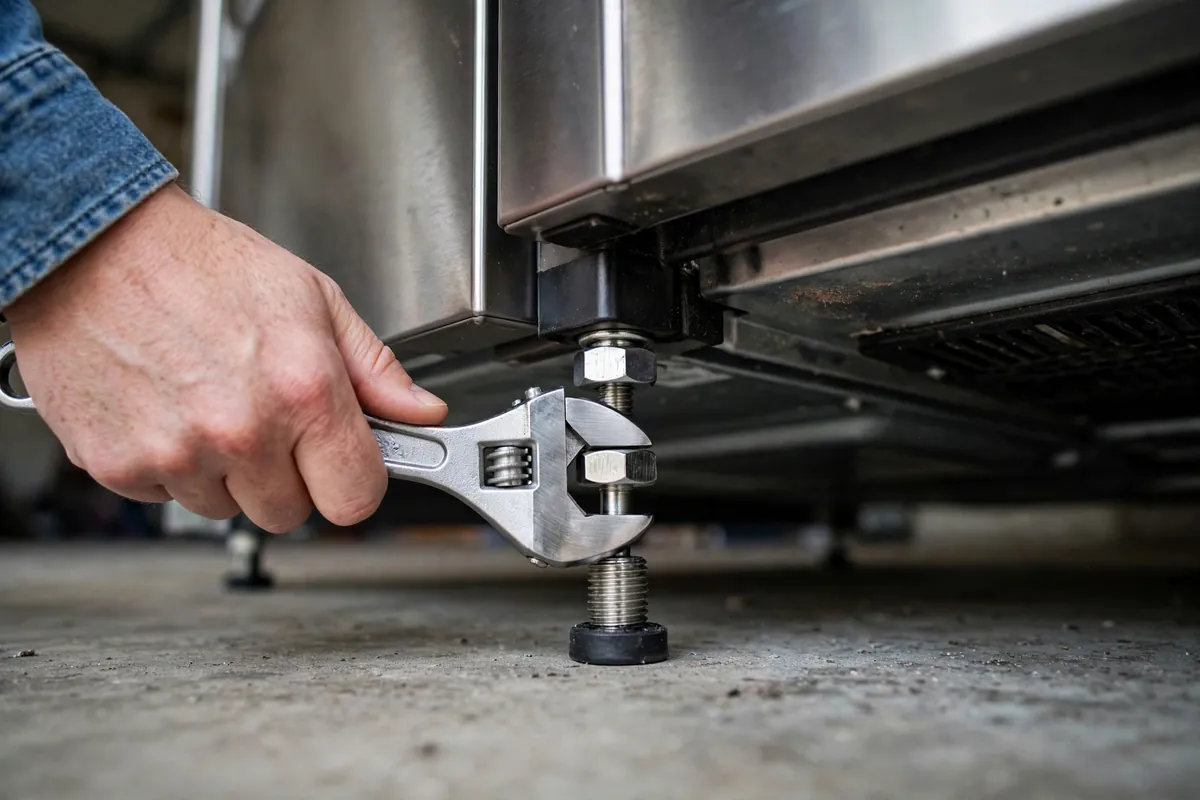
Check the level. Place a level on top of the fridge, front to back and side to side. Adjust the leveling feet — usually turned by hand or with a wrench — until the unit is level, with a very slight tilt backward (about a quarter inch) so the doors close on their own. This alone resolves a surprising number of “loud refrigerator” complaints.
Check the clearances. The fridge should not touch the wall, adjacent cabinets, or anything stored on top of it. Even light contact transmits vibration. Pull it forward an inch or two and make sure nothing on top — cereal boxes, decorations — is rattling against the cabinet. Check behind it too: water lines and power cords vibrating against the back panel are a classic hidden rattle.
Check the drain pan. Underneath most refrigerators sits a shallow drain pan that catches defrost water. If it has shifted or is sitting crooked, it rattles with every vibration. Slide it back into place. While you are down there, check that no packing material or debris is touching the condenser fan.
Check inside. Sometimes the “refrigerator noise” is just bottles or containers vibrating against each other on a shelf. Rearrange anything that rattles when the compressor kicks on. It sounds trivial, but it is one of the first things a technician checks — because it is that common.
The touch test: when the fridge is making the noise, press your hand firmly against different panels — sides, top, doors. If the noise stops or changes when you press a specific spot, you have found a loose panel or a vibration point. Tightening the screws or adding a small adhesive bumper at that spot often silences it completely.
DIY Diagnosis: Five Steps Before You Call
Work through these in order. Most refrigerator noise complaints resolve in the first three steps.
Locate the noise. Stand behind the fridge, then in front, then beside it. Is it loudest at the back bottom (condenser fan or compressor), inside the freezer (evaporator fan), near the top (ice maker), or everywhere (leveling or vibration)? Location narrows the cause faster than any other step.
Check level and clearances. Level the fridge, pull it away from the wall, remove anything touching it or rattling on top. This takes five minutes and fixes a large share of noise complaints outright.
Clean the condenser coils and fan area. Unplug the fridge, vacuum the coils and the condenser fan with a brush attachment, and clear any debris from the fan. Plug it back in and give it a day — a fridge with clean coils runs noticeably quieter.
Test the freezer door. If the noise comes from the freezer, open the door while it is making the sound. If it stops, the evaporator fan is the source — check for ice buildup around it. A one-time defrost may clear it; recurring ice means a defrost system problem.
Listen for the click-hum-click pattern. If you hear the compressor trying to start every few minutes and failing, stop DIY here. That is a start relay or compressor issue, and running it in that state risks turning a small repair into a dead compressor.
Keeping Your Fridge Quiet for the Long Term
Most refrigerator noise is preventable. This short routine keeps every sound-making component in good shape.
That last habit — just listening — is the most underrated maintenance there is. You know what your refrigerator sounds like on a normal day. When something changes, you will notice it before any diagnostic tool could, because you have the baseline memorized. Trust your ears. They are the reason you are reading this guide, and they are usually right.
In Central Oregon specifically, add one more item: after wildfire smoke season, vacuum the coils again. Fine ash is remarkably effective at coating condenser coils and fan blades, and a bad smoke stretch can undo a spring cleaning in a matter of weeks. It takes ten minutes and prevents the exact buzzing this guide opened with.
When Should You Call a Refrigerator Technician?

Call a technician when the DIY steps do not resolve it, or when the sound points to a sealed-system or electrical component: the click-hum-click of a failing start relay, grinding that returns after defrosting, squealing fan bearings, knocking from the compressor mounts, or any noise accompanied by poor cooling.
Call promptly — not eventually — for the click-hum-click pattern. Every failed start attempt stresses the compressor, and a start relay is an inexpensive part when caught early. Waiting can turn it into a compressor replacement, which on an older fridge means replacing the whole appliance.
For homeowners in Bend, professional refrigerator repair starts with your description of the sound. Tell the scheduler exactly what you hear and where — “clicking every three minutes from the lower back” or “grinding in the freezer that stops when I open the door.” That detail lets the technician arrive with the right parts and often resolves it in a single visit.
And do not be embarrassed to call about “just a noise.” Some of the most expensive refrigerator failures we see started as sounds the homeowner lived with for months. A start relay caught in week one is a minor repair. The same relay ignored for three months can take the compressor with it. Your ears noticed something real — let a professional confirm what it is.
Frequently Asked Questions About Noisy Refrigerators
Why is my refrigerator making a loud humming noise?
A louder-than-usual hum usually means the compressor is working harder than it should — most often because of dirty condenser coils or a dusty condenser fan. Clean the coils first. If the hum keeps getting louder, the compressor may be wearing and needs professional assessment.
What does it mean when my fridge clicks every few minutes?
Repeated clicking — especially a click, brief hum, then another click — usually means the compressor start relay is failing to start the compressor. This needs prompt professional attention before it damages the compressor.
Is a gurgling sound from my fridge normal?
Yes. Gurgling or bubbling is refrigerant moving through the cooling system, and it is a normal part of operation. It is not a sign of a leak or a problem.
Why is my freezer making a grinding noise?
Grinding or scraping from the freezer is usually the evaporator fan hitting ice buildup. Open the freezer door — if the noise stops, that confirms it. A one-time defrost may clear it; recurring ice points to a defrost system failure.
Can a refrigerator be too loud and still work fine?
Yes. Many loud-fridge causes — dirty coils, leveling, loose panels, ice maker sounds — do not affect cooling at all. But noise combined with poor cooling is a different situation that needs prompt professional diagnosis.
How do I make my refrigerator quieter?
Clean the condenser coils twice a year, level the fridge properly, ensure clearances around it, tighten any loose panels, and keep the ice maker maintained. These steps resolve most noise complaints without any repair.
Why does my fridge get louder in summer?
Hot kitchens make the compressor run longer and harder to maintain temperature, which increases noise. Dirty coils make this much worse. Summer is the most important season for coil cleaning, especially in Central Oregon’s dusty climate.
When should I replace a noisy refrigerator instead of repairing it?
Consider replacement when the noise comes from a failing compressor on a fridge past ten years, when sealed-system repairs are needed, or when multiple components are failing together. A start relay or fan motor on a younger fridge is worth repairing.
Refrigerator Repair in Bend, OR
A noisy refrigerator is asking for diagnosis, not guesswork. Our technicians pinpoint the actual source — fan, compressor, ice maker, or simply leveling — and give you an upfront estimate before any work begins. Noisy does not always mean expensive; many of the causes in this guide are quick fixes.
We serve homeowners throughout Bend — including Northwest Crossing, Awbrey Butte, Boyd Acres, Larkspur, River West, Mountain View, Summit West, Orchard District, and Southern Crossing — as well as appliance repair in Redmond, Oregon and surrounding Central Oregon communities. Same-day appointments available, upfront pricing, 90-day warranty on every repair.
Final Takeaway
A refrigerator making a loud noise is speaking a language you can learn. Humming points to the compressor working hard, buzzing to the condenser fan, clicking to the start relay, grinding to the evaporator fan, and rattling to leveling. Match the sound, work the DIY steps, and call a technician for the rest.
The two habits that prevent most fridge noise are coil cleaning twice a year and proper leveling — both take minutes. And when a sound is new or worsening, do not wait: early diagnosis is what keeps a small repair small.
Fridge Louder Than It Should Be?
Do not live with the noise — or guess at the cause. Our technicians will find the real source, give you an upfront estimate, and quiet it down properly.