Gas Stove Igniter Keeps Clicking? Fixes for Bend, OR Homes
A gas stove igniter keeps clicking when the spark system cannot settle into a steady flame. Common culprits include food debris, moisture, a misaligned burner cap, or a failing switch or spark module. This guide shows you how to read the click pattern. It also covers safe fixes and when to call a Bend technician.
Start Here: That Clicking Sound Has a Meaning
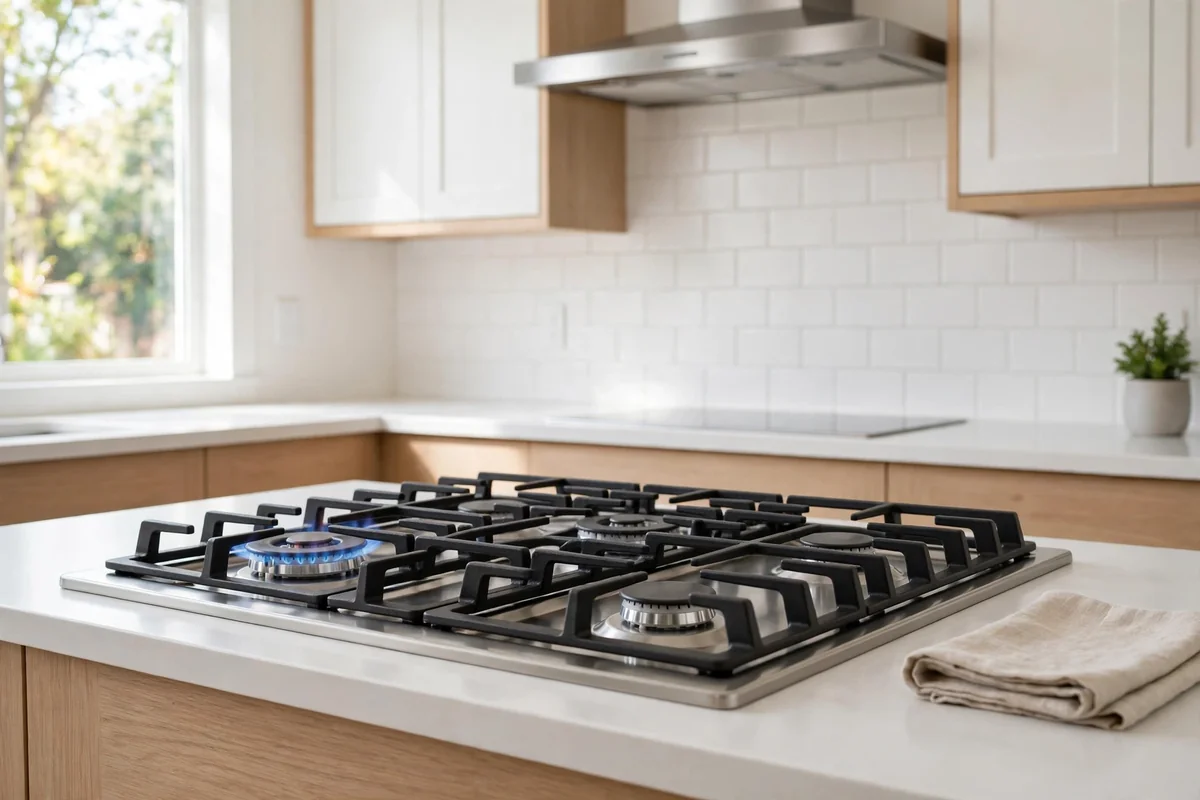
When a gas stove igniter keeps clicking, the stove is telling you something. The electric spark system is firing, but the burner is not settling into a flame the way it should. On most modern gas ranges, that click-click-click is the sound of a tiny high-voltage spark. It jumps between the igniter electrode and the burner base. Hearing it for a few seconds while a burner lights is perfectly normal. Hearing it for minutes — or with every knob turned off — is not.
The good news is that most clicking problems are caused by simple, fixable issues. Food debris and grease on the igniter are the top causes. Moisture from cleaning or a boilover is another. So is a burner cap that did not seat quite right after the last wash. These are problems you can diagnose and fix yourself in minutes. You need no tools, and you never touch anything connected to the gas supply.
The less common causes — a stuck ignition switch, a shorted wire, or a failing spark module — need more care. Some involve opening up the cooktop and working around electrical parts. This guide shows you how to tell which camp you are in. It includes a click-pattern diagnosis table and six causes ordered from simplest to most serious. It also gives a safe step-by-step fix routine and clear rules for when to call a professional.
This guide is written for homeowners in Bend, Oregon and the surrounding Central Oregon area. One safety note before you read further. If you smell gas at any point — a rotten-egg or sulfur odor — stop reading and stop troubleshooting. Do not touch light switches or the stove knobs. Leave the house, then call the gas company from outside. Gas safety comes before any repair.
Table of Contents — Tap to Jump to a Section
- 01 Introduction
- 02 Quick Answer
- 03 Click-Pattern Diagnosis
- 04 How Spark Ignition Works
- 05 6 Common Causes
- 06 Food Debris and Grease
- 07 Moisture After Spills or Cleaning
- 08 Burner Cap Misalignment
- 09 Clogged Burner Ports
- 10 Faulty Switch or Spark Module
- 11 Worn or Cracked Electrode
- 12 Step-by-Step Fix Routine
- 13 Prevention Checklist
- 14 Central Oregon Factors
- 15 DIY or Professional?
- 16 When to Call a Technician
- 17 FAQ
- 18 Bend & Redmond Service
- 19 Final Takeaway
Why Does a Gas Stove Igniter Keep Clicking?
A gas stove igniter keeps clicking when the spark system keeps firing but the burner will not stay lit. It also happens when the system thinks a knob is on even though it is not. The most common reasons are:
- Food debris and grease coating the igniter electrode, which insulates the spark and weakens it.
- Moisture from a spill, boilover, or recent cleaning, which shorts the spark path.
- A misaligned burner cap, which redirects gas flow away from the spark.
- Clogged burner ports, which starve the flame so the spark keeps firing.
- A stuck or shorted ignition switch under one of the knobs, often from liquid seeping in.
- A failing spark module, the small box that generates the high-voltage spark.
- A worn or cracked igniter electrode, whose ceramic insulator can no longer contain the spark.
Start with the click-pattern table below. It matches when the clicking happens to the most likely cause. You can skip straight to the right fix instead of working through every possibility.
Gas safety first: if you smell gas (a rotten-egg odor) while troubleshooting, stop immediately. Do not flip light switches, touch the stove knobs, or use your phone indoors. Leave the house and call the gas company from outside. Never attempt to work on gas supply lines or fittings yourself — that work always belongs to a qualified professional.
Click-Pattern Diagnosis: Match the Sound to the Cause
The single most useful clue is when the clicking happens. Find your pattern in the table below, then jump to the matching cause section. Generic online guides skip this diagnostic step. It is what turns a guessing game into a quick fix.
| What You Notice | Likely Cause | Check First |
|---|---|---|
| Clicking for a few seconds, then the burner lights normally | Normal ignition | Nothing — this is how spark ignition is supposed to work |
| Clicking goes on much longer than usual, burner eventually lights | Moisture or light debris on the igniter | Dry and clean the igniter electrode (Cause 2) |
| Clicking continues and the burner never lights | Dirty electrode, misaligned cap, or clogged ports | Clean the igniter, reseat the cap, clear the ports (Causes 1, 3, 4) |
| Clicking with all knobs turned off | Moisture in the switch area, or a stuck/shorted ignition switch | Dry everything out; unplug the stove (Causes 2, 5) |
| Burner lights fine, but the clicking never stops | Sticking ignition switch or failing spark module | Turn the knob fully past “Lite”; if it persists, see Cause 5 |
| Only one burner misbehaves; the others are fine | Debris, damage, or moisture on that one burner | Clean and inspect that burner alone (Causes 1, 6) |
| No clicking sound at all, and the burner will not light | Dead spark module, broken wire, or no power | Check that the stove is plugged in; then see Cause 5 |
Important quirk of most gas ranges: on many models, turning one burner to “Lite” makes all the igniters click. Only the burner receiving gas will light. So if every burner clicks but only the one you turned on matters, that is normal. Do not mistake it for a fault.
How Gas Stove Spark Ignition Works
Understanding the ignition sequence makes every fix in this guide intuitive. Each cause interrupts the sequence at a specific point. Here is what happens when you turn a burner knob to “Lite”:
First, the knob activates a small ignition switch mounted behind the control panel. The switch sends a signal to the spark module. That small box converts household current into rapid high-voltage pulses.
Those pulses travel through wires to the igniter electrode at each burner. The electrode is a small metal tip mounted on a white ceramic insulator. The spark jumps from the tip to the grounded metal of the burner base, several times per second. That jumping spark is the click you hear.
At the same time, the open valve releases gas through the burner ports. The spark ignites it, and the flame spreads around the burner. Then you turn the knob past “Lite” to set your flame level. When the knob moves off the ignition position, the switch tells the spark module to stop.
Every clicking problem is a break in this chain. The spark may be weak or misdirected (dirty, wet, or cracked electrode). The gas may not reach the spark (clogged ports, misaligned cap). Or the “stop” signal never arrives (stuck switch, failed module). Fix the break and the clicking stops.
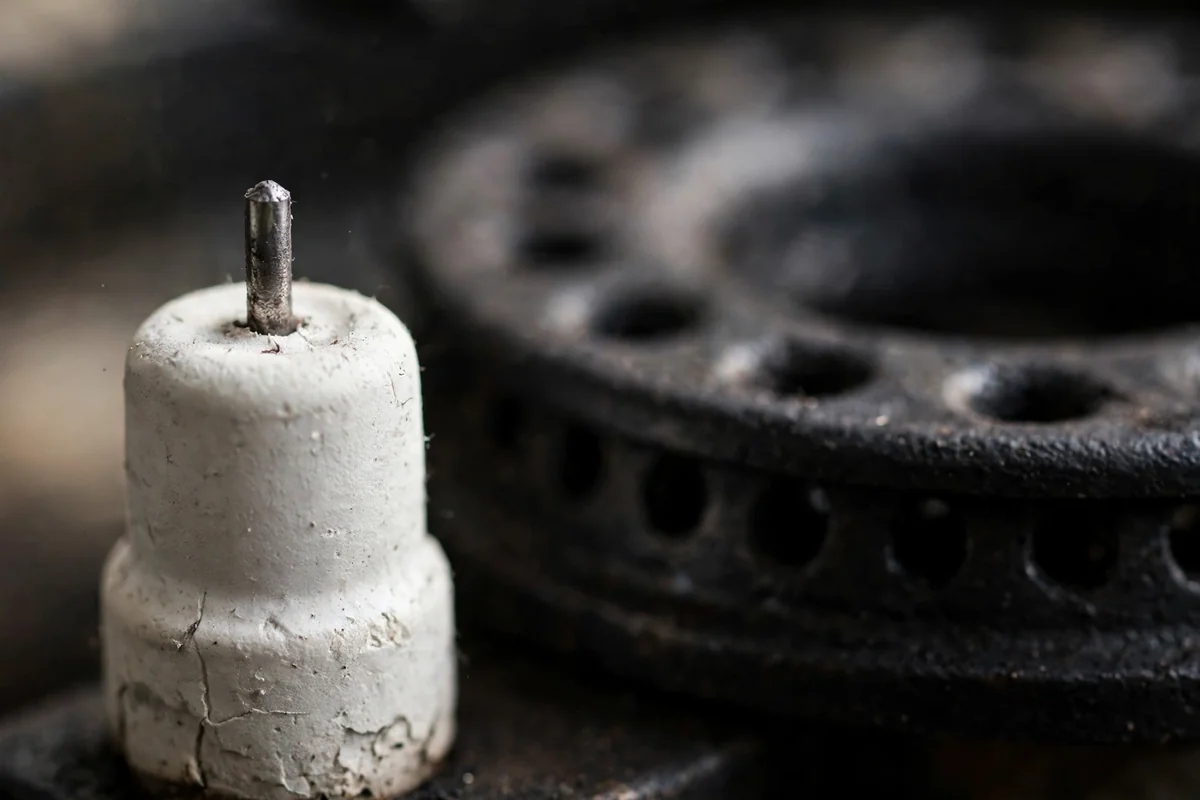
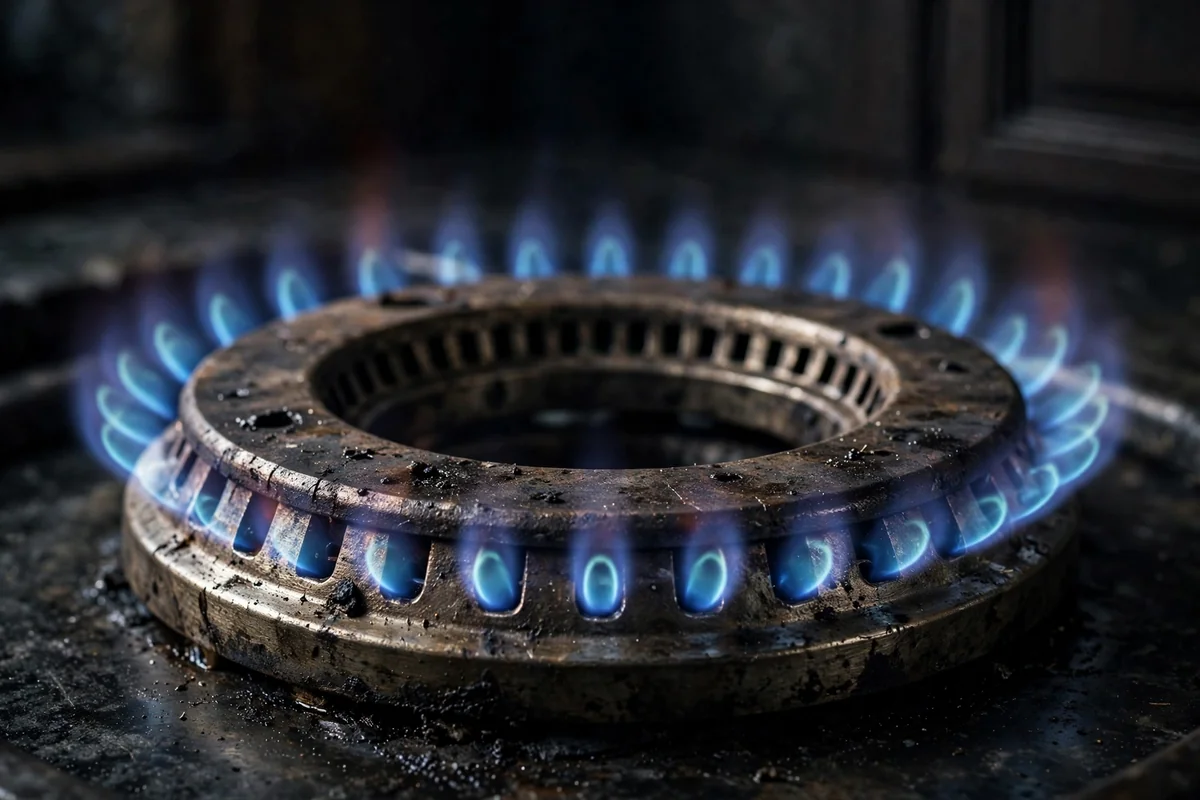
The igniter electrode has two parts. The small metal tip fires the spark, and the white ceramic body guides the high voltage. Most clicking problems start right here.
6 Common Reasons a Gas Stove Igniter Keeps Clicking
The sections below cover each cause in detail. They are ordered from the simplest checks to the problems most likely to need a technician. Work through them in order — rule out the easy causes before assuming a failed part.
| Common Cause | Main Symptom | Difficulty |
|---|---|---|
| Food debris and grease on the igniter | Clicking, burner slow to light or will not light | Easy — 10 minutes |
| Moisture after a spill or cleaning | Clicking after cleaning, boilover, or with knobs off | Easy — drying time |
| Burner cap misaligned | Uneven flame, clicking after the cap was removed | Easy — 2 minutes |
| Clogged burner ports | Weak or partial flame, clicking continues | Moderate — 15 minutes |
| Faulty ignition switch or spark module | Clicking with knobs off, or no spark at all | Professional |
| Worn or cracked igniter electrode | Weak or misdirected spark, one burner only | Professional |
1. Food Debris and Grease on the Igniter
This is the single most common reason a gas stove igniter keeps clicking in a working kitchen. Every time you cook, tiny splatters of oil, sauce, and food particles land on the cooktop. Over weeks and months, that residue coats the igniter electrode — and grease is an electrical insulator. A coated electrode produces a weaker spark, or a spark that jumps to the wrong place entirely.
The symptom pattern is distinctive. The igniter clicks and clicks. The burner takes much longer than it used to, or it will not light until you try several times. It often gets worse gradually, not overnight. If one burner is much worse than the others, check the one you cook with most. Heavy-use burners collect debris fastest.
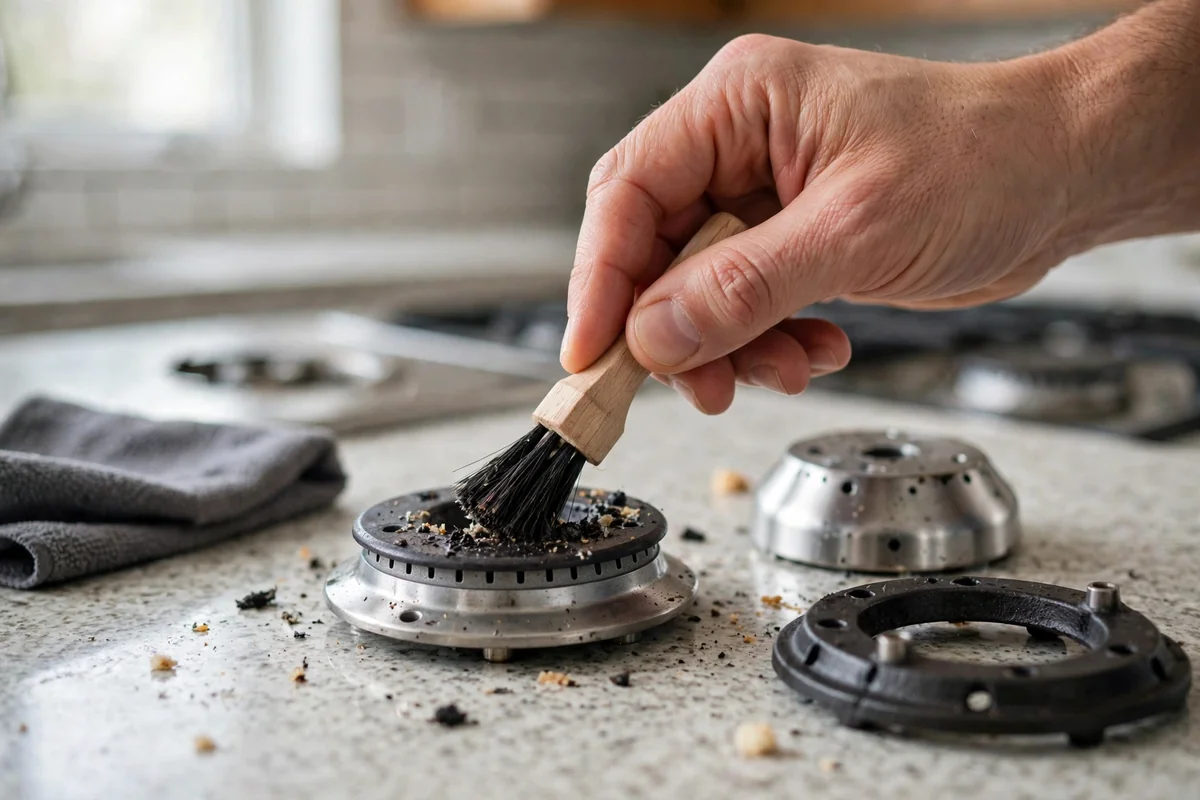
Here is how to clean the igniter safely. First, let the cooktop cool completely. Remove the grates and the burner cap so you can see the small white ceramic electrode and its metal tip. Gently scrub the electrode tip and ceramic body with a soft toothbrush. Or use a cotton swab dampened with a little rubbing alcohol or mild dish soap. The alcohol cuts grease without soaking the area.
Be gentle with the ceramic. It is fragile, and a cracked electrode is a bigger problem than a dirty one. Do not use metal tools, steel wool, or abrasive pads on the electrode. Wipe away loosened debris with a dry cloth. Then let the area air-dry fully before reassembling the burner and testing it.
If the spark is strong and the burner lights quickly after cleaning, you found the problem. When a gas stove igniter keeps clicking because of grease buildup, a two-minute cleaning is often the entire repair. Repeat it every few months to prevent a recurrence.
2. Moisture After a Spill, Boilover, or Cleaning
Moisture is the classic cause of sudden-onset clicking — the igniter was fine yesterday, and today it will not stop. Water conducts electricity. Even a thin film of liquid around the igniter creates a short circuit. The spark takes the easy path through the moisture instead of jumping the gap to the burner base. The system keeps firing because, electrically speaking, the spark never “arrives.”
The usual triggers are easy to recognize. A pot boiled over during cooking is one. So is sauce splashed across the cooktop, or cleaning water left under the knobs. Moisture is also the main reason an igniter clicks with all the knobs turned off. Liquid can seep into the switch area under the control panel. It bridges the switch contacts and convinces the spark module that a burner is on “Lite.”
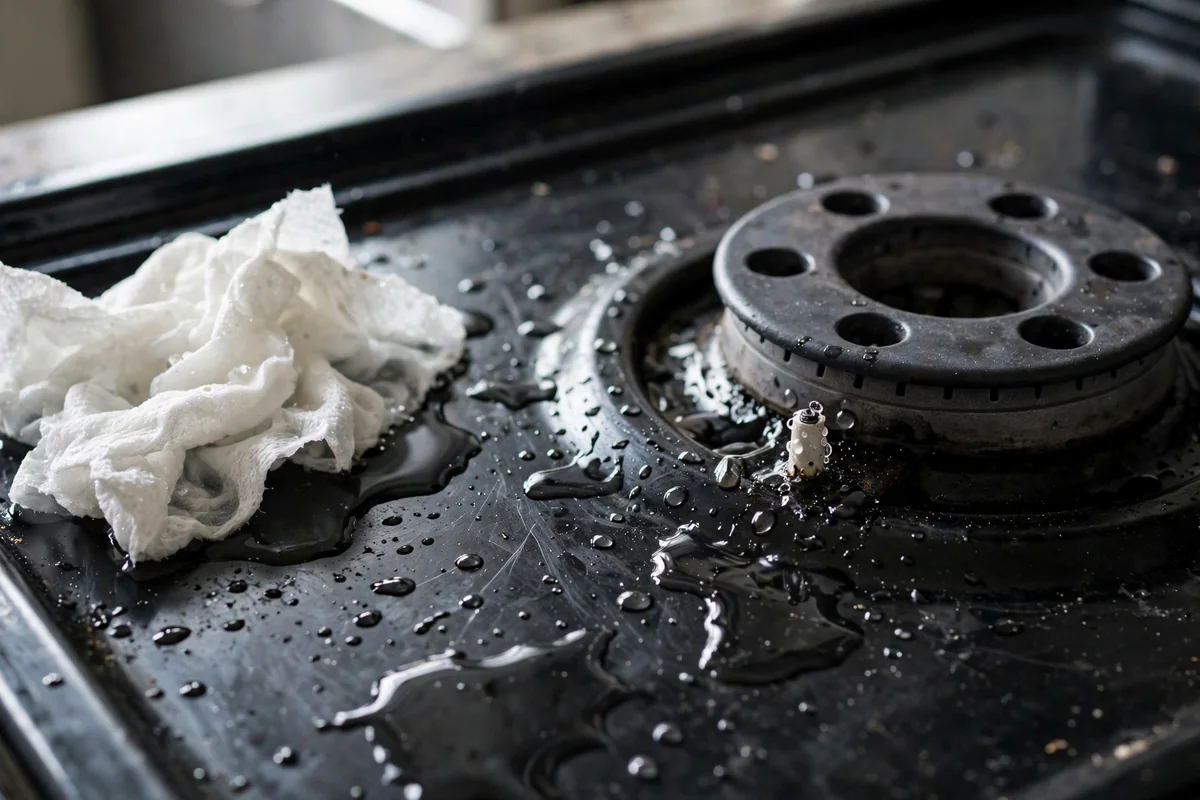
The fix is mostly patience. Remove the grates and burner caps. Wipe everything with a dry cloth or paper towels. Include the area under the knobs if you can reach it safely. Then let the cooktop air-dry completely. A hair dryer on the low or cool setting, held at a distance, speeds things up. Never use high heat. It can damage the ceramic electrode and nearby plastic parts.
For moisture that has soaked into the switch harness under the cooktop, drying can take longer. If the igniter keeps clicking with the knobs off, unplug the stove. Let it sit for up to 24 hours so it can dry fully. In most cases the problem clears on its own once the moisture evaporates. If the clicking returns the moment you plug it back in, liquid may have damaged a switch. That moves you to Cause 5.
One preventive habit helps a lot. After deep-cleaning a gas cooktop, dry the burners and igniters immediately instead of letting them air-dry overnight. A surprising number of “mystery clicking” calls start the morning after a cleaning session.
3. Burner Cap Misalignment
The burner cap is the removable metal disc that sits on top of the burner base. It does more than look tidy. It shapes the gas flow so fuel reaches the spark at the right place and the right speed. When the cap sits even slightly crooked, gas escapes unevenly and the flame cannot form properly around the igniter. The spark keeps firing into gas that is not quite there.
Misalignment almost always follows a cleaning. You lift the caps off to wash the cooktop and drop them back on quickly. One sits at a slight angle or is not fully nested in its locating pins. The telltale sign is timing. The clicking started right after you cleaned the stove. And the flame — if it lights at all — looks lopsided or lifts off the burner.
Fixing it takes seconds. Let the burner cool and lift the cap off. Set it back down flat. Rotate it gently until it drops into its locating notch or sits level on the burner base. Most caps have a small pin-and-slot or notch design. When it is seated correctly, the cap will not wobble when you nudge it.
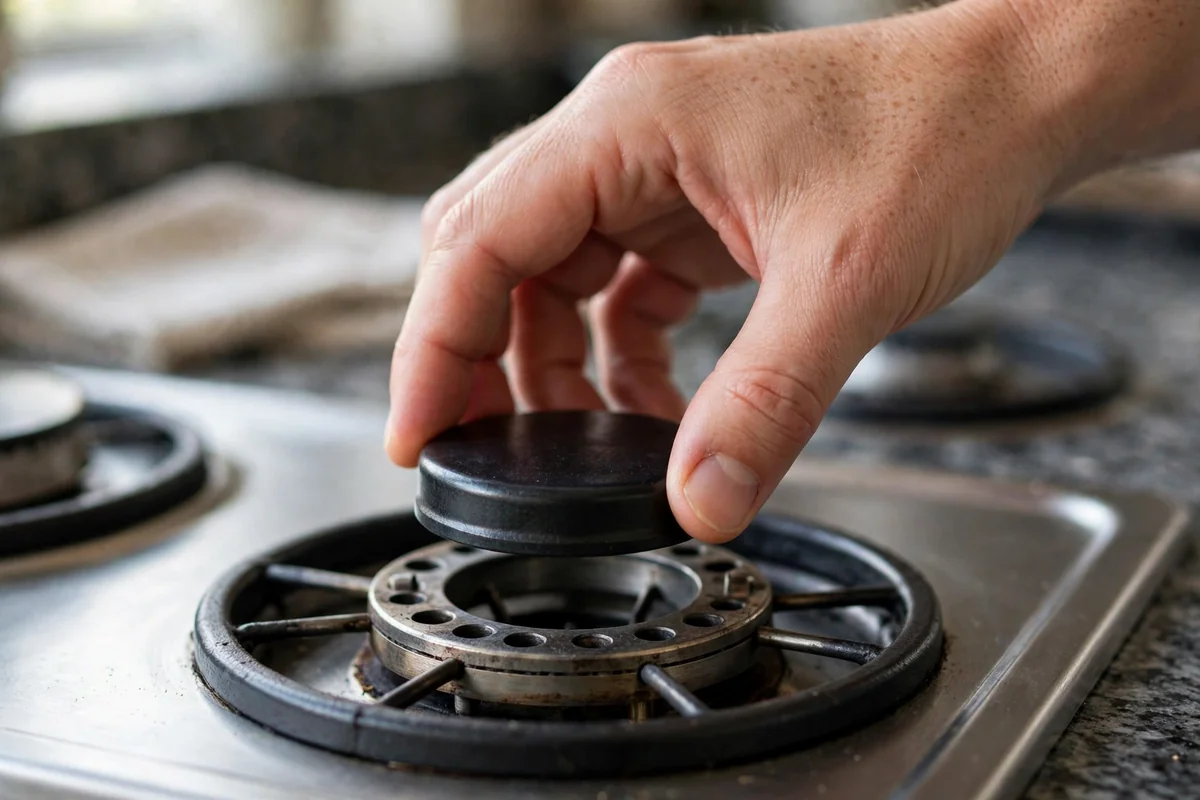
While the cap is off, glance at the underside. Baked-on debris or a warped cap can prevent a flat seat even when you place it carefully. Warping usually comes from overheating an empty pan. Clean the underside with a non-abrasive pad. If the cap is visibly warped, replacement is the practical fix. It is a simple part and does not require touching anything electrical or gas-related.
This is the quickest of all the fixes in this guide. If a gas stove igniter keeps clicking and you recently removed the caps, check alignment first. Do that before cleaning, before drying, before anything else.
4. Clogged Burner Ports
The burner ports are the tiny holes ringing the burner head that release gas. When some of them are blocked, the flame cannot spread fully around the burner. The usual blockers are dried sauce, sugary boilovers, or mineral deposits. Gas still flows from the open ports, but the flame pattern is broken. On models that sense the flame to stop sparking, the weak coverage means the igniter keeps clicking.
You can diagnose this visually. With the cap off and the area cool, look closely at the ring of ports on the burner head. Blocked ports are usually obvious: dark crusty buildup, or holes that look filled compared with their neighbors. When the burner does light, a clogged burner produces a patchy flame — gaps in the ring where ports are blocked.
To clear them, use a straight pin, needle, or fine wire and gently probe each blocked port. Work carefully — enlarging a port changes the gas flow and can make the flame worse. Follow with a soft brush to sweep away loosened debris, then wipe the burner head clean. For heavy buildup on removable burner heads, soak them in hot water with a little dish soap. Twenty to thirty minutes loosens the crust before you probe the ports. Dry the head completely before reinstalling.
After clearing the ports, test the burner. You are looking for a full, even ring of blue flames with no gaps and no yellow tipping. Yellow or orange flame tips on a natural-gas burner usually mean the gas-to-air mix is off. Ports are often still partially blocked. Keep cleaning until the flame is clean and blue. Try this final check. The ports are clear, the cap is flat, and the igniter is clean. Yet the burner will not hold a flame. The problem is likely electrical (Cause 5) or a damaged electrode (Cause 6).
Do not drill or ream out burner ports. Enlarged ports change the burner’s gas flow permanently and can create an unsafe flame. If a port will not clear with gentle probing, that burner head may need professional service or replacement.
5. A Faulty Ignition Switch or Spark Module
A gas stove igniter keeps clicking even with every knob turned off. Drying has not helped. Then the fault is usually in the electrical controls, not on the cooktop surface. Two parts are the usual suspects: the ignition switches behind the knobs and the spark module that generates the spark.
Each knob has a small ignition switch. Turning the knob to “Lite” closes the switch and tells the spark module to fire. Liquid from spills and cleanings can seep down around the knob shafts and into these switches. That corrodes or bridges the contacts. A switch that is stuck closed — electrically “on” even though the knob is off — makes the spark module fire nonstop. Wiggling the knob sometimes changes the clicking, which is a strong hint the switch is the problem.
The spark module is a small box, usually mounted under the cooktop or behind the range. It turns household current into the high-voltage pulses for the spark. When its internal relays fail, it can get stuck in the ignition cycle, clicking forever. Or it can fail silently, producing no spark at all. Module failures are more common on older ranges and on units that have survived power surges.
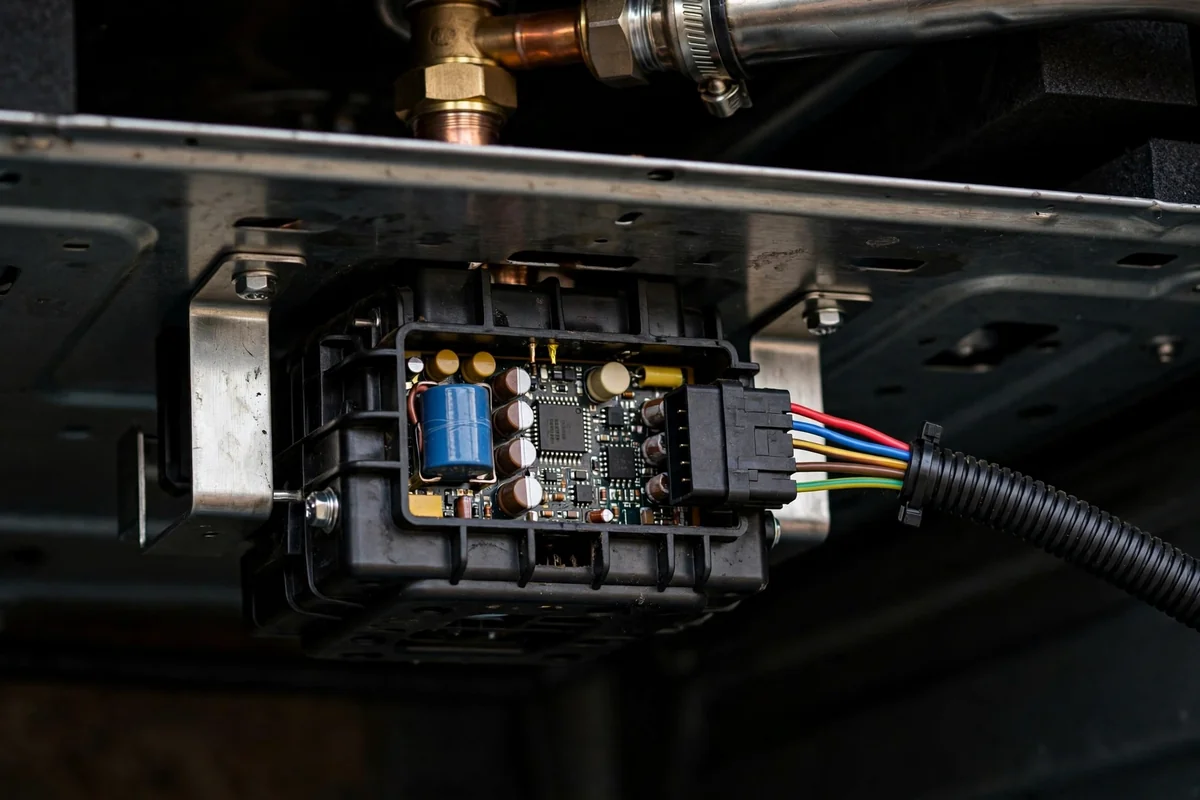
This is where DIY ends for most homeowners. Replacing a switch or module means lifting the cooktop. You also work around live electrical connections and must order the exact part for your model. The switches on most ranges are wired as a harness. Replacing one often means replacing the set. And an incorrect module can damage the igniters.
There is one safe DIY step left: the power-cycle test. Unplug the range for five minutes, then plug it back in. If the phantom clicking is gone, a glitch in the module cleared. If it starts again — immediately or after a day or two — the switch or module is genuinely failing. Then it is time for professional service. Keep the stove unplugged between uses until it is repaired. Keep paper towels, curtains, and anything flammable away from the cooktop. The stray spark can still ignite light materials.
Stop here if you smell gas. Electrical faults and gas leaks can overlap in confusing ways. If the clicking comes with any gas odor, do not keep testing switches. Leave the house and call the gas company from outside. Never open gas fittings or work on the gas supply line yourself.
6. A Worn or Cracked Igniter Electrode
The igniter electrode lives a hard life. It endures repeated heating and cooling, grease, cleaning chemicals, and the occasional bump from a heavy pot. Over time, the white ceramic insulator can crack or chip, and the metal tip can erode. A cracked ceramic no longer contains the high-voltage pulse. The spark leaks out through the crack and jumps to the wrong place, or disappears into the burner base. The result: weak sparking, sparking in the wrong spot, and an igniter that keeps clicking without lighting the burner.
This cause usually affects one burner only, which makes it easy to spot. The other burners light normally while one struggles. Inspect the suspect electrode closely with a flashlight once the cooktop is cool. Look for hairline cracks in the white ceramic and chips around the base. Also check for a metal tip that looks rounded and worn instead of sharp. Cracks can be surprisingly small — look carefully.
You can also test the spark visually. In a dim room, turn the suspect burner to “Lite” and watch the electrode. A healthy spark is a crisp blue-white snap jumping straight from the tip to the burner base. A damaged electrode shows a weak orange spark or a spark that wanders sideways. You may also see arcing down through a crack in the ceramic.
Cracked electrodes cannot be repaired — the part needs replacement. On most ranges this is a moderate repair. The cooktop lifts, the old electrode unplugs, and the new one seats in its place. But because it involves internal access and exact part matching, most homeowners are better served by a technician. A quick rule: if only one burner clicks badly and cleaning did not help, suspect the electrode on that burner.
The Safe Fix Routine for a Clicking Igniter
Follow these steps in order. Each step rules out a cause before you move to the next. You will not waste effort or buy parts you do not need.
Step 1: Safety Check First
Before anything else, sniff for gas. A rotten-egg odor means this is not a DIY situation — leave the house and call the gas company from outside. If there is no odor, confirm all knobs are fully in the off position.
Step 2: Let Everything Cool
Wait until every burner and grate is completely cool to the touch. Cleaning or inspecting a hot cooktop risks burns, and thermal shock can crack a hot ceramic electrode.
Step 3: Remove Grates and Burner Caps
Lift off the grates and burner caps and set them aside. Note which cap belongs on which burner. Caps are sized to their burners. Swapping them can cause the same misalignment problems you are trying to fix.
Step 4: Inspect and Clean the Igniter
Look at each electrode for grease, food crust, and visible cracks in the ceramic. Scrub the tip and ceramic gently with a soft toothbrush or cotton swab dampened with rubbing alcohol. Wipe clean and dry.
Step 5: Dry Out Any Moisture
Wipe the burner area, under the caps, and around the knobs with a dry cloth. If the cooktop was recently cleaned or a spill occurred, give it extra drying time. You can speed things along with a hair dryer on low or cool heat.
Step 6: Clear the Burner Ports
Probe any visibly blocked ports with a straight pin or fine wire, then brush away loosened debris. Look for a full, even ring of open ports around each burner head.
Step 7: Reseat the Burner Caps
Place each cap back on its own burner, flat and level, rotating until it drops into its locating notch. Nudge each cap — a correctly seated cap does not wobble.
Step 8: Test the Burner
Turn the burner to “Lite” and watch. You want a quick light, a full blue ring, and clicking that stops once you turn past “Lite.” If the igniter keeps clicking, unplug the range for five minutes and try once more. If it persists, move to professional help.
How to Keep the Igniter From Clicking Again
A few low-effort habits prevent most ignition problems.
These steps take minutes and address the root causes behind the majority of clicking-igniter service calls.
Central Oregon Factors That Affect Gas Stove Ignition
Igniters fail for the same mechanical reasons everywhere. But a few local Bend-area conditions make certain ignition problems more common here than national averages suggest.
Hard Water and Mineral Deposits
Much of Central Oregon’s water — municipal and well alike — runs hard with dissolved calcium and magnesium. When boilovers and cleaning water dry on the cooktop, those minerals deposit as a crusty scale. It coats burner heads, ports, and igniter electrodes. Over time, the scale narrows ports and coats electrodes, producing exactly the weak-spark, patchy-flame symptoms described above. Homes on private wells tend to see it fastest. Drying the cooktop after cleaning — instead of letting hard water evaporate on it — is the simplest defense.
High-Desert Dust on the Cooktop
Central Oregon’s dry, dusty air settles on everything, including cooktops. A fine layer of dust mixes with cooking grease. It forms a grimy film that builds up on igniter electrodes faster here than in damper climates. Burners getting sluggish a few months after each deep clean? Dust-plus-grease film on the electrodes is a likely contributor. A quick brush-off every few months keeps it in check.
Altitude and Flame Behavior
Bend sits at roughly 3,600 feet above sea level, where the thinner air slightly changes how gas flames burn. A flame that looks a touch different from what you remember at sea level is not necessarily a fault. It may look slightly softer or show faint yellow tipping. What is a fault is a flame that will not stay lit or an igniter that keeps clicking. Do not adjust air shutters to chase a “perfect” flame at altitude. Misadjustment causes more problems than it solves unless you know the model’s specifications.
Vacation and Second Homes
Many Central Oregon homes sit empty for weeks between visits. A gas range left unused in an unheated house can develop sticky ignition switches. Modules can also turn sluggish, especially after cold snaps. If the igniter acts up on your first visit back, run through the drying and cleaning steps. Do not assume a failure first. Condensation and disuse explain a large share of these cases. Does the house use propane from a tank rather than piped natural gas? Then never adjust regulators or fittings yourself. That work always belongs to a qualified technician.
Clicking Igniter Repair: DIY or Professional Service?
Use this table to decide what to handle yourself and what to hand to a technician. The dividing line is simple. Anything on the cooktop surface is fair game. Anything under the cooktop or connected to gas is not.
| Repair Task | DIY Suitability | Professional Help |
|---|---|---|
| Clean the igniter electrode | Good | Usually unnecessary |
| Dry out moisture after a spill or cleaning | Good | Usually unnecessary |
| Reseat a misaligned burner cap | Good | Usually unnecessary |
| Clear clogged burner ports with a pin | Good, with care | Helpful if ports will not clear |
| Power-cycle the range (unplug 5 minutes) | Good | Usually unnecessary |
| Replace an ignition switch or harness | No | Yes — internal electrical work |
| Replace the spark module | No | Yes — exact part matching required |
| Replace a cracked igniter electrode | Model-dependent | Recommended for most homeowners |
| Anything involving gas lines or fittings | Never | Always — qualified technician only |
The key rule is simple. DIY the cleaning, drying, and alignment. Let a professional handle the electrical internals and anything gas-related. A correct diagnosis from your own troubleshooting makes the service visit faster and cheaper.
When Should You Call a Technician for a Clicking Igniter?

Call a technician once your own troubleshooting has ruled out the simple causes. That means debris, moisture, cap alignment, and clogged ports are all fine. If the igniter still will not behave, it is time. The remaining suspects are the ignition switches, the spark module, and the igniter electrode. All of them benefit from professional testing and correct part sourcing.
Call sooner — without further DIY attempts — in these situations:
- You smell gas at any point. Do not keep troubleshooting. Leave the house and call the gas company from outside.
- The igniter clicks with all knobs off even after a full drying period and a power cycle. A stuck switch or failing module is the likely cause, and the stove should stay unplugged until it is repaired.
- There is no spark at all after cleaning, and the stove is plugged in. That points to a dead module, broken wire, or failed switch — all internal repairs.
- You found a cracked or visibly damaged electrode and are not comfortable lifting the cooktop to replace it.
For homeowners in Bend, professional service starts with your symptoms. Tell the scheduler what you have already checked. For example: “the igniter keeps clicking with the knobs off, even after drying it for a day.” Or: “one burner will not light after I cleaned the ports.” That detail helps the technician arrive with the right parts and often resolves the problem in a single visit. Request a free estimate and describe the click pattern you are hearing.
Frequently Asked Questions About Gas Stove Igniters That Keep Clicking
Why does my gas stove igniter keep clicking even when all the knobs are off?
Phantom clicking with the knobs off is almost always electrical. The usual causes are moisture in the switch area under the control panel. Or an ignition switch may be stuck or shorted in the “on” position. Unplug the stove and let it dry for up to 24 hours. If the clicking returns when you plug it back in, a switch or the spark module needs professional replacement.
Is it safe to keep using a burner while the igniter keeps clicking?
If the burner lights and holds a normal blue flame, the immediate danger is low. The underlying fault still needs attention. Do not use the stove at all if you smell gas. The same applies if the flame is yellow and sooty, or if clicking continues with the knobs off. In those cases, stop using the appliance until it is repaired.
What should I do if I smell gas while the igniter is clicking?
Stop everything. Do not touch light switches, stove knobs, or your phone indoors, and do not try to find the leak. Leave the house immediately and call the gas company from outside. Never attempt to tighten or repair gas fittings or supply lines yourself — that work is for qualified professionals only.
Why does my igniter keep clicking right after I cleaned the stove?
Cleaning water almost certainly got into the igniter area, under the knobs, or into the switch harness. Moisture creates short circuits that confuse the spark system. Remove the grates and caps and wipe everything dry. Then let the cooktop air-dry completely. Most post-cleaning clicking clears up within a few hours to a day.
How do I clean a gas stove igniter safely?
Let the cooktop cool completely, then remove the grates and burner caps. Gently scrub the metal tip and the white ceramic body with a soft toothbrush. Or use a cotton swab dampened with rubbing alcohol. Avoid metal tools and abrasive pads, which can crack the ceramic. Wipe it dry and let it air-dry before reassembling.
The burner lights fine, but the igniter keeps clicking. Why?
The spark system is not getting its “stop” signal. First, turn the knob fully past “Lite” to the flame setting. On many ranges the sparking only stops off the ignition position. If it still clicks, the ignition switch behind that knob is likely sticking, or the spark module is failing. Both are internal repairs for a technician.
Can I light the burner manually with a match while waiting for a repair?
Only as a short-term measure, and only if there is no gas smell. Turn the knob to the light position and immediately hold a long-reach lighter or match to the burner. Never let gas flow unlit for more than a few seconds. Never leave a manually lit burner unattended. And do not use this as a long-term workaround — get the ignition system repaired.
When should I call a technician instead of fixing it myself?
Call a pro when cleaning, drying, and cap alignment have not fixed it. Also call when the igniter clicks with all knobs off after drying. Or when there is no spark at all. Or when you found a cracked electrode you do not want to replace yourself. And always call the gas company — not a repair tech — first if you smell gas.
Gas Stove and Cooktop Repair in Bend, OR
A clicking igniter is often the first sign of a developing ignition problem. Catching it early usually means a simpler repair. If the cleaning and alignment steps in this guide have not solved it, a technician can help. They can test the switches, spark module, and electrodes directly and give you a clear answer.
We serve homeowners throughout Bend. Service areas include Northwest Crossing, Awbrey Butte, Boyd Acres, Larkspur, River West, Mountain View, Summit West, and Orchard District. We also cover appliance repair in Redmond, Oregon and surrounding Central Oregon communities. Describe the click pattern using the diagnosis table above. It helps the technician diagnose the problem faster, often in a single visit.
Final Takeaway
A gas stove igniter keeps clicking because the spark system cannot complete its job. In most cases the reason is ordinary. It is grease on the electrode, moisture from a spill or cleaning, a crooked burner cap, or clogged ports. Those four causes are safe DIY fixes that take minutes once you know the click pattern to look for.
When the clicking happens with every knob off, the fault is deeper. The same is true when there is no spark at all or cleaning changes nothing. The cause may be a sticking switch, a failing spark module, or a cracked electrode. That is professional territory. And whatever you find, gas safety comes first. Any smell of gas means you leave the house and call the gas company from outside, before anything else.
Igniter Still Clicking?
If the troubleshooting steps haven’t solved the problem, our technicians can help. They can test the switches, spark module, and electrodes directly. And they give you a clear, upfront repair estimate before any work begins.