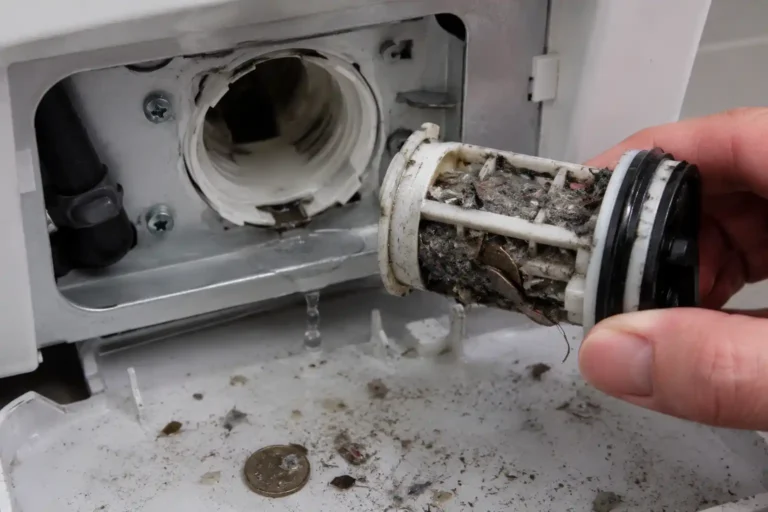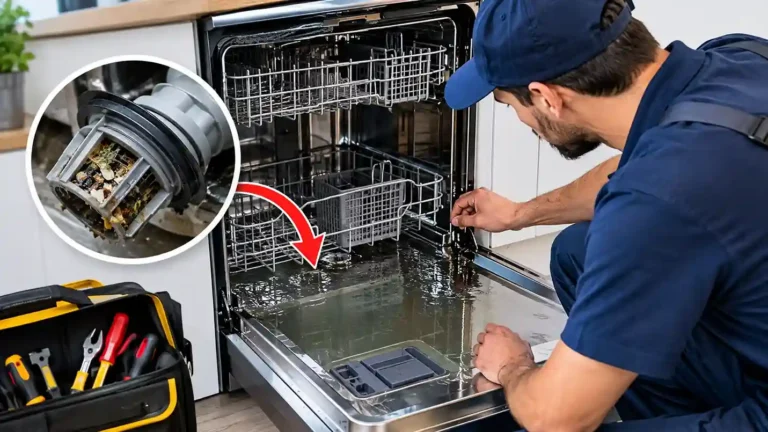
Washing Machine Shaking Violently? Causes and Fixes for Bend, OR Homes
Washing Machine Shaking Violently? Causes and Fixes for Bend, OR Homes
A washing machine shaking violently during the spin cycle is startling. It can also damage your washer, your floors, and your hoses. This guide explains the most common causes and safe step-by-step checks. It also shows when to call a local washer repair technician.

Start Here: What to Check When Your Washer Starts Shaking
When your washing machine is shaking violently, the first instinct is often to assume the machine is broken. In practice, many shaking problems turn out to be simple. The cause is often an unbalanced load, an unlevel machine, or one heavy item thrown off balance. These are checks you can do yourself in minutes, with no tools and no risk.
That said, parts like suspension rods, shock absorbers, and springs do wear out over time. Knowing how to tell a simple problem from a failing part saves time and money. Either you fix it yourself in minutes, or you call a technician already knowing the cause.
This guide is written for homeowners in Bend, Oregon and the surrounding Central Oregon area. It covers how a washer handles spin forces and seven common shaking causes. You also get a step-by-step fix routine. Finally, it explains when professional washing machine repair in Bend is the right move.
Table of Contents — Tap to Jump to a Section
- 01 Introduction
- 02 Why It Shakes
- 03 How a Washer Handles Spin
- 04 Match Symptom to Cause
- 05 7 Common Causes
- 06 Unbalanced Load
- 07 Unlevel Machine or Feet
- 08 Worn Suspension Rods
- 09 Shipping Bolts Left In
- 10 Overloaded or Single Heavy Item
- 11 Worn Shock Absorbers
- 12 Floor or Pedestal Problems
- 13 Step-by-Step Fix Routine
- 14 Central Oregon Factors
- 15 Prevention Checklist
- 16 DIY or Pro?
- 17 When to Call a Pro
- 18 FAQ
- 19 Bend & Redmond Service
- 20 Final Takeaway
Why Is My Washing Machine Shaking Violently?
The most common reasons a washer shakes or walks during spin are:
- The load is unbalanced — heavy items have bunched on one side of the drum.
- The machine is not level — one or more leveling feet are not touching the floor firmly.
- The washer is overloaded, or a single heavy item (like a bathrobe) is spinning alone.
- Shipping bolts were never removed from a new front-load washer after installation.
- Suspension rods or springs (top-load) or shock absorbers (front-load) have worn out.
- The floor or pedestal underneath the washer is not rigid enough to absorb vibration.
A little vibration during spin is normal. A washer that walks across the floor, bangs loudly, or shakes the whole laundry room is not normal. It needs attention before it damages hoses, flooring, or the machine itself.
Stop a violent shaker first. If the washer is walking, pause or cancel the cycle before you inspect anything. A machine in full shaking motion can pinch fingers under the lid. It can also strain the water hoses and grind its leveling feet into the floor.
How a Washing Machine Handles Spin Forces
Understanding spin physics makes every fix below easier to follow. A washing machine does not simply turn the drum faster and hope for the best. It manages forces at each step of the cycle.
During the wash and rinse, the drum turns slowly and tumbles the clothes. Speeds are low, so balance problems barely matter. This is why a washer can seem fine through most of the cycle and only start shaking at the end.
Then comes the spin cycle. The drum ramps up to high speed to fling water out of the fabric. That often means 800 to 1,200 revolutions per minute. At those speeds, even a small weight imbalance becomes a powerful force pulling the drum off-center with every rotation.
To handle that force, the drum hangs inside a suspension system. On most top-load washers, four suspension rods with springs hang the wash basket from the cabinet corners. On most front-load washers, shock absorbers connect the outer tub to the base frame, much like a car’s suspension. The system absorbs normal imbalance so the cabinet stays still.
Violent shaking happens when that system gets overwhelmed. That means too much imbalance, parts too worn, or an unlevel machine. The sections below walk through each cause in order — from the easiest fix to the hardest.
Match the Symptom to the Cause
Match what you are seeing and hearing to the most likely cause. Start with the easiest explanation in each row before assuming a part has failed.
| What You Notice | Most Likely Cause | Check First |
|---|---|---|
| Shakes violently only on some loads | Unbalanced or overloaded load | Redistribute the laundry |
| Rocks when pushed, even when empty | Not level, foot not touching the floor | Adjust the leveling feet |
| Brand-new washer shakes from day one | Shipping bolts left installed | Rear panel bolt holes |
| Washer walks across the floor | Leveling plus load balance together | Feet first, then the load |
| Tub bounces freely with a loud bang | Worn suspension rods (top-load) | Push down on the empty tub |
| Deep banging even with balanced loads | Worn shock absorbers (front-load) | Tub movement and leak checks |
| Shakes worse on high spin than low | Any suspension wear or loose level | Try a lower spin speed as a test |
| Whole laundry room floor vibrates | Flexible wood floor or pedestal | Where the washer sits |
7 Common Causes of a Washing Machine Shaking Violently
The sections below walk through each cause in detail. They run from the simplest checks to the problems most likely to need a technician. Work through them in order — do not assume worn parts before ruling out the easy causes.
| Common Cause | Main Symptom | Difficulty |
|---|---|---|
| Unbalanced load | Shakes on some loads only | Easy — 2 minutes |
| Machine not level | Rocks when pushed by hand | Easy — 5 minutes |
| Overloaded or single heavy item | Loud thumping mid-spin | Easy — 5 minutes |
| Shipping bolts left in (new front-load) | Violent shaking from the first wash | Easy — 20 minutes |
| Worn suspension rods (top-load) | Tub bounces and bangs | Moderate to pro |
| Worn shock absorbers (front-load) | Banging with balanced loads | Moderate to pro |
| Floor or pedestal not rigid | Whole room vibrates | Varies by situation |
1. The Load Is Unbalanced
An unbalanced load is the single most common reason a washer shakes during spin. It happens when wet laundry bunches up on one side of the drum instead of spreading evenly around it. Heavy items like bathrobes, jeans, and bed sheets are the usual culprits. They hold lots of water and clump together easily.
Small loads cause the same problem. One or two items cannot spread around the drum, so their weight sits on one side. Even bulky items like bath mats can throw the drum off balance. A single comforter twisted into a wet ball does the same.
The fix takes two minutes. Pause the cycle and wait for the drum to stop fully. Then open the door, pull the clothes apart, and redistribute them evenly around the drum. Break up any twisted items — sheets and towels love to wrap into ropes. Close the door and restart the spin cycle.
For top-load washers without a center agitator, arrange items in a ring. Place them around the basket instead of dropping everything in the middle. For front-load washers, mix large and small items so heavy pieces cannot gather on one side.
If the same loads keep going off balance, wash heavy items with a few medium-weight pieces. The extra pieces help the load spread. Sheets wash better in pairs than as a single sheet. Two sheets are less likely to ball up into one twisted rope.

2. The Machine Is Not Level
If one corner of the washer sits even slightly higher than the others, the drum tilts. As it spins, the tilted drum knocks against the inside of the cabinet. This is one of the most common reasons a quiet washer suddenly starts shaking. The machine may have settled after a move, been nudged during cleaning, or vibrated into a new position.
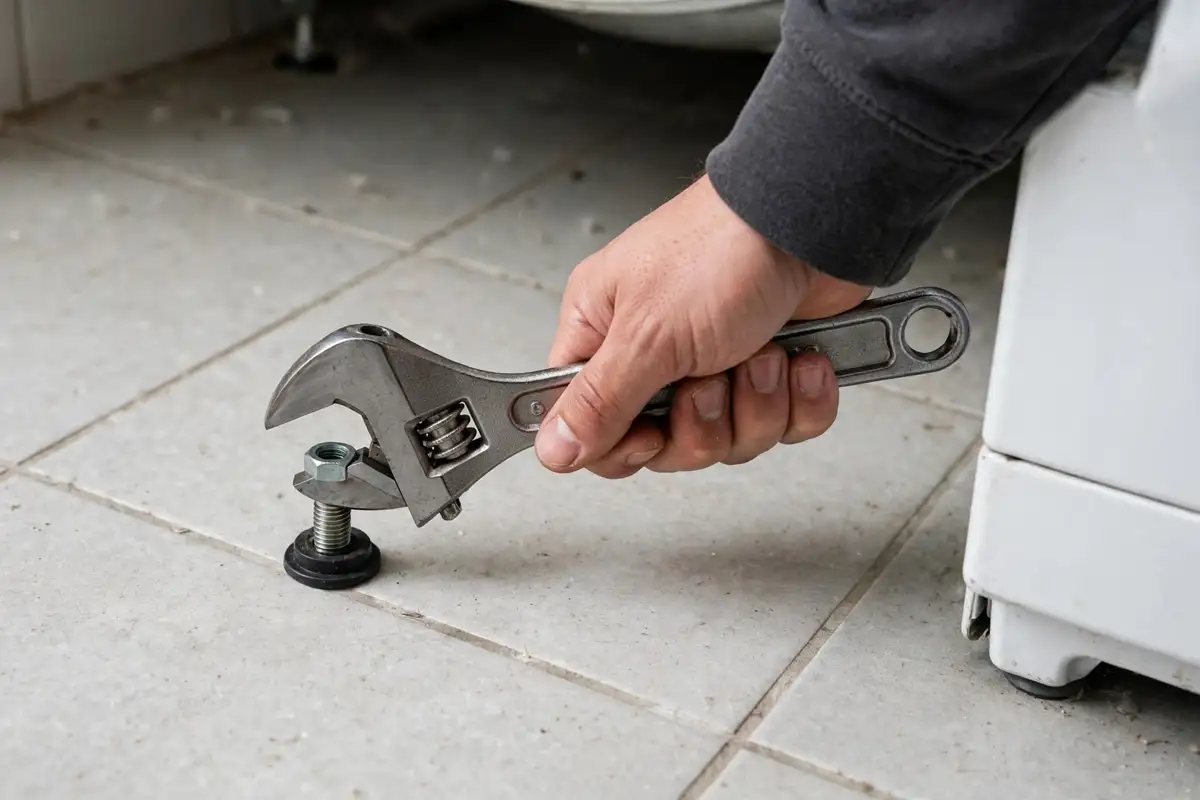
Check level with a simple test. Push the top corners of the machine firmly — front-left, front-right, back-left, back-right. If any corner rocks or the machine shifts, check the feet. At least one leveling foot is not making solid contact with the floor. For a precise check, place a small bubble level on top of the washer, first front-to-back and then side-to-side.
Washers have adjustable leveling feet — threaded posts at each corner that screw in and out. Turn a foot clockwise to raise that corner, counterclockwise to lower it. Adjust until the machine sits flat, then push each corner again to confirm nothing rocks. Finish by tightening the lock nuts against the washer base so the feet cannot vibrate loose again.
Do not use shims, folded cardboard, or wood blocks under the feet as a permanent fix. Improvised shims can shift during spin, which makes the problem worse. The built-in feet are designed to carry the full weight of a spinning washer.
After leveling, also check that the washer is not touching the wall, a cabinet, or the dryer beside it. A machine that cannot vibrate freely will transmit shaking into whatever it touches. It can also pick up vibration from a neighboring appliance.
3. The Suspension Rods or Springs Are Worn Out
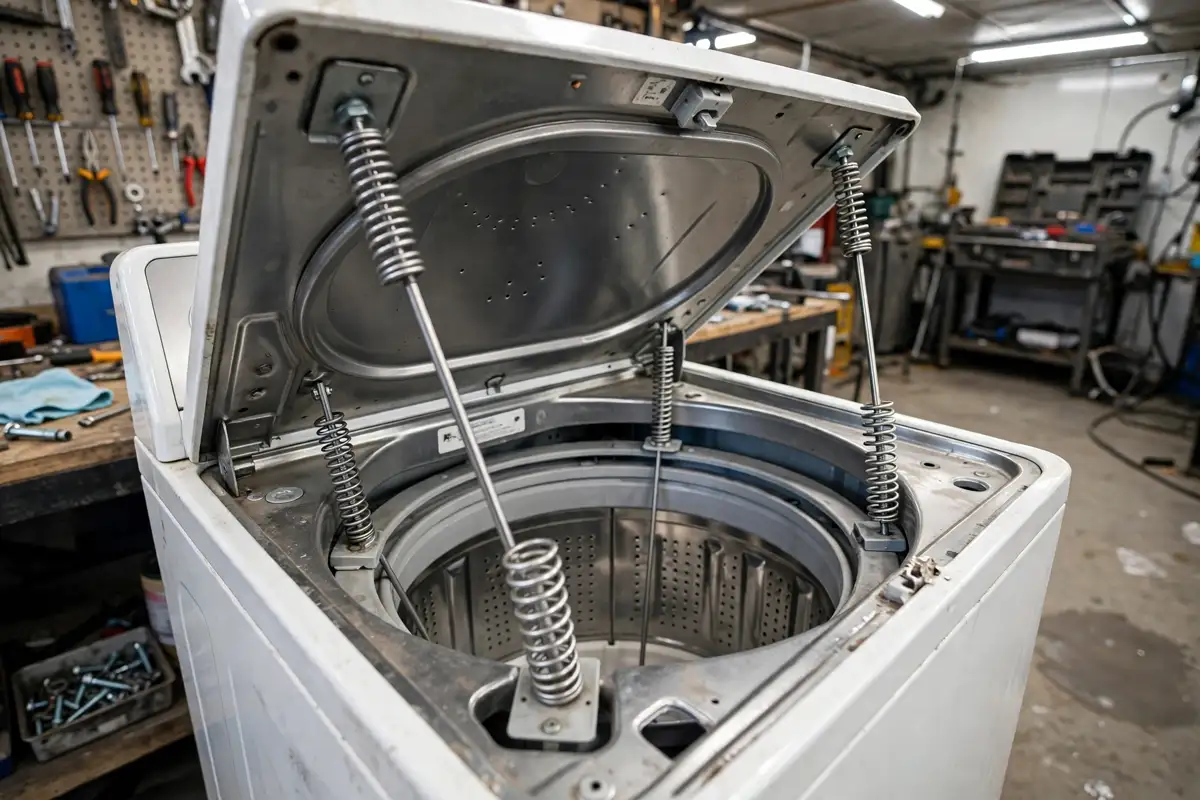
On most top-load washers, four suspension rods hang the wash basket from the cabinet corners. Each rod has a spring and damper assembly that absorbs the tub’s motion during spin. When these rods wear, the tub starts bouncing instead of gliding. Springs stretch, dampers lose their grip, or the rod mounts loosen.
The classic symptom is a tub that bounces freely with a loud bang during spin. This happens even with a perfectly balanced load. The shaking may appear gradually. The washer seems fine for weeks, then bangs once in a while, and finally bangs every cycle. That slow progression is a sign of parts wearing out, not a sudden load problem.
You can test the rods with the washer empty and powered off. Push the empty tub straight down firmly, then let go. A healthy suspension settles smoothly and stops. If the tub bounces up and down several times like a basketball, the damping is gone. The rods need attention.
Also look inside for visible damage. Watch for broken or stretched springs, rods hanging at odd angles, or grease on the inner cabinet walls. Any of these means the suspension is failing and will not get better on its own.
A confident DIYer can replace suspension rods. The job involves tipping or opening the cabinet, releasing the rod mounts, and installing a matched set. Replace all four at once, never just the worst one. Mixed old and new rods dampen unevenly, and the new ones will wear out fast trying to compensate. Because the job means disassembling the cabinet and handling the heavy tub, many homeowners hand it to a technician.
Do not keep running it. A washer with worn suspension rods slams the tub against the cabinet with every spin. Continued use can crack the tub, break the cabinet panels, or snap the remaining rods. That turns a moderate repair into a major one.
4. Shipping Bolts Were Never Removed
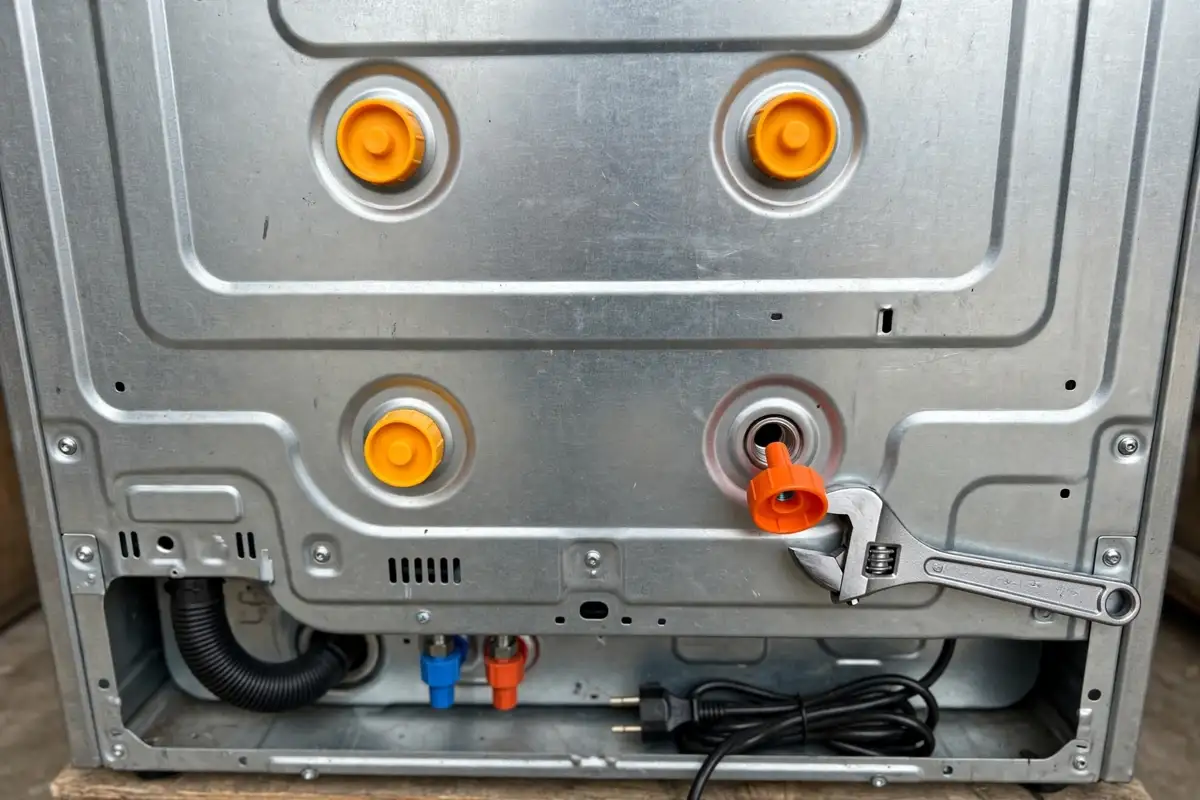
This one applies to new front-load washers. During shipping, the drum is locked rigid with long bolts. Called shipping bolts or transit bolts, they stop the drum from slamming around inside the cabinet in the truck. These bolts must be removed after installation, before the first wash.
If the bolts are still in, the drum cannot move on its suspension at all. Every bit of spin force transfers straight into the cabinet, and the washer shakes violently from the very first cycle. The machine may even walk several inches and make a harsh mechanical racket.
Checking is easy. Look at the back of the washer. Shipping bolts sit in large holes in the rear panel, usually three or four, often with bright plastic caps. If the bolts are still there, you have found your problem. Your owner’s manual shows their exact locations for your model.
Removing them takes about twenty minutes. Unplug the washer and remove each bolt with a wrench. Then push the plastic hole covers (supplied with the washer) into the empty holes. Keep the bolts in a labeled bag. You will need them again if the washer ever moves to a new home.
This also explains why a used washer can start shaking after a move. Anyone transporting a front-load washer should reinstall the shipping bolts for the trip and remove them afterward. Skip either step and the machine will shake — or worse, arrive with a damaged suspension.
5. The Washer Is Overloaded — or Washing One Heavy Item Alone
Cramming too much laundry into the drum does more than clean poorly — it makes violent shaking almost certain. An overstuffed drum has no room for clothes to spread out, so wet fabric clumps wherever it lands. Water adds even more weight, and the whole mass locks into one side of the drum.
The opposite extreme causes the same problem. Washing a single heavy item alone puts all the weight on one side of the drum. One bath mat, one pair of heavy jeans, or one bathrobe is enough to do it. There is nothing else in the load to balance it. Even a medium-size washer can shake itself across the floor spinning one heavy item.
The rule is simple: fill the drum about three-quarters full, leaving a hand’s width of space at the top. Clothes should tumble freely, not pack tight. For a lone heavy item, add a few medium-weight towels to balance the load. They give the drum counterweight without overloading it.
Watch for the overload error some modern washers display. High-efficiency models can sense excessive weight and either refuse to spin fast or add extra rinse cycles. If your washer frequently adds time to the cycle or ends with soaking-wet clothes, overloading is the likely reason.
Repeated overloading wears parts faster. The suspension works harder on every cycle, bearings take extra stress, and the machine’s lifespan shortens. Loading correctly is the cheapest maintenance a washer can get.
6. The Shock Absorbers Are Worn Out (Front-Load Washers)
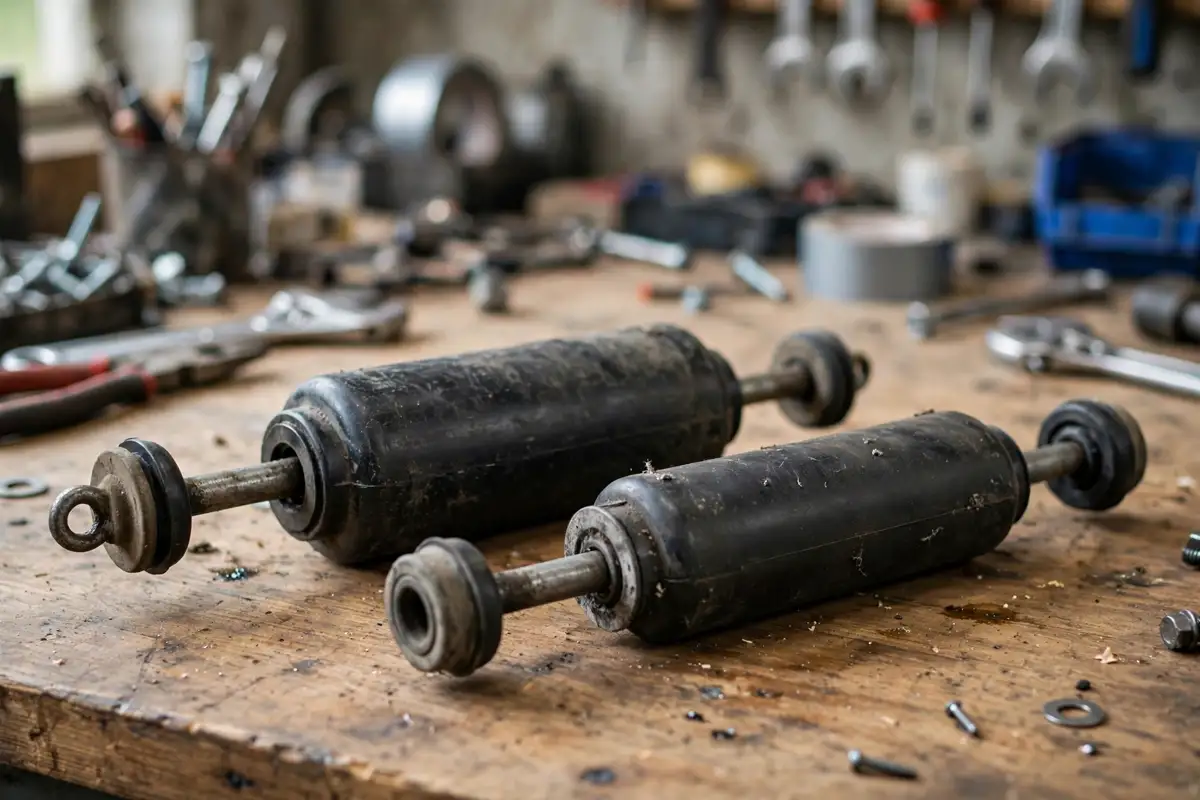
Front-load washers do not use hanging suspension rods. Instead, shock absorbers connect the outer tub to the base frame. These small hydraulic dampers work like a car’s and soak up drum movement. After years of spin cycles, their seals wear and the damping fluid leaks out. The absorber becomes a loose metal stick that moves freely instead of resisting motion.
The telltale sign is a deep banging or thumping even with balanced loads. The washer may run quietly at low speeds, then start pounding when the spin ramps up. You might also notice a low humming or groaning as the tub sways. The machine may also rock more than it used to.
To inspect them, unplug the washer and remove the front or rear access panel (your manual shows how). The absorbers sit at the bottom of the tub, usually two or three of them. Push the tub down by hand. If it drops easily and bounces, or you see oil leaking from the absorbers, they are worn.
As with suspension rods, replace all the absorbers as a matched set. A single new absorber alongside worn ones creates uneven damping and wears out quickly. Access varies by model — some allow absorber swaps from the front panel, others require lifting the whole machine. The tub must be supported during the swap, and parts are model-specific. For both reasons, many Bend homeowners hand this repair to a professional.
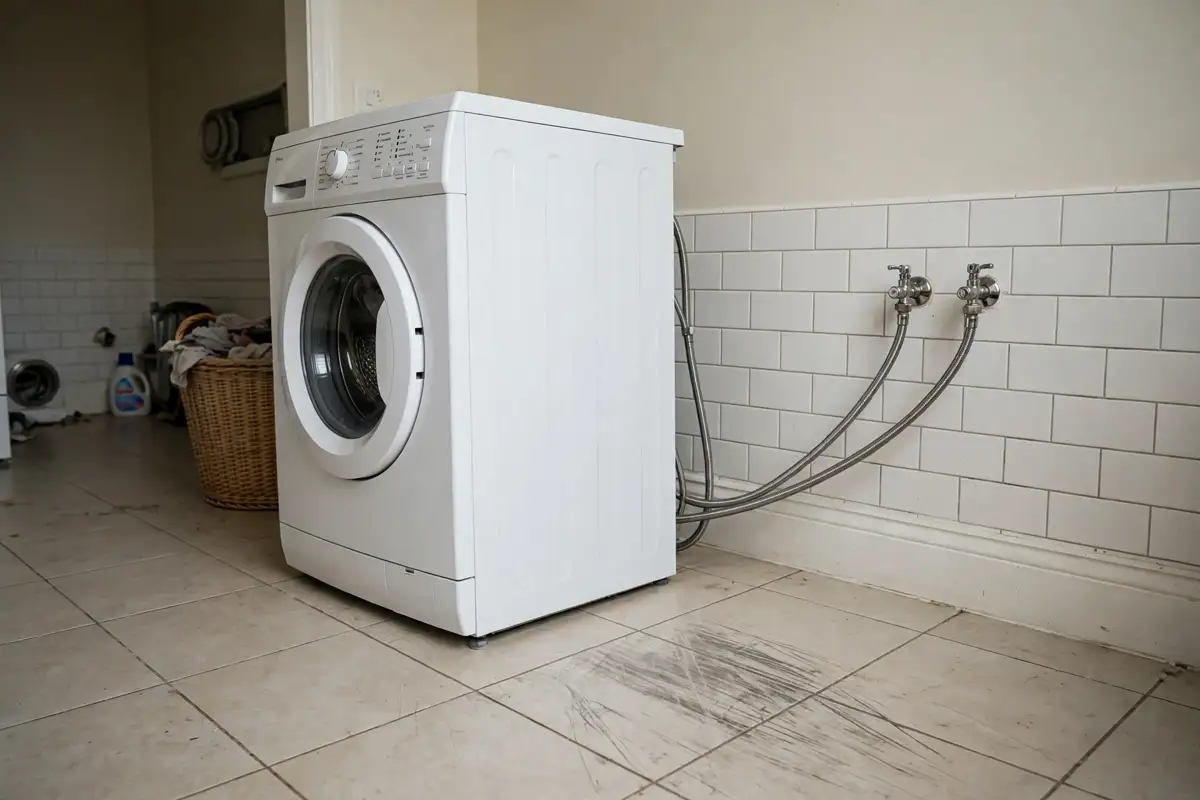
7. The Floor or Pedestal Cannot Handle the Vibration
Sometimes the washer is fine and the floor is the problem. A washing machine needs a solid, rigid surface underneath it. If the floor flexes, even a balanced washer transfers its vibration into the floorboards. The floor then amplifies it into shaking that rattles the whole laundry room.
Concrete slab floors — common in Bend garages and ground-floor laundry rooms — are ideal. Wood subfloors, especially on second floors or over crawlspaces, flex under a spinning washer. If the whole room vibrates but the machine itself is not walking, the floor is absorbing and amplifying the motion.
Pedestals add another wrinkle. A washer on a tall storage pedestal shakes more than the same washer on the floor. The pedestal raises the center of gravity and adds flex points. If shaking started after adding a pedestal, try running the washer directly on the floor as a test.
Practical fixes start simple. Place the washer against a load-bearing wall where the floor joists are strongest. Anti-vibration pads under the feet help with minor floor flex, though they cannot fix a truly springy floor. For second-floor laundry rooms with serious flex, add a plywood reinforcement layer under the washer area. Moving the washer to the ground floor may be the long-term answer.
Also check the feet themselves. Worn or missing rubber foot pads let the metal feet slide on smooth floors. That turns mild vibration into full walking. Replacement pads are inexpensive and press or screw on in minutes.
Step-by-Step Fix Routine for a Shaking Washer
Follow these steps in order. Each step rules out a cause before you move to the next. That way you do not waste time or money on parts chasing the wrong problem.
Step 1: Stop the Machine and Check the Load
Pause or cancel the cycle and wait for the drum to stop completely. Open the door and look at how the laundry is sitting. If clothes are bunched on one side, spread them out evenly around the drum and untwist any ropes of fabric. Remove excess items if the drum is packed tight. Also add a couple of towels if one heavy item was spinning alone. Restart the spin cycle and see whether the shaking is gone.
Step 2: Push-Test Every Corner
With the washer off, push each top corner firmly. Any rocking means a leveling foot is not making solid contact. Place a bubble level on top of the machine, front-to-back then side-to-side. Adjust the threaded feet until the machine sits flat and no corner rocks. Tighten the lock nuts against the base.
Step 3: Check for Shipping Bolts (New Machines)
If the washer is new or recently moved, unplug it and look at the rear panel. Shipping bolts sit in large holes, often with bright plastic caps. Remove every bolt with a wrench and press the supplied hole covers into place. Keep the bolts for the next move.
Step 4: Test the Suspension With the Tub Bounce Test
Open the lid or door and push the empty tub straight down, then let go. A healthy suspension settles smoothly. If the tub bounces repeatedly, the suspension rods (top-load) or shock absorbers (front-load) are worn and need replacement. Do not keep running heavy loads on worn suspension — it gets worse, not better.
Step 5: Run a Test Cycle With a Balanced Load
Load the washer three-quarters full with mixed laundry. Wash no single heavy item alone, and run a full cycle on your normal spin speed. Watch the spin: mild vibration that stays in place is normal. Walking, banging, or shaking that rattles the room means the problem is mechanical, not the load.
Step 6: Try a Lower Spin Speed
As a diagnostic test, run the same load on a lower spin speed setting. If the shaking disappears at low speed but returns at high speed, the suspension is struggling. The cause may be worn rods, absorbers, or a floor that flexes under high force. If it shakes at every speed, leveling or a severe imbalance is more likely.
Step 7: Inspect Underneath and Behind
Pull the washer out carefully (it is heavy — get help) and check what is underneath. Look for worn or missing rubber foot pads, debris under the feet, and hoses pulled tight from walking. Check that the machine is not touching the wall or cabinets. Clean debris away and replace damaged pads.
Step 8: Decide Between Repair and a Service Call
If you have reached this step, you have ruled out the load, the leveling, the shipping bolts, and the floor. The remaining suspects are suspension rods, shock absorbers, springs, or a failing drum support. They involve disassembling the cabinet and ordering model-specific parts. Most homeowners are better served by a professional diagnosis at this point. Call a washer repair technician in Bend for the next step.
Central Oregon Factors That Make Washers Shake
Washers shake for the same mechanical reasons everywhere. But a few local conditions around Bend make certain shaking problems more common here.
Concrete Garage Floors With Uneven Spots
Many Bend homes run their washers on garage or utility-room concrete. Concrete is great for vibration control. But older garage slabs often slope slightly for drainage or develop uneven spots over the years. A washer that is perfectly level in the showroom rocks on a sloped slab. If your washer shakes in the garage but the load is fine, re-level it in place. Do it on the slab itself, not by the bubble level alone.
Second-Floor Laundry in Newer Builds
Second-floor laundry rooms are popular in newer Bend neighborhoods like Northwest Crossing and parts of Boyd Acres. Wood subfloors on a second story flex far more than a ground-floor slab. That flex turns normal spin vibration into room-wide shaking. If the whole upstairs rattles during spin while the washer stays in place, the floor is amplifying the motion. Anti-vibration pads and positioning near a load-bearing wall help the most.
High-Desert Dust in Leveling Feet Threads
Central Oregon’s fine, dry dust works its way into everything — including the threaded leveling feet under your washer. Dust-packed threads can seize a foot in place, so the adjustment you think you made never actually happened. If a foot refuses to turn, brush the threads clean and work it back and forth before re-leveling.
Washers in Vacation and Rental Properties
Bend’s rental market means many washers get moved between properties regularly. Every move risks skipped shipping bolts on a front-loader. It is also a chance for a level washer to arrive unlevel. If a rental washer shakes from the first load, check two things first. Look at the shipping bolts and the level before assuming the machine is worn out.
How to Keep Your Washer From Shaking
A few low-effort habits prevent most shaking problems before they start.
These steps take minutes and address the root causes behind the majority of shaking-related service calls.
Washer Shaking: DIY or Professional Service?
Use this table to decide what to handle yourself and what to hand to a technician.
| Repair Task | DIY Suitability | Professional Help |
|---|---|---|
| Redistribute an unbalanced load | Good | Usually unnecessary |
| Adjust the leveling feet | Good | Usually unnecessary |
| Remove shipping bolts (new front-load) | Good | Usually unnecessary |
| Correct overloading habits | Good | Usually unnecessary |
| Replace rubber foot pads | Good | Usually unnecessary |
| Add anti-vibration pads or floor reinforcement | Good, with care | Helpful for structural fixes |
| Replace suspension rods (top-load) | Moderate | Recommended for most homeowners |
| Replace shock absorbers (front-load) | Moderate | Recommended for most homeowners |
| Diagnose drum or bearing problems | No | Yes |
The key rule is simple. DIY the load, the level, and the simple checks. Let a professional handle suspension parts and anything that requires opening the cabinet. A correct diagnosis from your own troubleshooting makes the service visit faster and cheaper.
When Should You Call a Washer Repair Technician?

Call a technician when your own troubleshooting has ruled out the simple causes. If load balance, leveling, shipping bolts, and floor issues all check out, a shaking washer needs a pro. The remaining suspects are suspension rods, shock absorbers, springs, and drum support problems. All of them involve opening the cabinet and sourcing model-specific parts.
Call sooner, without further DIY attempts, if the tub visibly drops or hangs crooked. Also call if you hear grinding or scraping, or if the machine shakes violently while empty. Those signs point past worn suspension to deeper mechanical problems that need professional diagnosis.
For homeowners in Bend, professional washing machine repair starts with your symptoms. Tell the scheduler what you have already checked. For example: “It is level and the load is balanced.” Or: “It shakes from the first cycle.”
Frequently Asked Questions About Washers Shaking Violently
Is it normal for a washing machine to shake during the spin cycle?
Some vibration during spin is normal, but a washing machine shaking violently is not. The line is clear: light shaking that stays in place is the machine working. Walking across the floor, loud banging, or shaking heard in another room means something is wrong. It needs fixing.
Can I keep using a washer that shakes violently?
No — stop using it until you find the cause. A washer shaking violently strains the water supply hoses, scores flooring, and bends its own leveling feet. Continued use also slams worn suspension parts against the cabinet, which turns a moderate repair into a much bigger one.
Why does my washing machine shake only during the spin cycle?
The drum spins up to 800 to 1,200 RPM during spin, while wash and rinse run slowly. At spin speed, even a small imbalance becomes a powerful off-center force. That is why a washer seems fine most of the cycle and only shakes when the spin ramps up.
Why is my brand-new washing machine shaking violently?
On new front-load washers, the most common reason is shipping bolts left installed after delivery. The bolts lock the drum rigid for transport and must be removed before the first wash. Check the rear panel for bolts in the large transit holes. Remove them and press the supplied covers into the holes.
How do I know if my washer is level?
Push each top corner firmly — if any corner rocks, a foot is not touching the floor. For a precise check, place a bubble level on top of the washer, front-to-back and then side-to-side. Adjust the threaded leveling feet until nothing rocks, then tighten the lock nuts so they stay put.
Why does my top-load washer bang loudly during spin?
Loud banging in a top-load washer usually means the suspension rods are worn out. Push the empty tub straight down and let go. If it bounces up and down several times instead of settling smoothly, the rods have lost their damping. Replace all four as a matched set, since mixed old and new rods wear out fast.
Do anti-vibration pads really stop a washer from shaking?
Anti-vibration pads help with mild vibration and small amounts of floor flex, and they protect floors from foot damage. They cannot fix an unbalanced load, an unlevel machine, or worn suspension parts. Use pads as a supplement to proper leveling and load habits, not as a substitute for them.
Why does my washer shake even with a small, balanced load?
Very small loads can be just as unbalanced as huge ones. One or two items cannot spread evenly around the drum. But if the washer shakes on every load size and in empty test cycles, the cause is mechanical. It may be the leveling, worn suspension parts, or a flexible floor, and a technician should take a look.
Washing Machine Repair in Bend and Redmond, OR
A washer that shakes violently will not fix itself. Every shaking cycle risks hoses, floors, and the machine’s own parts. If the load, the level, and the shipping bolts all check out, get professional diagnosis. It is the fastest way to the real cause.
We serve homeowners throughout Bend, including Northwest Crossing, Awbrey Butte, Boyd Acres, and Larkspur. We also cover River West, Mountain View, Summit West, Orchard District, and Southern Crossing. For appliance repair in Redmond, Oregon and nearby Central Oregon communities, we have you covered. Describe what you have already checked using the steps above. It helps the technician diagnose the problem faster, often in a single visit.
Final Takeaway
A washing machine shaking violently is usually a balance or leveling problem, not a dead machine. Start with the load and the leveling feet — those two checks resolve most shaking in minutes. Shipping bolts explain nearly every new-machine case.
If the easy fixes do not help, use the tub bounce test to judge the suspension. Worn rods or absorbers need replacement as a matched set, and a flexible floor may need pads or reinforcement. When the cabinet has to come apart, professional diagnosis is the sensible next step.
Washer Still Shaking Violently?
If the troubleshooting steps haven’t solved the problem, our technicians can diagnose the actual cause. That includes suspension rods, shock absorbers, leveling, or installation issues. You get a clear, upfront repair estimate before any work begins.