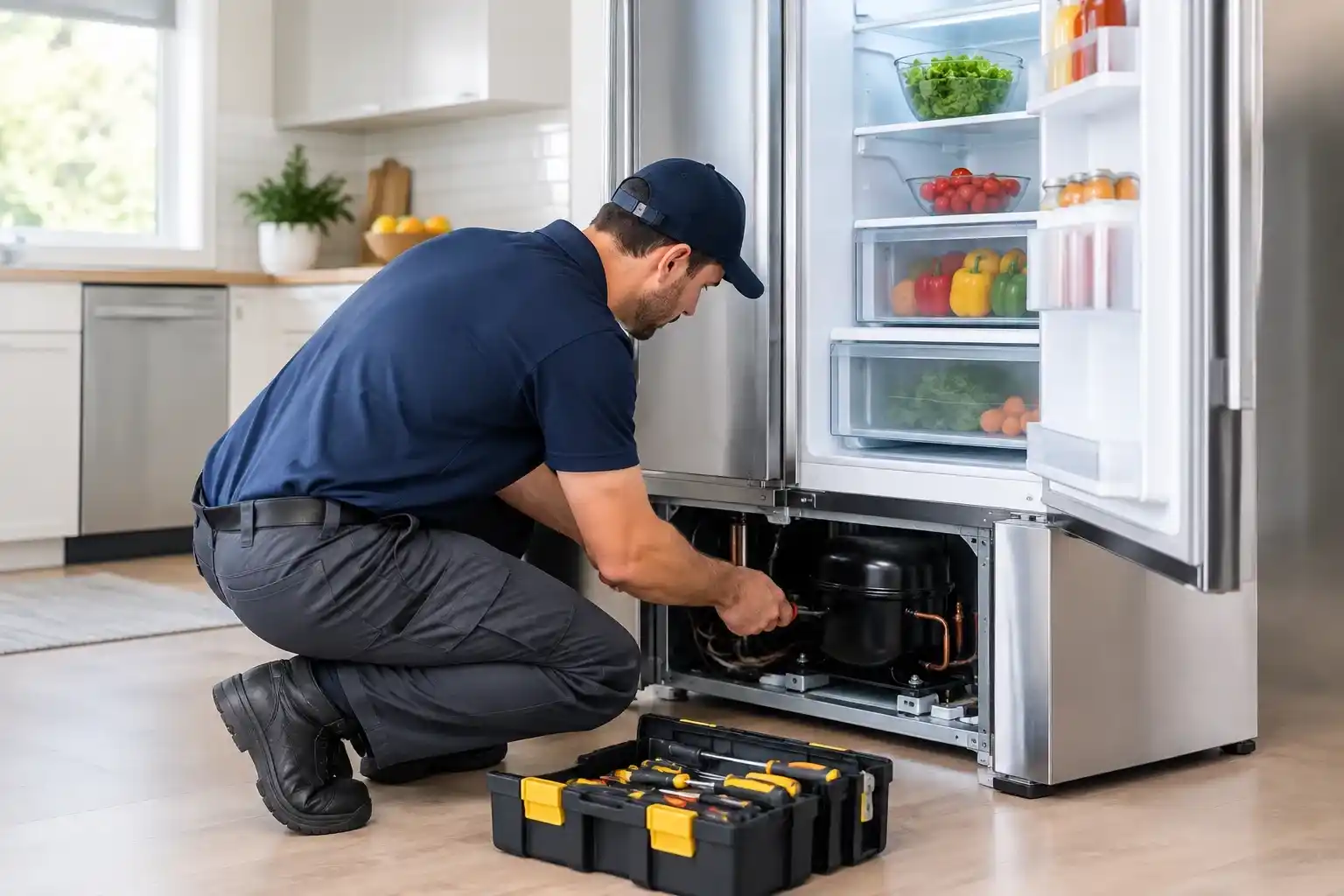
Refrigerator Not Cooling? 9 Common Causes and Fixes
Is your refrigerator not getting cold? Learn why refrigerator not cooling happens, what to check first, and when to call a local repair technician.
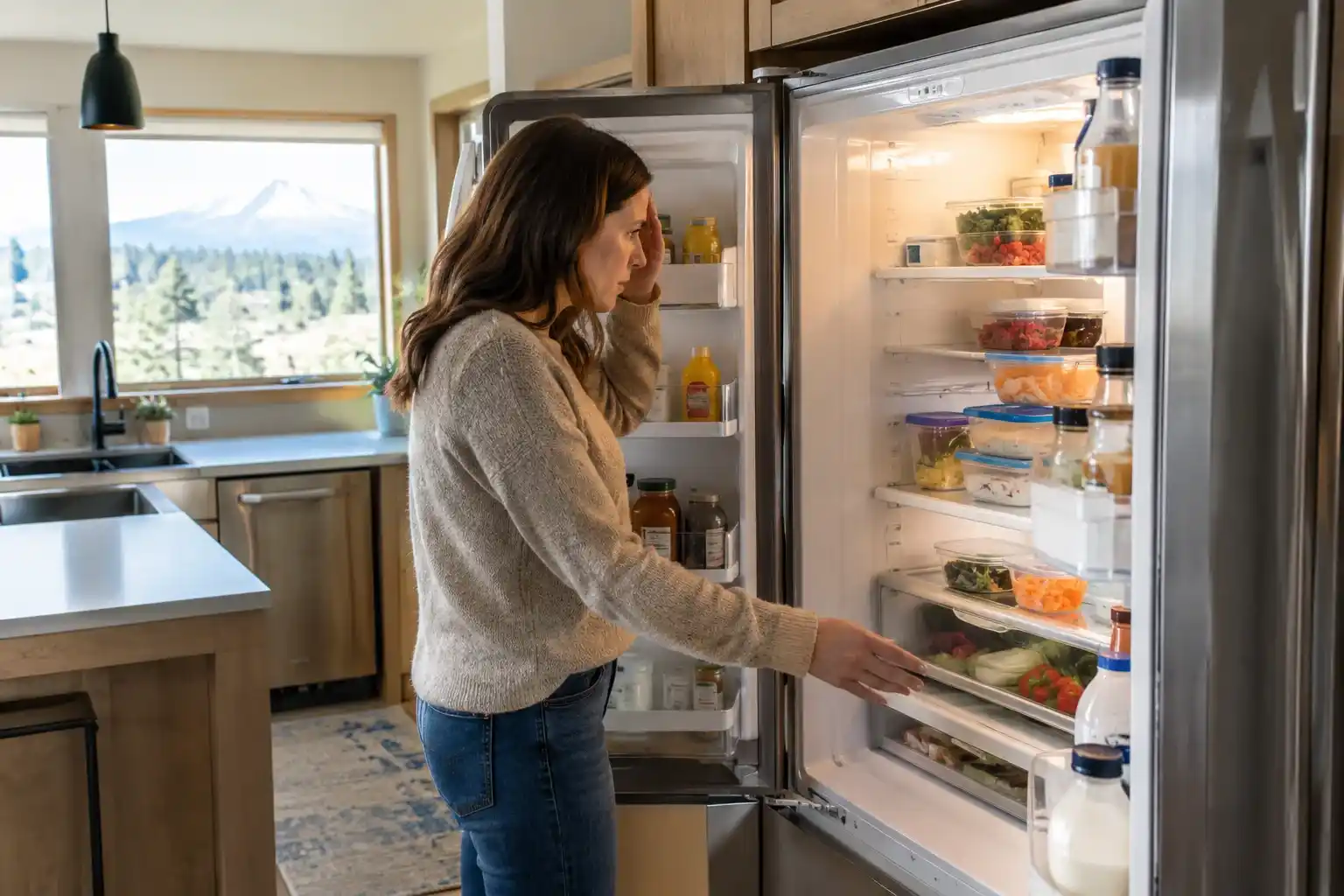
Refrigerator Not Cooling: 9 Causes and Condenser Fan Motor Problems
A refrigerator not cooling can become a serious problem quickly. Food gets warm, drinks lose their chill, and the appliance may run for hours. The good news is that many cooling problems start with simple issues.
Start with the basics before assuming a major repair. Check the temperature setting, power supply, airflow, door gasket, and visible frost. Then check whether the freezer is still cold. That detail can narrow the problem quickly.
For homeowners in Bend, Oregon, refrigerator problems can happen in any kitchen. Homes around Old Bend, River West, Larkspur, and the Old Mill District have different kitchen layouts. Some refrigerators also sit close to cabinets, walls, or other appliances. Poor clearance can affect airflow around the unit.
This guide explains the most common causes in simple terms. You will also learn which checks are safe to perform yourself. More complex repairs are better left to a qualified appliance technician.
📋 Table of Contents — Tap to Jump to a Section
Why Is My Refrigerator Not Cooling?
A refrigerator not cooling can have several causes. Common problems include an incorrect temperature setting, blocked airflow, dirty condenser coils, fan failure, frost buildup, damaged door seals, faulty sensors, compressor problems, and sealed-system issues.
Start with the temperature control. The FDA recommends keeping a refrigerator at 40°F or below. An appliance thermometer gives a more reliable reading than touching the food.
Next, check whether the freezer is still cold. If the freezer remains cold while the refrigerator warms, airflow becomes an important clue. The evaporator fan, vents, damper, defrost system, or temperature sensor may need attention.
If both compartments are warm, the problem may be larger. The condenser system, compressor, start relay, control board, or sealed system could be involved.

Quick Diagnostic Guide
| What You Notice | Likely Cause | What to Check |
|---|---|---|
| Freezer is cold but refrigerator is warm | Airflow, evaporator fan, frost, or damper issue | Check vents, frost buildup, and airflow |
| Refrigerator and freezer are both warm | Condenser, compressor, control, or sealed-system issue | Check power, temperature setting, condenser area, and unusual sounds |
| Refrigerator runs almost constantly | Dirty coils, poor airflow, door seal, or cooling-system issue | Check coils, clearance, gasket, and temperature |
| Heavy frost inside freezer | Defrost system problem | Look for thick ice around the evaporator area |
| Clicking or repeated starting sounds | Start relay or compressor issue | Listen for repeated clicks and call for testing if it continues |
| Lights work but refrigerator stays warm | Cooling system problem | Check temperature, vents, frost, fans, and compressor operation |
Use this guide as a starting point rather than a final diagnosis. Several refrigerator problems can produce similar symptoms.
How a Refrigerator Cooling System Works
Understanding the basic cooling cycle makes troubleshooting easier.
A refrigerator removes heat from inside the cabinet. The compressor moves refrigerant through the sealed system. The condenser coils release heat outside the cabinet. A condenser fan helps move air across those coils.
The refrigerant then reaches the evaporator section. The evaporator coils become cold. An evaporator fan moves that cold air through the refrigerator and freezer compartments.
Temperature sensors monitor the cabinet temperature. The control system uses those readings to manage cooling cycles. The defrost system also prevents excessive ice from blocking airflow.
When one part fails, another part may appear to be the problem. That is why symptoms matter when diagnosing a refrigerator not cooling.
Refrigerator Troubleshooting: Start With Simple Checks
Good refrigerator troubleshooting starts with the easiest checks.
9 Common Causes of Refrigerator Not Cooling
There are several reasons for a refrigerator not cooling properly. Some are easy to check, while others require electrical or refrigeration testing.
| Common Cause | Main Symptom | Safe First Check |
|---|---|---|
| Incorrect temperature setting | Cabinet feels warmer than expected | Check the temperature control |
| Dirty condenser coils | Long run times or poor cooling | Inspect accessible condenser areas |
| Condenser fan motor | Poor cooling or unusual lower-section noise | Check for abnormal fan operation |
| Evaporator fan | Freezer cold but refrigerator warm | Check airflow from refrigerator vents |
| Frost or defrost failure | Heavy ice buildup | Inspect the freezer for excessive frost |
| Door gasket | Warm air or moisture entering | Inspect the complete door seal |
| Thermistor or temperature sensor | Temperature changes unexpectedly | Check temperature and seek professional testing |
| Start relay or compressor | Clicking or failure to cool | Listen for repeated starting sounds |
| Sealed-system or refrigerant issue | Persistent poor cooling | Professional diagnosis required |
These causes can overlap. A refrigerator may have more than one issue at the same time.
1. Incorrect Temperature Setting
An incorrect temperature setting is one of the simplest possibilities.
Check the control before assuming a component has failed. Some refrigerators use electronic controls. Older models may use mechanical thermostats.
Use an appliance thermometer to check the actual cabinet temperature. The FDA recommends keeping the refrigerator at 40°F or below.
If the setting looks correct but the temperature stays high, the thermostat, thermistor, or control system may need testing. Do not keep lowering the temperature repeatedly — that will not repair a failed component.
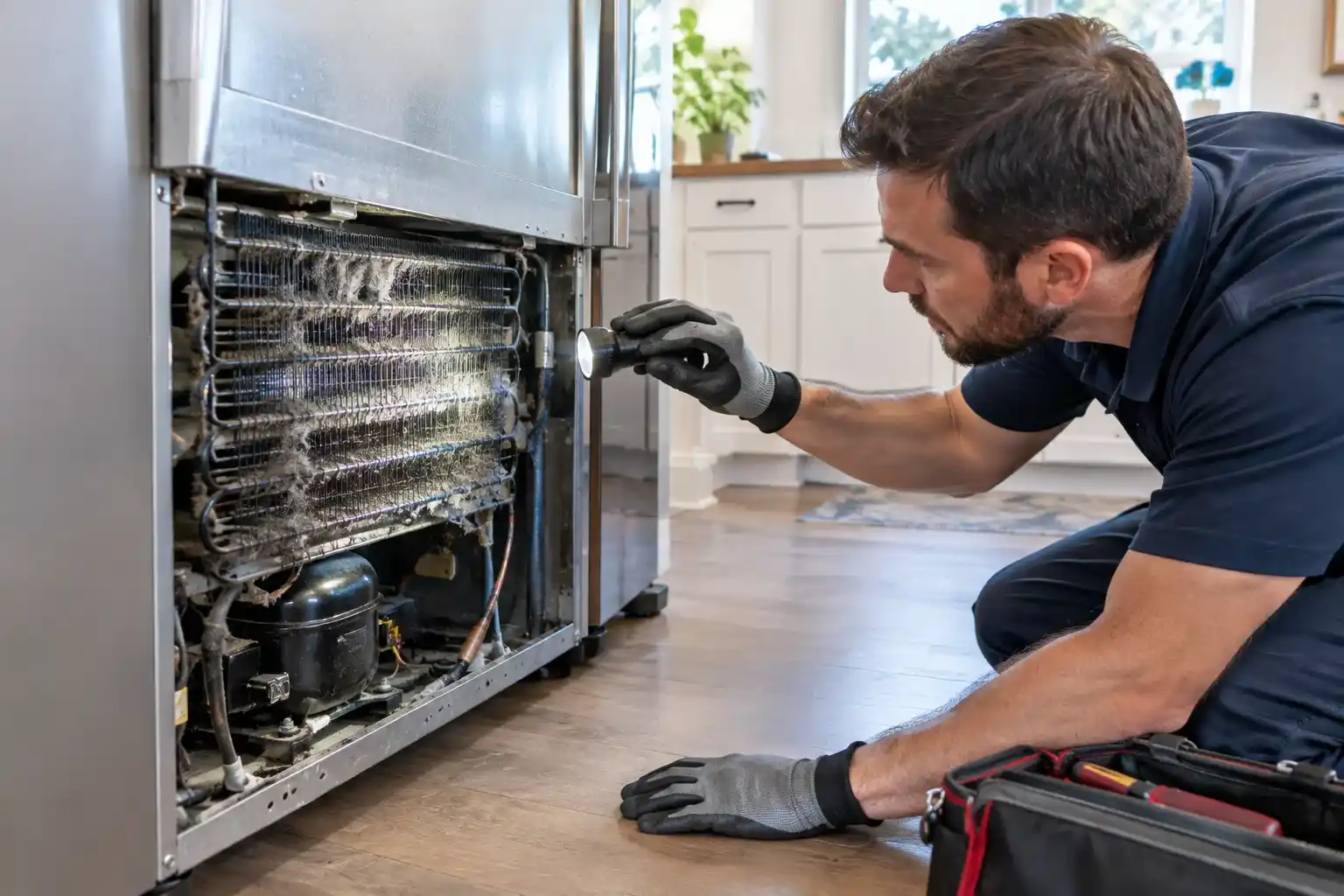
2. Dirty Condenser Coils or Poor Ventilation
Dirty condenser coils can make a refrigerator not cooling problem worse.
The condenser coils release heat removed from inside the appliance. Dust, dirt, and pet hair can cover these surfaces over time.
When heat cannot escape efficiently, the refrigerator may struggle to maintain temperature. The compressor may also run for longer periods.
Refrigerator clearance matters too. A unit pushed tightly against a wall may not have enough space for proper airflow. This can be especially important in smaller kitchens around Bend. Check your owner’s manual for the required clearance around your specific model.
Clean accessible condenser areas only according to the manufacturer’s instructions. Never damage refrigerant tubing while cleaning.
3. Condenser Fan Motor Failure
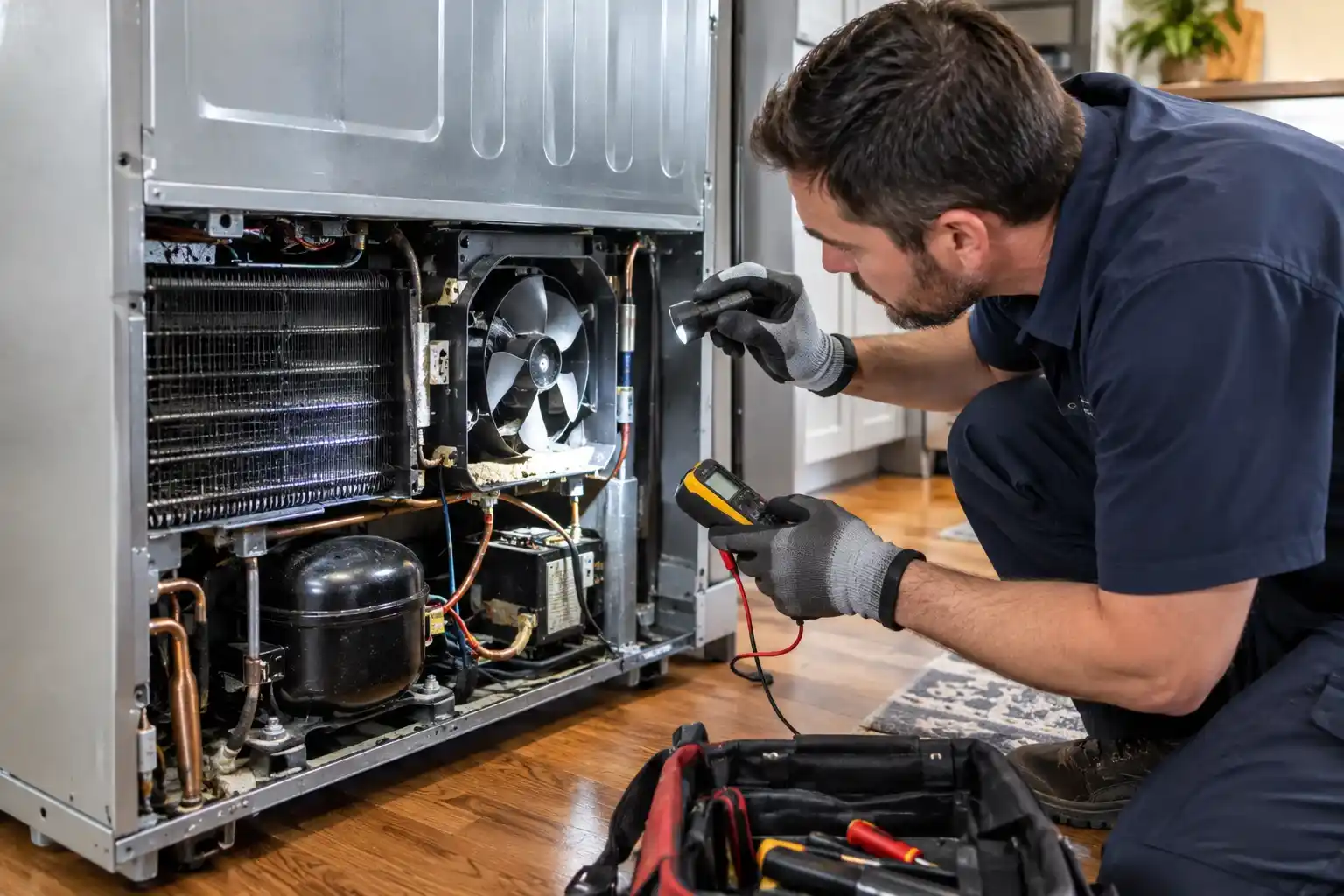
The condenser fan motor helps move air across the condenser area.
A faulty condenser fan motor can cause poor cooling and long run times. You may also notice unusual sounds near the bottom or rear of the refrigerator.
Do not reach into a moving fan. Do not bypass safety switches or electrical components.
If the fan does not operate correctly, a technician can test the motor, wiring, control signal, and related components. A failed fan does not always mean the motor itself is defective. Proper testing helps prevent unnecessary parts replacement.
4. Evaporator Fan or Airflow Problem
The evaporator fan distributes cold air inside the refrigerator.
When the evaporator fan not working, the freezer may remain cold while the refrigerator compartment becomes warm.
You may notice weak airflow from the refrigerator vents. You may also hear unusual sounds or no fan noise when cooling should occur.
Blocked vents can create similar symptoms. Check that containers are not covering the air passages. This is why fridge not cooling but freezer works is such a useful diagnostic clue.
Fridge Not Cooling but Freezer Works
When you have a fridge not cooling but freezer works problem, do not immediately assume the compressor has failed.
Start by checking airflow. Make sure refrigerator vents are not blocked by food containers.
Then look for excessive frost inside the freezer. Heavy frost can restrict airflow through the evaporator section.
A failed evaporator fan can create the same symptom. A damper problem or temperature sensor can also affect cold-air distribution.
If basic checks do not restore cooling, professional diagnosis can save time. A technician can test the fan, airflow, sensors, defrost system, and related controls.

5. Frost Buildup and Defrost System Failure
Frost naturally forms during refrigeration. The defrost system removes unwanted frost during scheduled cycles.
A failed defrost heater, thermostat, sensor, timer, or electronic control can allow ice to build up.
As frost increases, airflow becomes restricted. The refrigerator section can become warm even while the freezer remains cold.
Turning the refrigerator off may melt the ice temporarily. However, that does not fix the underlying problem. If frost returns after defrosting, the defrost system needs proper diagnosis.
Refrigerator Not Cooling Enough
A refrigerator not cooling can sometimes be difficult to notice when the cabinet still feels somewhat cold. A refrigerator not cooling enough may still be above the safe food-storage temperature.
Use an appliance thermometer instead of judging temperature by touch. The FDA recommends keeping the refrigerator at 40°F or below.
Check airflow around stored food. Avoid overpacking the cabinet. Cold air needs room to circulate. Then check the door gasket, condenser area, and visible frost.
Refrigerator Not Cold Enough
A refrigerator not cold enough may run for long periods without reaching the correct temperature.
Long run times can result from restricted airflow, dirty condenser surfaces, poor door sealing, or a cooling-system problem.
Check whether the freezer remains cold. If it does, focus first on airflow, frost, and the evaporator fan. If both compartments are warm, the diagnosis becomes broader.
6. Damaged Door Gasket or Poor Door Seal
The refrigerator door gasket creates a seal around the cabinet.
A damaged gasket can allow warm air into the appliance. Moisture can enter at the same time. That moisture can contribute to frost buildup.
Inspect the entire gasket. Look for tears, hardened sections, gaps, or areas pulling away from the door.
Clean dirt from the seal using an appropriate mild cleaner. Make sure the door closes completely. Also check whether large containers or shelves prevent the door from closing.
A door that stays slightly open can make the refrigerator work harder. It can also cause temperature fluctuations.

7. Faulty Thermistor or Temperature Sensor
A thermistor measures temperature inside many modern refrigerators.
The control system uses that information to determine when cooling should start or stop.
If the sensor sends an incorrect reading, the refrigerator may cool too much or too little. A faulty sensor can be difficult to confirm without testing. Its symptoms can overlap with airflow and control problems.
If temperatures change without an obvious reason, professional testing may be worthwhile. Replacing a sensor without confirming the fault can waste money.
How to Fix Refrigerator Not Cooling
If you are wondering how to fix refrigerator not cooling, start with simple maintenance and inspection.
Check the temperature setting. Clear blocked vents. Inspect the door gasket. Confirm power. Check for excessive frost. Clean accessible condenser areas according to the manufacturer’s instructions.
Some refrigerators also support a reset after certain temporary control issues. Follow the instructions for your exact model.
Do not attempt refrigerant charging yourself. Sealed-system work requires specialized equipment and proper training. The same applies to compressor replacement, electrical testing, and many control-board repairs.
If these basic checks do not restore normal cooling, professional diagnosis is better than replacing parts randomly.
Refrigerator Running but Not Cooling
A refrigerator running but not cooling can have several causes. The compressor may run while another component has failed. Dirty condenser surfaces can reduce heat transfer. A failed fan can affect airflow. Frost can block the evaporator. A sealed-system problem can also reduce cooling.
Listen for unusual clicking, buzzing, repeated starting, or unusually long run times. Do not assume that a running compressor proves the compressor is healthy.
Refrigerator Has Power but Not Cooling
A refrigerator has power but not cooling is a different situation from a refrigerator with no power. Working lights and displays show that some electrical circuits are active — they do not prove the compressor, fans, controls, or sealed system are working correctly.
Check the temperature setting first, then inspect airflow and visible frost. If both compartments are warm, the problem may involve the condenser system, compressor, start relay, control board, or sealed system.
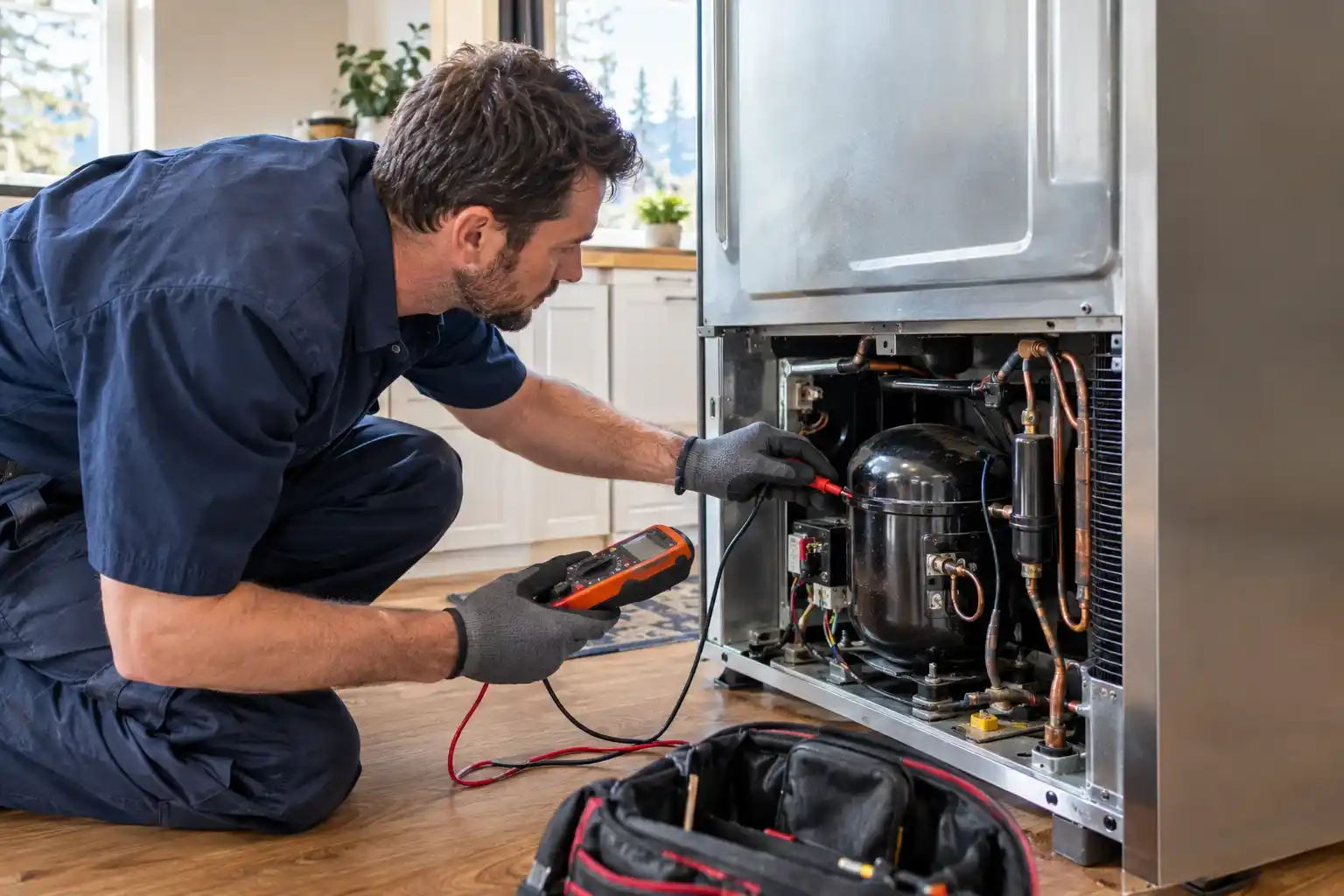
Refrigerator Compressor Not Working
The compressor is one of the main components in the cooling system.
If the refrigerator compressor not working, the appliance may stop cooling or become increasingly warm.
A failed start relay can prevent the compressor from starting. Repeated clicking can occur when the compressor repeatedly tries to start. Other possibilities include electrical faults, overheating, or internal compressor failure.
Do not diagnose a compressor based only on noise. A technician should test the start circuit and compressor before recommending replacement. A sealed-system problem can also cause poor cooling — refrigerant leaks require specialized equipment and qualified service.
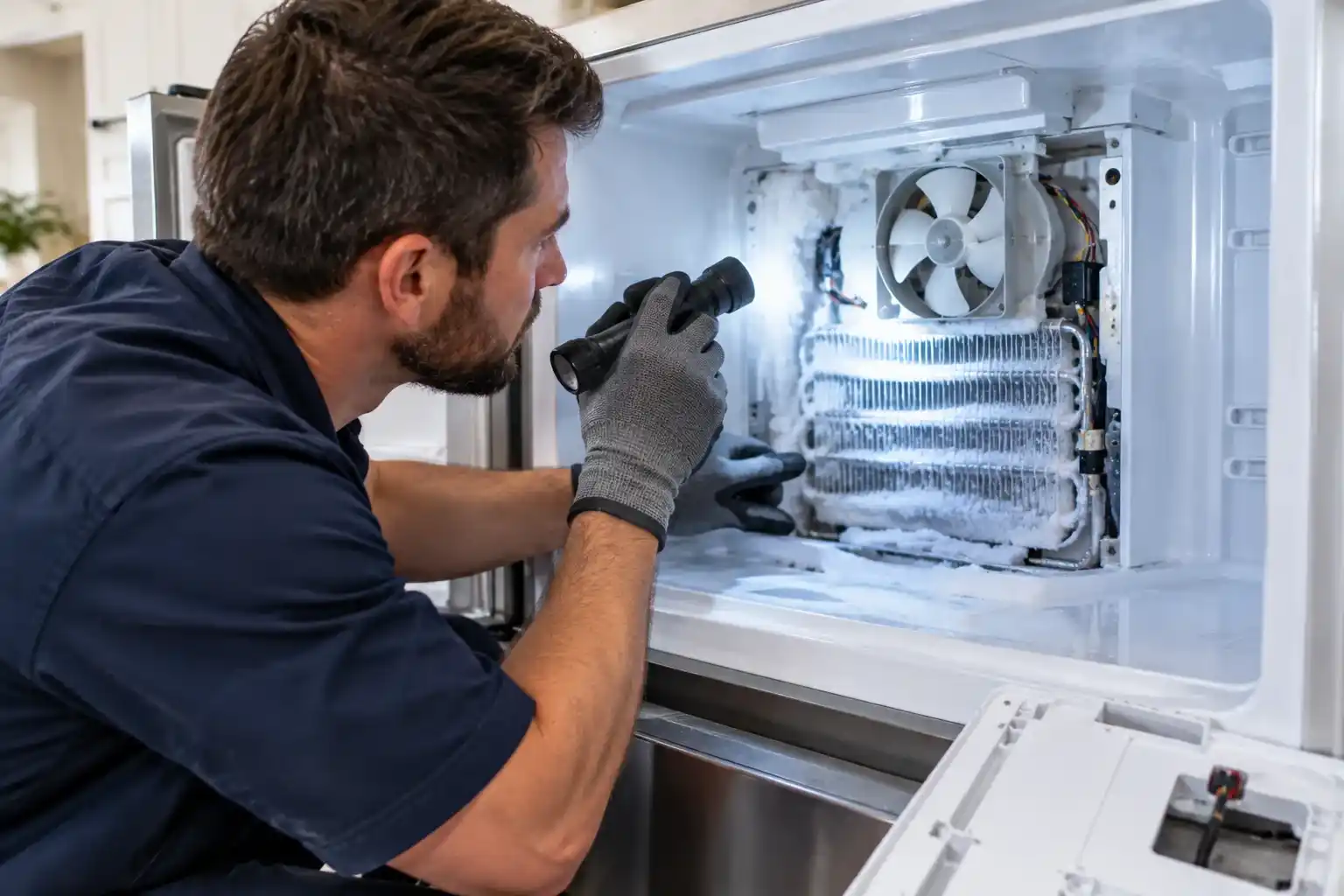
Evaporator Fan Not Working
The evaporator fan moves cold air through the refrigerator.
When the evaporator fan not working, the freezer may remain colder than the refrigerator compartment.
You may notice weak airflow from the refrigerator vents. You may also hear unusual fan noise or no fan noise at all. Heavy frost can also interfere with the fan.
Do not force the fan blade or reach into the appliance while moving parts operate. A technician can test the motor, wiring, control signal, and frost condition.
Refrigerator Troubleshooting: Follow the Symptoms
Good refrigerator troubleshooting starts with the symptom rather than the part.
If there are no lights or sounds, check power, the outlet, and the breaker first. If the lights work but both compartments are warm, investigate the cooling system.
If the freezer stays cold while the refrigerator warms, focus on airflow, frost, the evaporator fan, damper, and temperature sensing. If heavy frost covers the freezer’s rear area, the defrost system deserves attention.
If the refrigerator clicks repeatedly, the start relay, overload device, or compressor may need testing. If the refrigerator runs constantly but stays warm, check airflow, condenser performance, and the sealed system.
This approach can reduce unnecessary parts replacement.
How to Fix Refrigerator Not Cooling: DIY or Professional?
Some checks are suitable for homeowners. Others involve electrical testing or sealed refrigeration components.
| Check or Repair | Homeowner Can Check | Technician Recommended? |
|---|---|---|
| Temperature setting | Yes | No |
| Refrigerator vents | Yes | No |
| Door gasket | Yes | If damaged or replacement is needed |
| Accessible condenser area | Yes, following the manual | If deeper access is required |
| Excessive frost | Yes | Yes, if frost returns |
| Evaporator fan | Basic observation only | Yes, for testing or replacement |
| Condenser fan motor | Basic observation only | Yes, for testing or replacement |
| Thermistor or temperature sensor | Basic symptom check | Yes, for electrical testing |
| Start relay | No internal testing | Yes |
| Compressor | No internal testing | Yes |
| Control board | No internal testing | Yes |
| Refrigerant or sealed system | No | Yes |
The key is knowing where a safe inspection ends. A simple visual check can help identify symptoms. It should not turn into an unsafe electrical or refrigeration repair.
When Should You Call a Refrigerator Repair Technician?
A A refrigerator not cooling after basic checks may need professional refrigerator repair in Bend.
Call a technician when the compressor will not start. Professional service is also appropriate when a fan motor, control board, sensor, or sealed system requires testing.
Call sooner if the refrigerator repeatedly trips the circuit breaker. Do not attempt refrigerant charging or sealed-system repairs without proper equipment and training.
A technician can also help when temporary defrosting restores cooling only for a short time. For Bend homeowners, early diagnosis can help prevent further food loss and unnecessary parts replacement.
Food Safety: What to Do While the Refrigerator Is Warm
Food safety should come before troubleshooting.
The FDA recommends keeping a refrigerator at 40°F or below. The freezer should stay at 0°F or below. An appliance thermometer provides a reliable way to monitor both temperatures.
Keep the refrigerator door closed as much as possible while investigating the problem. The FDA says an unopened refrigerator can keep food cold for about four hours during a power outage.
Do not rely only on smell or appearance when deciding whether food is safe. If you are unsure about food safety, follow current FDA guidance.
A Bend, Oregon Homeowner’s Perspective
Refrigerator problems rarely happen at a convenient time.
A home near the Old Mill District may have a different kitchen layout from a home in River West. Homes around Larkspur can also have different appliance clearances and ventilation setups.
Some refrigerators sit tightly between cabinets. Others sit near garages, utility spaces, or busy entry areas. The location matters because refrigerators need room to release heat, and dust can also collect around accessible appliance areas.
If your refrigerator sits near a garage, workshop, or frequently used entry area, inspect the accessible condenser area regularly. The same principle applies whether you live near Century Drive, 3rd Street, US-20, or another part of Bend.
Testimonials, Awards, and Case Studies
Customer experiences can add useful local proof when they are genuine. Any testimonial used on this page should come from an actual customer and describe a real service experience. Awards and certifications should also be verified before publication. Avoid invented testimonials, awards, customer names, or repair results — accurate proof builds more trust than exaggerated claims.
Accurate Diagnosis
The strongest reviews explain the original symptom, diagnosis, repair, and result in the customer’s own words.
No Unnecessary Parts
Homeowners value technicians who test fans, sensors, and the compressor before recommending a repair.
Fast Local Response
Same-day appointments help Bend homeowners limit food loss quickly.
Case Study Example
A real Bend service case could describe a refrigerator with a warm fresh-food section and a cold freezer. The technician could explain what testing found and which repair restored normal operation. Replace this example with real, verified service details before publishing.
Facts and Figures That Matter
The refrigerator should stay at 40°F or below for safe food storage. The freezer should stay at 0°F or below.
The FDA also recommends appliance thermometers because refrigerator controls may not show the actual internal temperature.
Cold air needs space to circulate. Overpacking the refrigerator can interfere with proper cooling. During a power outage, an unopened refrigerator generally keeps food cold for about four hours.
These figures matter because a refrigerator can feel cool while remaining above the recommended food-storage temperature.
Refrigerator Maintenance That Helps Prevent Problems
Frequently Asked Questions
Why is my refrigerator not cooling but the freezer is working?
This usually points toward an airflow or temperature-distribution problem. Common causes include an evaporator fan issue, blocked vents, frost buildup, damper problems, or a faulty temperature sensor. Check airflow first, then inspect the freezer for excessive frost.
What should I check first when my refrigerator is not cooling?
Check power, the temperature setting, airflow, door sealing, and visible frost. Then determine whether the freezer remains cold — that comparison can help separate an airflow problem from a larger cooling-system problem.
How do I know if my refrigerator compressor is bad?
A compressor problem may cause repeated clicking, overheating, or complete loss of cooling. However, those symptoms can also come from the start relay or another component. A technician should test the compressor circuit before recommending replacement.
How long can food stay in a warm refrigerator?
The FDA recommends keeping refrigerator temperatures at 40°F or below. During a power outage, an unopened refrigerator can generally keep food cold for about four hours. If perishable food has remained above safe temperatures, follow official FDA food-safety guidance.
Final Takeaway
A refrigerator not cooling can result from a simple setting, blocked airflow, dirty coils, frost, a damaged gasket, or a failed component.
Start with the simple checks. Verify power, the temperature setting, airflow, door sealing, and the condenser area. Then determine whether the freezer remains cold — that observation can narrow the diagnosis considerably.
If the refrigerator keeps running without reaching a safe temperature, do not keep guessing. A qualified appliance technician can test the fans, sensors, controls, compressor, and sealed system as part of professional appliance repair in Bend.
For homeowners in Bend, getting the correct diagnosis early can protect the appliance, reduce wasted food, and prevent unnecessary repairs. The goal is not simply to make the refrigerator run — the goal is to restore safe, reliable cooling and identify the actual cause.
Need Help Diagnosing a Refrigerator That Won’t Cool?
If basic checks haven’t solved the problem, our technicians can find the actual cause and give you a clear repair estimate before any work begins.