Freezer Not Freezing? Causes and Fixes for Bend, OR Homes
A freezer not freezing is one of the most stressful appliance problems — hundreds of dollars of groceries are on a timer. This guide walks you through the nine most common causes, safe checks you can do yourself in minutes, and how to tell when it is time to call a local technician.

Start Here: What to Check When Your Freezer Stops Freezing
When your freezer is not freezing, the first instinct is to assume the worst — a dead refrigerator and a total loss of everything inside. In practice, a surprising number of freezer failures are simple: the temperature setting was bumped a few degrees too warm, food packages are packed against the air vents, or the condenser coils are buried in dust. These are checks you can do yourself in minutes, with no tools and no risk.
That said, the parts that do the actual cooling do wear out — and knowing how to tell a simple problem from a failing part saves you time and money: fix it yourself in minutes, or call a technician already knowing what is wrong.
This guide is written for homeowners in Bend, Oregon and the surrounding Central Oregon area. It covers how a freezer produces cold, the nine most common reasons it stops, a step-by-step diagnosis you can follow in order, food-safety guidance for the time in between, and clear direction on when professional refrigerator repair in Bend is the right move.
Act fast on food safety: if the freezer compartment has climbed above 40°F for more than two hours, perishable food inside may no longer be safe — check the food-safety section and the FAQ below before deciding what to keep. When in doubt, throw it out.
Table of Contents — Tap to Jump to a Section
- 01 Introduction
- 02 Why It Stops Freezing
- 03 How Freezer Cooling Works
- 04 9 Common Causes
- 05 Temperature Setting Too High
- 06 Blocked Air Vents
- 07 Defrost System Failure
- 08 Failed Evaporator Fan
- 09 Dirty Condenser Coils
- 10 Damaged Door Seal
- 11 Faulty Thermostat or Sensor
- 12 Failed Start Relay or Compressor
- 13 Control Board Failure
- 14 Step-by-Step Diagnosis
- 15 Tools & Time Estimates
- 16 Diagnose by Symptom
- 17 Safety First
- 18 Central Oregon Factors
- 19 Prevention
- 20 DIY or Pro?
- 21 When to Call a Pro
- 22 FAQ
- 23 Bend & Redmond Service
- 24 Final Takeaway
Why Is My Freezer Not Freezing?
The most common reasons a freezer stops freezing are:
- The temperature setting is too warm — the freezer needs 0°F (−18°C), and even a few degrees too high softens food.
- Air vents inside the freezer are blocked by overpacked food, so cold air cannot circulate.
- The defrost system has failed and frost has choked the evaporator coils behind the back panel.
- The evaporator fan motor has failed and no longer moves cold air through the compartment.
- Condenser coils underneath or behind the refrigerator are caked with dust and cannot release heat.
- The door seal (gasket) is damaged or dirty, letting warm air leak in around the clock.
- A thermostat or temperature sensor is misreading, so the cooling cycle never runs long enough.
- The compressor start relay has failed — listen for a clicking sound every few minutes.
- The main electronic control board is not sending the right signals to the cooling system.
Always start with the simplest checks: the temperature setting, blocked vents, and the door seal. Most take less than five minutes.
Safety first: unplug the refrigerator before removing any rear or interior access panels. Capacitors and the compressor area can hold a charge, and sharp metal edges hide behind covers — when in doubt, stop and call a professional.
How Does a Refrigerator Freezer Produce Cold?
Understanding the cooling cycle makes troubleshooting much easier, because every failure happens at one specific step of that cycle. Here is what normal operation looks like:
The compressor pumps refrigerant through sealed tubing. As the refrigerant expands in the evaporator coils behind the freezer’s rear panel, it absorbs heat and becomes extremely cold. The evaporator fan blows air across those coils into the freezer compartment, and the condenser coils underneath or behind the fridge release the captured heat into your kitchen.
A thermostat or sensor cycles the compressor to hold roughly 0°F. A defrost system periodically melts frost off the evaporator coils. A start relay kicks the compressor into motion each cycle, and the main control board coordinates the sequence. When your freezer stops freezing, the failure is at exactly one of these steps — and the diagnostic section below finds which one.
Freezer Cooling Components and What Can Fail
The table below maps each part to its job and its most common failure. You will see these parts referenced throughout the troubleshooting steps.
| Component | What It Does | What Can Go Wrong |
|---|---|---|
| Thermostat / temperature sensor | Measures compartment temperature, cycles the compressor | Misreads temperature, cooling cycles stop too soon |
| Evaporator fan motor | Circulates cold air from the coils through the freezer | Burned out, iced-over blades, seized bearings |
| Defrost heater | Melts frost off the evaporator coils on a schedule | Burned-out element, frost chokes the coils |
| Defrost thermostat / timer | Times and terminates the defrost cycle | Stuck timer, dead thermostat, no defrost ever happens |
| Condenser coils | Release heat into the room | Dust blanket, poor heat transfer, overheating system |
| Door gasket | Seals warm kitchen air out of the freezer | Torn, hardened, or dirty seal leaking air |
| Start relay | Boosts the compressor at the start of each cycle | Burned contacts, clicking but no compressor start |
| Compressor | Pumps refrigerant through the sealed system | Weak or dead compressor, no cooling produced |
| Control board | Coordinates compressor, fans, and defrost cycles | Failed relay, erratic behavior, error codes |
When the refrigerator section stays cold but the freezer warms up, the problem is almost always in the freezer-side airflow chain — the evaporator fan or a defrost failure — rather than the compressor itself.
9 Common Reasons a Freezer Stops Freezing
The sections below walk through each cause in detail, ordered from the simplest checks to the problems most likely to need a technician. Work through them in order — do not skip ahead to part replacement before ruling out the easy causes.
| Common Cause | Main Symptom | Difficulty |
|---|---|---|
| Temperature setting too high | Food soft but everything else seems normal | Easy — 2 minutes |
| Blocked air vents | Uneven temperatures, some items frozen, some not | Easy — 5 minutes |
| Defrost system failure | Heavy frost on the rear panel, fridge cold but freezer warm | Moderate to pro |
| Failed evaporator fan | Fridge cold, freezer warm, no fan sound with door switch held | Moderate to pro |
| Dirty condenser coils | Both sections run warm, compressor runs constantly | Easy — 20 minutes |
| Damaged door seal | Frost buildup, condensation, freezer works harder than usual | Easy to moderate |
| Faulty thermostat or sensor | Inconsistent temperatures, compressor rarely runs | Professional test |
| Failed start relay or compressor | Clicking every few minutes, no cooling at all | Professional |
| Control board failure | Erratic behavior, error codes, sections misbehave | Professional |
1. The Temperature Setting Is Too High
This is the most common — and most embarrassing — cause, which is why it is worth checking first. Freezer controls get bumped while cleaning, by children pressing buttons, or when a power outage resets the display to a warmer default.
Your freezer needs to hold 0°F (−18°C). That is the temperature at which food stays safely frozen; a few degrees above that and ice cream turns soft, and a few more and food begins a slow thaw that you may not notice for days. The refrigerator section, by comparison, should sit around 37°F to 40°F.
Check the actual temperature with an inexpensive freezer thermometer placed inside for several hours rather than trusting the display alone — displays can be off by several degrees. If it reads above 0°F, lower the freezer setting, confirm that any vacation, eco, or demo mode is switched off, and allow a full 24 hours for the temperature to stabilize before rechecking.

2. Air Vents Are Blocked by Overpacked Food
Cold air needs to move freely for a freezer to hold temperature. The vents — usually along the rear panel of the freezer compartment — are where that cold air enters. When bags and boxes are packed tightly against them, airflow stalls: some areas stay frozen while others slowly warm, ice cream turns to soup, and the compressor runs longer trying to compensate.
Pull items away from the rear vents and leave a couple of inches of clearance. Counterintuitively, a fuller freezer holds temperature better than a nearly empty one — frozen food acts as thermal mass. Aim for about 70 to 80 percent full with clear space around the vents.
While you are rearranging, look for frost caked over the vents themselves. Frost-covered vents mean the problem is not overpacking at all — it is the defrost system failing to keep the coils clear, which is cause number 3 below.
3. The Defrost System Has Failed
In a frost-free refrigerator, the number one reason the freezer stops freezing is defrost system failure. Here is what happens: a defrost heater, thermostat, and timer (or control board) are supposed to melt the thin layer of frost that forms on the evaporator coils a few times a day. When any of those parts fails, frost accumulates unchecked until the coils are encased in a solid block of ice — and cold air can no longer pass through them into the compartment.
The textbook symptom: the refrigerator section stays cold but the freezer warms up. The fridge stays cool by convection, but the freezer — which needs the full airflow — climbs above freezing. You may also see heavy frost on the rear panel or hear the fan making a strained noise as its blades clip the ice.
Unplugging the refrigerator for 24 to 48 hours melts the frost and temporarily restores cooling — which fools people into thinking it fixed itself. It has not: without repairing the failed heater, thermostat, or timer, the frost comes back within weeks. Diagnosing which component failed requires a multimeter and access behind the freezer’s interior panel, so this is usually professional work. Our post on freezer frost buildup covers the defrost system in more depth.

4. The Evaporator Fan Motor Has Failed
The evaporator fan is the part that actually moves cold air from the evaporator coils into the freezer compartment. When it fails, the compressor can be running perfectly — the coils are ice cold — but the cold never reaches your food. This is the second most common cause of a freezer not freezing while the fridge stays cool, and it produces the same signature symptom as defrost failure.
To test it, open the freezer door and press the door switch by hand. The fan should run whenever the compressor runs; silence, clicking, buzzing, or grinding points to a dead motor, worn bearings, or ice-caked blades. Sometimes the blades are simply frozen in place by frost — a manual defrost buys time, but the underlying defrost fault still needs repair.
Replacing an evaporator fan means removing the freezer’s interior rear panel and swapping the motor — moderate work within reach of a careful DIYer, though many homeowners prefer a technician since panels and wiring vary by model. If the fan tests good but still does not run, the control board may not be sending it power.

5. Condenser Coils Are Caked with Dust
The condenser coils — under the front kick plate or across the back of the refrigerator — are how the sealed system dumps heat into your kitchen. When they are blanketed in dust, pet hair, and kitchen grease, they cannot shed heat efficiently. The compressor works harder, runs longer, and produces less cooling; both the freezer and refrigerator sections run warm, the compressor rarely shuts off, and your energy use climbs.
This is the easiest meaningful fix on this list. Unplug the refrigerator, pull it out or remove the kick plate, and vacuum the coils with a brush attachment — a long coil brush reaches where the vacuum cannot. Vacuuming once or twice a year is one of the highest-value maintenance tasks you can do.
While the refrigerator is pulled out, confirm the condenser fan next to the compressor spins freely when the compressor runs. A seized condenser fan overheats the compressor and produces the same warm-freezer symptoms; it needs replacement rather than cleaning.

6. The Door Seal (Gasket) Is Damaged or Dirty
A freezer door seal has one job: keep warm kitchen air out around the clock. A torn, hardened, or food-crusted gasket leaks air continuously — the freezer fights a losing battle, frost builds up around the leak, and temperatures creep upward. Even a small gap can cost several degrees.
Run the dollar-bill test: close a dollar bill in the freezer door at several points around the perimeter and pull it out. You should feel firm resistance at every spot; if it slides out easily anywhere, the seal is not gripping there. Also inspect visually for tears, warping, mold, and hardened sections that have lost their flexibility — and clean the gasket with warm soapy water, since sticky residue alone can break the seal.
A loose gasket can sometimes be warmed back into shape with a hair dryer on low heat, but a torn or hardened gasket needs replacement. Gaskets are model-specific and inexpensive; the swap is moderate DIY work, or a quick job for a technician.

7. A Thermostat or Temperature Sensor Is Misreading
The thermostat (older models) or thermistor sensor (newer models) tells the control board when to run the cooling cycle. If it misreads — reporting that the freezer is colder than it really is — the compressor shuts off too soon or barely runs at all. The classic symptom is inconsistent temperatures: the freezer drifts warm, then cools, then warms again, with no pattern tied to door openings.
Confirm with your freezer thermometer first: if the display insists the freezer is at 0°F but the thermometer reads 20°F, the sensor is lying to the system. Check that the sensor itself — usually a small probe clipped near the evaporator or on a freezer wall — is not buried under frost or knocked out of position, since that alone can skew readings.
Testing a thermostat or thermistor requires a multimeter and the manufacturer’s specifications, so this is professional territory. Sensors are inexpensive parts, and the repair is straightforward once a technician confirms which one is out of spec.
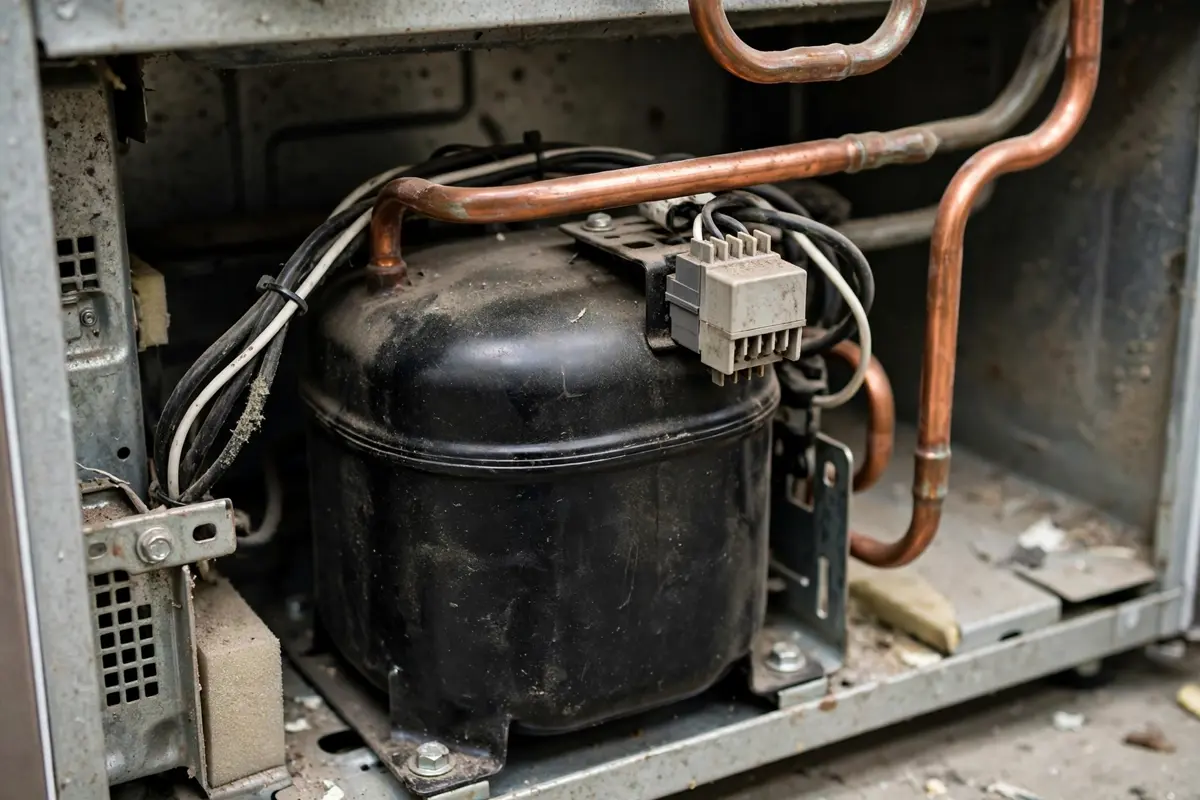
8. The Start Relay or Compressor Has Failed
The start relay gives the compressor its initial boost at the beginning of each cooling cycle. When it fails, you get a very distinctive symptom: a clicking sound from the back of the refrigerator every few minutes — the relay tries to start the compressor, fails, the overload protector trips, and the cycle repeats. The compressor never actually runs, so no cooling is produced at all; both sections warm up together.
A failed start relay is one of the more affordable professional repairs, and it is worth ruling out before assuming the worst. The relay is a small, inexpensive part mounted on the side of the compressor — a technician can test it in minutes. Some failures are visible: a burnt smell or rattling when you shake the removed relay both point to failure.
If the relay tests good but the compressor still will not run — or runs without cooling, hums excessively, or overheats — the compressor itself is the problem. Compressor replacement is sealed-system work requiring refrigerant certification; it is always professional work, and on an older refrigerator it may cost enough that replacement makes more sense. See our repair-or-replace guide if you are weighing that decision.
9. The Main Control Board Has Failed
Modern refrigerators route everything through a main electronic control board: it reads the sensors, starts the compressor, runs the fans, and schedules defrost cycles. When the board fails — a burned relay, a cracked solder joint, a surge-damaged component — the symptoms are often erratic: the freezer works some days and not others, error codes blink on the display, or one section misbehaves while everything else tests fine.
Control-board failure is a diagnosis of exclusion: a technician rules out the thermostat, sensors, fan, defrost components, and start relay first, because replacing a board when the real problem is a cheap fan is an expensive mistake. Before calling, try unplugging the refrigerator for five minutes to power-cycle the board — that resolves the occasional software glitch after a surge or outage.
If the reset does not help and the erratic behavior continues, professional diagnosis is the next step. Boards are model-specific and must be programmed or configured for some brands, so this is not a part to order on guesswork.
After a power outage: give the refrigerator a full 24 hours to recover before concluding anything is broken. Compressor protection circuits delay restart, and a warm freezer needs time to pull back down to 0°F. If it has not recovered after 24 hours, work through the causes above.
How to Diagnose a Freezer That Is Not Freezing
Follow these steps in order. Each one rules out a cause before you move to the next, so you do not waste time — or money on parts — chasing the wrong problem.
Step 1: Verify the Temperature Setting
Confirm the freezer is set to 0°F with no vacation, eco, Sabbath, or demo mode active. Place a freezer thermometer inside for several hours; if it reads above 0°F, lower the setting and allow 24 hours to stabilize.
Step 2: Clear Blocked Vents
Pull food away from the rear-panel vents and leave a couple of inches of clearance. If the vents are caked with frost rather than blocked by food, you are looking at a defrost problem.
Step 3: Test the Door Seal
Run the dollar-bill test around the door perimeter and clean the gasket with warm soapy water. Reseat or replace the gasket if the bill slides out without resistance anywhere.
Step 4: Clean the Condenser Coils
Unplug the refrigerator and vacuum the condenser coils thoroughly with a brush attachment. Plug it back in and allow several hours; noticeably improved cooling confirms the coils were the bottleneck.
Step 5: Check the Evaporator Fan
Open the freezer door, press the door switch by hand, and listen. A running fan confirms airflow; silence, clicking, or grinding points to a failed fan motor or iced-over blades. This step separates airflow failures from sealed-system failures.
Step 6: Look for Frost Choking the Evaporator Coils
If the fan is silent or the rear panel is frosted, the evaporator coils are likely iced over — the signature of defrost system failure. Unplugging for 24 to 48 hours restores cooling temporarily, but the failed defrost component still needs repair.
Step 7: Listen for the Start Relay Click
Put your ear to the back of the refrigerator. A repetitive click every few minutes with no compressor hum means the start relay is trying and failing to start the compressor — a classic relay failure and one of the cheaper professional fixes.
Step 8: Reset the Control Board
Unplug the refrigerator for five minutes to power-cycle the electronics. If erratic behavior persists after the reset, you have ruled out a software glitch.
Step 9: Decide Between Repair and a Service Call
By this step you have ruled out settings, vents, seals, coils, and simple airflow problems. Remaining suspects — defrost components, fan, thermostat, relay, compressor, and control board — need electrical testing and model-specific parts: professional diagnosis territory.
Tools Needed and Time Estimates per Fix
Knowing what each fix involves helps you decide what to attempt yourself and what to hand to a technician.
| Fix | Tools Needed | Typical Time |
|---|---|---|
| Check and adjust temperature setting | Freezer thermometer | 5 minutes active, 24 hours to stabilize |
| Clear blocked air vents | None | 5–10 minutes |
| Dollar-bill seal test and gasket cleaning | Warm soapy water, cloth | 10–15 minutes |
| Vacuum condenser coils | Vacuum with brush attachment, coil brush | 15–30 minutes |
| Full manual defrost (temporary fix) | Towels, cooler for food | 24–48 hours unplugged |
| Replace door gasket | Nut driver or screwdriver (model-specific) | 30–60 minutes |
| Replace evaporator fan motor | Nut driver, careful panel removal | 45–90 minutes; moderate DIY |
| Diagnose and repair defrost system | Multimeter, electrical experience | Professional service |
| Test or replace start relay | Multimeter, replacement relay | Professional service recommended |
| Diagnose control board | Multimeter, wiring diagram | Professional service |
Time estimates assume a straightforward freestanding model. Built-in and counter-depth refrigerators can take longer because access to the back and the interior panels is tighter.
Freezer Troubleshooting by Symptom
Match what you are seeing to the most likely causes. Start with the easiest explanation in each row before moving to part replacement.
| What You Notice | Most Likely Causes | Check First |
|---|---|---|
| Ice cream soft, everything slightly thawed | Setting too warm, dirty condenser coils | Temperature setting, then coils |
| Fridge cold, freezer warm | Defrost failure, failed evaporator fan | Fan sound test, then frost on rear panel |
| Both sections warm, compressor always running | Dirty condenser coils, failing compressor | Clean coils, then call a pro |
| Clicking every few minutes, no cooling | Failed start relay | Professional relay test |
| Heavy frost on freezer rear panel | Defrost system failure, bad door seal | Defrost components, then seal test |
| Uneven freezing, some items fine, some thawed | Blocked vents, overpacking | Clear vents, redistribute food |
| Freezer works intermittently, error codes | Control board, sensor glitch | Power-cycle reset, then pro |
| Freezer stopped after a power outage | Board glitch, compressor protection delay | Wait 24 hours, then reset |
Safety Warnings Before You Start
Freezer troubleshooting is safe when you respect electricity and sharp edges.
- Unplug the refrigerator before removing any rear access panel or interior cover. Line voltage is present at the compressor, start relay, and control board even when the compressor is not running, and start capacitors can hold a charge.
- Never chip at frost with a knife, screwdriver, or other sharp tool. It is easy to puncture an evaporator coil or a refrigerant line hidden under the frost. A punctured sealed system turns a routine repair into a major one and releases refrigerant you should not breathe.
- Use only low heat when thawing a frost-blocked compartment. High heat can warp plastic liners, damage wiring insulation, and crack glass shelves.
- Move food safely. A full manual defrost means unloading the freezer into insulated coolers — lift with your legs, not your back.
- Stop immediately if you smell burning plastic, see scorch marks, or notice sparking. Unplug the refrigerator and call a professional.
Food safety is not optional: perishable food held above 40°F for more than two hours should be discarded — thawing and refreezing does not make it safe again. A freezer thermometer removes the guesswork: check the highest temperature the compartment reached before deciding what to keep.
Central Oregon Factors That Affect Freezers
Freezers fail for the same mechanical reasons everywhere, but a few local conditions in the Bend area make certain failures more common here than the national averages suggest.
High-Desert Dust on Condenser Coils
Central Oregon’s dry, dusty air coats condenser coils fast. Dusty coils make the sealed system work harder and can push freezer temperatures marginally higher — sometimes just enough to soften food while the fridge still seems fine. In Bend-area homes, vacuuming the coils twice a year is genuinely preventive maintenance, especially with pets or nearby construction.
Garage Freezers and Cold Snaps
Second freezers in Bend garages, shops, and outbuildings face a different problem: in deep winter the compressor may rarely run, and many units in unheated spaces struggle with temperature swings. If a garage unit quits freezing in winter but works the rest of the year, ambient conditions are the likely explanation rather than a failed part. Our guide on garage refrigerators in cold weather explains the mechanism and the alternatives.
Power Outages and Summer Heat
Central Oregon sees both winter storm outages and hot, smoky late-summer stretches. Outages trip control boards into protection delays and error states — give the refrigerator a full 24 hours to recover before diagnosing anything. During heat waves, a refrigerator parked against a sun-warmed wall or in a hot garage works measurably harder; extra clearance behind the unit for condenser airflow pays off exactly when the system is under the most stress.
How to Keep Your Freezer Freezing Reliably
A few low-effort habits prevent most freezer failures.
These steps take minutes and address the root causes behind most freezer service calls. Our seasonal appliance maintenance checklist folds them into your regular home care.
Freezer Repair: DIY or Professional Service?
Use this table to decide what to handle yourself and what to hand to a technician.
| Repair Task | DIY Suitability | Professional Help |
|---|---|---|
| Check and adjust temperature setting | Good | Usually unnecessary |
| Clear blocked air vents | Good | Usually unnecessary |
| Dollar-bill seal test and gasket cleaning | Good | Usually unnecessary |
| Vacuum condenser coils | Good | Usually unnecessary |
| Power-cycle reset after outage | Good | Usually unnecessary |
| Replace door gasket | Moderate | Helpful to get the right part |
| Replace evaporator fan motor | Moderate | Recommended for most homeowners |
| Diagnose defrost system components | No | Yes |
| Test or replace start relay | No | Yes |
| Compressor or sealed-system work | No | Yes — certified only |
| Diagnose control board | No | Yes |
The key rule is simple: DIY the diagnosis and the simple fixes; let a professional handle electrical testing, sealed-system work, and part replacement when you are unsure. A correct diagnosis from your own troubleshooting makes the service visit faster and cheaper.
When Should You Call a Freezer Repair Technician?

Call a technician when your own troubleshooting has ruled out the simple causes — setting, vents, seal, and condenser coils — and the freezer still will not hold 0°F. The remaining suspects are the defrost components, evaporator fan, thermostat, start relay, compressor, and control board, all of which benefit from professional testing and correct part sourcing.
Call sooner — without further DIY attempts — for a burning smell, sparking, a compressor that clicks but never starts, or a sealed system you suspect has been punctured. Unplug the refrigerator first if there is any sign of electrical trouble.
For homeowners in Bend, professional refrigerator repair starts with your symptoms: tell the scheduler what you have already checked — for example, “the fridge is cold but the freezer is warm” or “it clicks every few minutes.” That detail often resolves the problem in a single visit.
Frequently Asked Questions About a Freezer Not Freezing
What temperature should my freezer be?
0°F (−18°C). That is the temperature at which food stays safely frozen for its full storage life. A few degrees warmer and ice cream softens; several degrees warmer and food begins a slow thaw. Verify with a freezer thermometer rather than trusting the display alone.
Why is my refrigerator cold but my freezer not freezing?
This is the textbook sign of a freezer-side airflow failure: most commonly defrost system failure (frost choking the evaporator coils) or a failed evaporator fan motor. The fridge stays cool by convection from whatever cold air still makes it through, but the freezer cannot hold 0°F without full airflow. Check the fan with the door-switch test and look for heavy frost on the freezer’s rear panel.
How long will food stay safe in a freezer that stopped freezing?
As a general guide, a full freezer keeps food safe for about 48 hours if the door stays closed, and about 24 hours if it is half full. Perishable food that has been above 40°F for more than two hours should be discarded — when in doubt, throw it out. A freezer thermometer tells you the highest temperature reached so you are not guessing.
Will unplugging the freezer to defrost it fix the problem?
A full manual defrost — 24 to 48 hours unplugged with the doors open — melts frost-choked coils and temporarily restores cooling, which is useful to save your food right now. But if a defrost component failed, the frost comes back within weeks. Treat the manual defrost as a stopgap and have the defrost heater, thermostat, and timer tested to fix it permanently.
My freezer stopped freezing after a power outage. What should I do?
First, wait a full 24 hours — compressor protection circuits delay restart and a warm freezer needs time to pull back down to 0°F. If it has not recovered, unplug it for five minutes to reset the control board, then check the breaker. Persistent failure after that points to a board or component damaged by the surge.
Why does my freezer keep clicking every few minutes?
That click is almost always the start relay trying — and failing — to start the compressor. The overload protector trips, the relay retries a few minutes later, and the cycle repeats with no cooling produced. A failed start relay is a relatively affordable professional repair, but do not keep letting it cycle indefinitely; call a technician to test the relay before the compressor itself is stressed further.
Should I repair my freezer or replace the refrigerator?
It depends on age and the failed part. Simple fixes — settings, coils, seals, relays — are almost always worth doing at any age. But on a refrigerator past about 15 years, a compressor or sealed-system failure can cost enough that replacement makes more financial sense. Our repair-or-replace guide walks through the math.
Freezer and Refrigerator Repair in Bend, OR
A freezer that will not freeze is often the first sign of a developing problem with the defrost system, airflow, or controls — catching it early usually means a simpler repair and less food loss.
We serve homeowners throughout Bend — including Northwest Crossing, Awbrey Butte, Boyd Acres, Larkspur, River West, Mountain View, Summit West, Orchard District, and Southern Crossing — as well as appliance repair in Redmond, Oregon and surrounding Central Oregon communities. Describe what you have already checked using the steps above; it helps the technician diagnose the problem faster, often in a single visit.
Final Takeaway
A freezer not freezing is usually an airflow or temperature problem, not a dead refrigerator. Start with the setting, the vents, the seal, and the coils — then use the fan test and the frost check to pin down the defrost system, the evaporator fan, or the sealed system.
Watch food safety closely while you diagnose, treat burning smells and repeated clicking as stop-and-call signals, and do not chip at frost with sharp tools. When the simple checks do not resolve it, professional diagnosis is the sensible next step.
Freezer Still Not Freezing?
If the troubleshooting steps haven’t solved the problem, our technicians can diagnose the actual cause — defrost system, fan, thermostat, relay, or control board — and give you a clear, upfront repair estimate before any work begins.