
Repair or Replace Your Refrigerator? A Bend, OR Guide
A warm fridge or a dead compressor forces a big question: fix it or buy a new one? This guide gives you the same decision framework technicians use. You will learn the 50%-rule, typical age ranges, and five factors that settle the call. That way, you decide with confidence instead of guessing.

Start Here: The Decision Every Fridge Owner Eventually Faces
Every refrigerator reaches a crossroads. It might stop cooling overnight, the compressor might start screaming, or the repair quote might come back higher than expected. Suddenly you are asking the question every homeowner eventually asks: should I repair or replace my refrigerator?
The stakes are real. Guessing wrong costs money in both directions. Replacing a refrigerator that had years of life left wastes a major appliance and the money you paid for it. Pouring repair money into a dying unit just delays the inevitable. The next breakdown usually arrives at the worst possible moment.
Technicians do not guess. They weigh a small set of factors. These include the unit’s age, the repair cost, its overall condition, its efficiency, and parts availability. This guide walks you through that exact framework, written for homeowners in Bend and Redmond, Oregon. You will learn the widely used 50%-rule. You will see how appliance age ranges shape the call. You will also learn to read the signs that point toward repair or replacement.
One important note: this is a decision guide, not a troubleshooting manual. If your refrigerator is running but not cooling, or leaking water, those problems each have their own fixes. This guide helps you decide whether fixing them is worth it. When you are ready for a firm quote, professional refrigerator repair in Bend gives you the real repair number. That number lets you apply the 50%-rule.
Table of Contents — Tap to Jump to a Section
- 01 Introduction
- 02 The Quick Answer
- 03 The 50%-Rule Explained
- 04 Typical Appliance Age Ranges
- 05 The 5-Factor Decision Framework
- 06 Repair Is the Smart Call When…
- 07 Replacement Wins When…
- 08 Major Part Failures
- 09 Energy Efficiency Math
- 10 What a Technician Checks
- 11 What a Diagnosis Gives You
- 12 Disposal and Recycling
- 13 When to Call a Technician
- 14 FAQ
- 15 Bend & Redmond Service
- 16 Final Takeaway
Should I Repair or Replace My Refrigerator? The Short Version
If you want the short answer to “should I repair or replace my refrigerator,” here it is. Repair usually wins for a relatively young refrigerator. It also wins when the fix costs less than half the price of a comparable new one. Replacement usually wins for an old unit with a major failure. It wins when breakdowns keep repeating. Everything below is just the reasoning behind those sentences.
- Lean toward repair if your refrigerator is under roughly 8 to 10 years old. This applies when the failed part is minor — a fan, thermostat, gasket, or inlet valve. The quote should be well under half the replacement cost. The fridge should otherwise be reliable.
- Lean toward replacement if the refrigerator is past roughly 15 years. This applies when the failure involves the compressor or sealed system. It also applies after two or more recent repairs. Parts being hard to find is another clear signal.
- Get a real quote first. The 50%-rule needs an actual repair number to work. A professional diagnosis costs far less than a wrong decision in either direction.
These are widely used rules of thumb, not hard guarantees. A well-maintained premium model can justify a repair at an age where a budget model would be replaced. The five-factor framework in the next sections shows you how to weigh the details for your specific situation.
Do not decide from a symptom alone. “Not cooling” can mean a $15 thermostat or a failed sealed system. The symptom tells you to investigate; the age, cost, and condition tell you whether to repair or replace the refrigerator.
The 50%-Rule: The Industry’s Favorite Shortcut
Ask any experienced appliance technician how they decide. You will hear some version of the same rule. If the repair costs more than half the price of a comparable new refrigerator, replace it. If it costs less than half, repair it. It is that simple — and that is exactly why it has survived for decades in the appliance trade.
The 50%-rule in plain terms: get a firm repair quote. Find the price of a comparable new refrigerator — similar size, style, and features. Then compare the two numbers. Repair above half the replacement cost usually stops making financial sense. You would invest major money into an aging machine with no warranty. A new unit resets the clock completely.
Why does half work as the line? Think of it as a risk adjustment. A repaired older refrigerator has no new warranty and carries the risk of the next failure. Paying more than half the replacement cost for that outcome is a poor trade. You spend most of the price of new. You do not get the lifespan of new. Below half, the math flips. You extend the life of an appliance you already own. You pay a fraction of replacement cost, and the risk stays proportionate.
The rule has limits, and honest technicians will tell you what they are. It assumes the refrigerator is otherwise in normal condition. A quote below half the price means different things in different cases. On a rusted 18-year-old unit with two prior repairs, it is still a gamble. On a 6-year-old unit in great shape, it is a clear repair. Every honest answer to “should I repair or replace my refrigerator” starts with the rule, then adjusts for condition. That is why the 50%-rule is the starting point, not the whole decision. The five-factor framework below is the rest of it.
One more practical point: the comparison must be against a comparable new unit. Comparing a repair quote for a standard top-freezer model against the price of a premium French-door refrigerator distorts the ratio. Match size, configuration, and feature level roughly, and the rule does its job.
Typical Appliance Age Ranges: Where Does Your Refrigerator Stand?
Age is the single most influential factor in the repair-or-replace decision. It tells you how much useful life you are buying with a repair. The ranges below are broad, widely used industry rules of thumb — not manufacturer guarantees and not precise statistics. Brand, build quality, usage, and maintenance all move individual units well above or below these ranges.
| Appliance Type | Typical Service-Life Range | What It Means for the Decision |
|---|---|---|
| Refrigerators | Roughly 10–20 years | The widest range of any major appliance. Simple top-freezer models often outlast complex French-door units with ice and water systems. |
| Freezers (chest and upright) | Roughly 10–20 years | Simple design, few parts — many run for years beyond the range with basic care. |
| Ranges and ovens | Roughly 10–20 years | Few moving parts. Often worth repairing even late in the range if the frame and electronics are sound. |
| Dishwashers | Roughly 8–12 years | Heat, water, and detergent are hard on components. Mid-range repairs on older units deserve scrutiny. |
| Washing machines | Roughly 10–15 years | Top-loaders tend toward the longer end; front-loaders trade longevity for efficiency and gentler washing. |
| Clothes dryers | Roughly 10–15 years | Simple heating appliances. Frequently worth repairing even late, since most failures are minor parts. |
| Microwaves | Roughly 8–10 years | Replacement cost is low, so the repair threshold arrives early. Minor repairs on young units still make sense. |
These are general rules of thumb used across the appliance service industry. Your refrigerator’s real condition matters more than any range on a chart — that is what a technician’s diagnosis establishes.
How to Use the Age Ranges
Think of the ranges as three zones. Early in the range, repair is the default answer. For refrigerators, that means roughly the first 8 to 10 years. Only a catastrophic failure changes the call. Late in the range, replacement becomes the default. That means roughly 15 years and beyond. A repair then needs a strong reason, like a minor part on an otherwise excellent unit. In the middle, the other four factors decide. These are the repair cost ratio, the unit’s condition and history, its efficiency, and parts availability.
Premium and built-in refrigerators deserve special mention. They cost far more to replace than standard models. Their repair threshold sits higher as a result. A repair that looks questionable on a basic top-freezer can be clearly worthwhile on a built-in. That is especially true when the built-in has years of service left.
A Technician’s 5-Factor Framework for Repair vs Replace
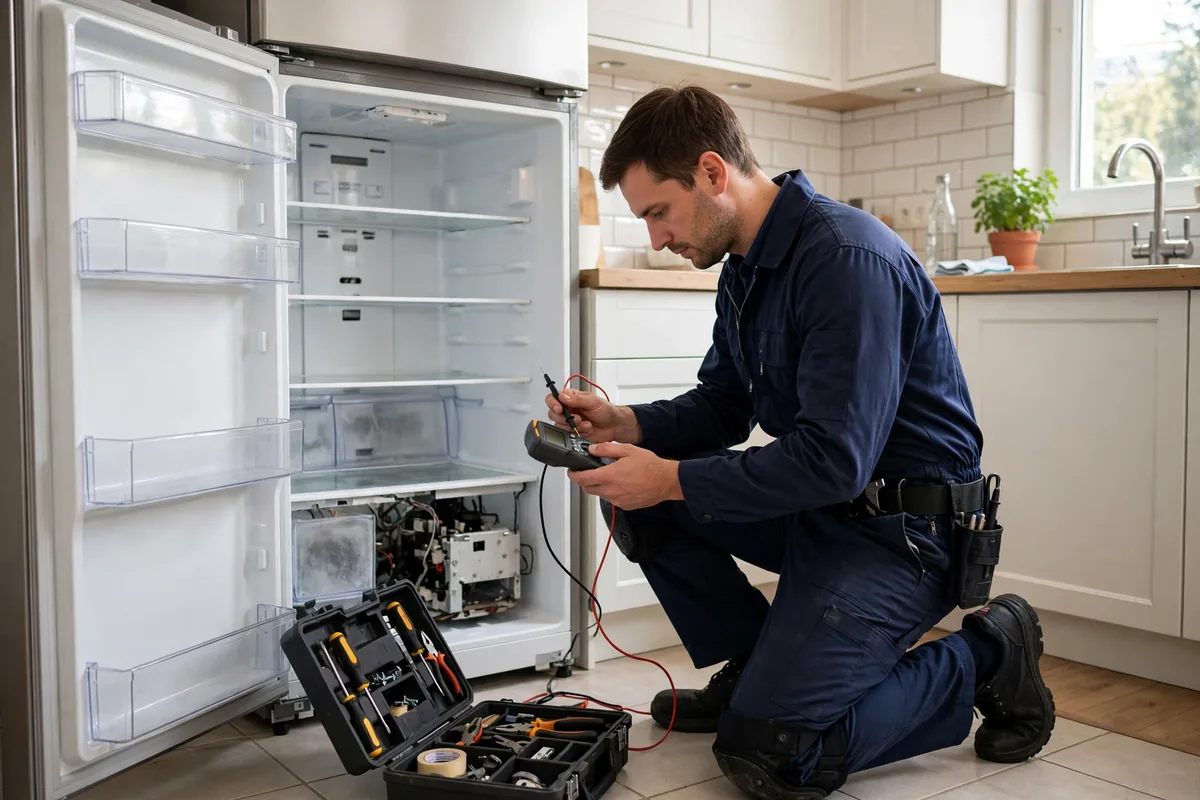
When a homeowner asks should I repair or replace my refrigerator, a good technician runs through five factors before answering. Age gives the context, but these five together give the verdict. Walk through them in order for your own situation.
Age and Remaining Life
The real question is not just “how old is it.” It is “how much useful life does the repair buy?” Fixing a 6-year-old refrigerator likely buys many more years. Fixing a 17-year-old one buys borrowed time — and every other original part is aging on the same schedule.
Repair Cost vs Replacement Cost
This is where the 50%-rule lives. Compare the firm repair quote against a comparable new refrigerator — similar size, style, and features. Under half favors repair. Over half favors replacement. Near the line, the other factors tip it.
Condition and Repair History
A refrigerator with one failure in 9 years is a different patient than one with three repairs in 18 months. Repeated breakdowns signal systemic decline — seals, controls, and cooling parts wearing out together. Track your repair history honestly; patterns matter more than any single failure.
Energy Efficiency
Older refrigerators generally use more electricity than newer models of similar size. If your unit predates modern efficiency standards by a wide margin, the running-cost gap matters. Treat it as a genuine factor favoring replacement. Do not treat it as a precise dollar figure.
Parts Availability
A repair is only possible if the part exists. Manufacturers typically support models with parts for a number of years after production. Still, control boards and model-specific components eventually get discontinued. If a technician says the part is no longer available, the decision makes itself.
How the Factors Combine
No single factor decides alone. A 12-year-old refrigerator needing a minor repair with parts readily available is usually a repair. The same age with a major repair, a history of breakdowns, and a discontinued control board is a replacement. When three or more factors lean the same way, the answer is usually clear. When they split, a professional diagnosis breaks the tie.
Repair Is the Smart Call When…
Repair wins more often than most people expect. A refrigerator is a big, durable machine, and many common failures involve inexpensive parts. When the conditions below line up, fixing it is usually the better financial decision — sometimes by a wide margin.
Why Repair Usually Wins for Younger Refrigerators
Consider what you are really buying. A refrigerator in its first decade has already proven itself. It survived the early-failure window that claims defective units. Replacing it discards that proven reliability and restarts the clock with an unknown machine. A professional repair, done with correct parts and backed by a warranty, simply extends a good thing.
There is also a practical timing factor. A repair can often be completed in a single visit, sometimes the same day you call. Replacing a refrigerator means shopping, measuring, and ordering. Then you wait for delivery and arrange haul-away of the old unit. All the while, your food sits in coolers. When the repair math works, the convenience math usually works too.
Ask “should I repair or replace my refrigerator” about a young unit. With a minor failure, the answer is almost always repair. Spend that energy on getting a proper diagnosis instead. That way, the repair addresses the real cause rather than a symptom.
Replacement Wins When…
Sometimes the honest answer is that a refrigerator has given what it had to give. Recognizing that point saves you from spending good money after bad. It also spares you the slow drip of repeat service calls. Those calls add up to a replacement anyway.
The Repeat-Repair Trap
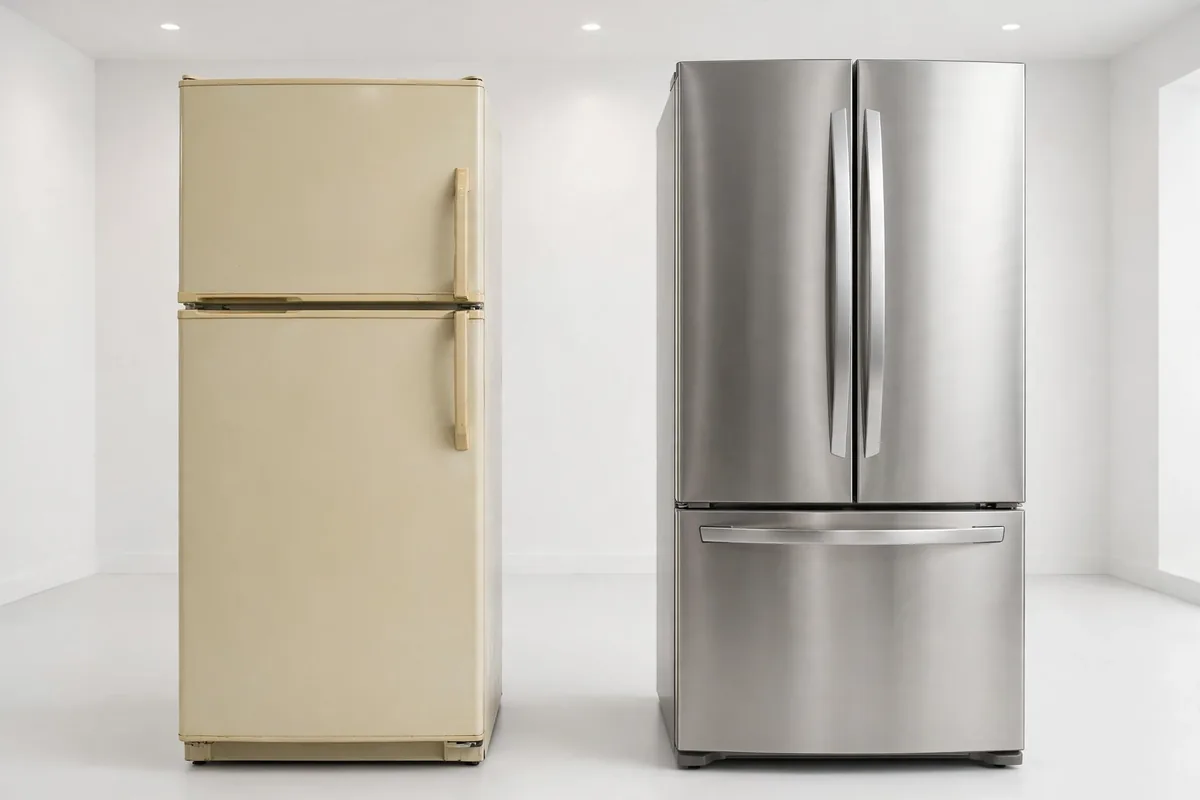
The most expensive mistake homeowners make is not a single bad repair — it is a series of reasonable ones. Each fix looks sensible on its own: a fan here, a thermostat there, a gasket next year. But three repairs over two years often total more than an old refrigerator is worth. You still own a 14-year-old unit with everything else original.
This is why technicians ask about repair history before quoting. If this is your second service call within a year or two, ask the technician directly. Ask: “Would you put this money into this refrigerator?” An honest local technician will give you a straight answer. Their reputation depends on your long-term satisfaction, not on selling one more repair.
Major Part Failures: Compressor, Sealed System, and Control Board
Not all parts are equal. A failed fan and a failed compressor are both “broken refrigerators,” but they lead to very different decisions. Understanding the big three helps you read any quote with a technician’s eyes.
The Compressor
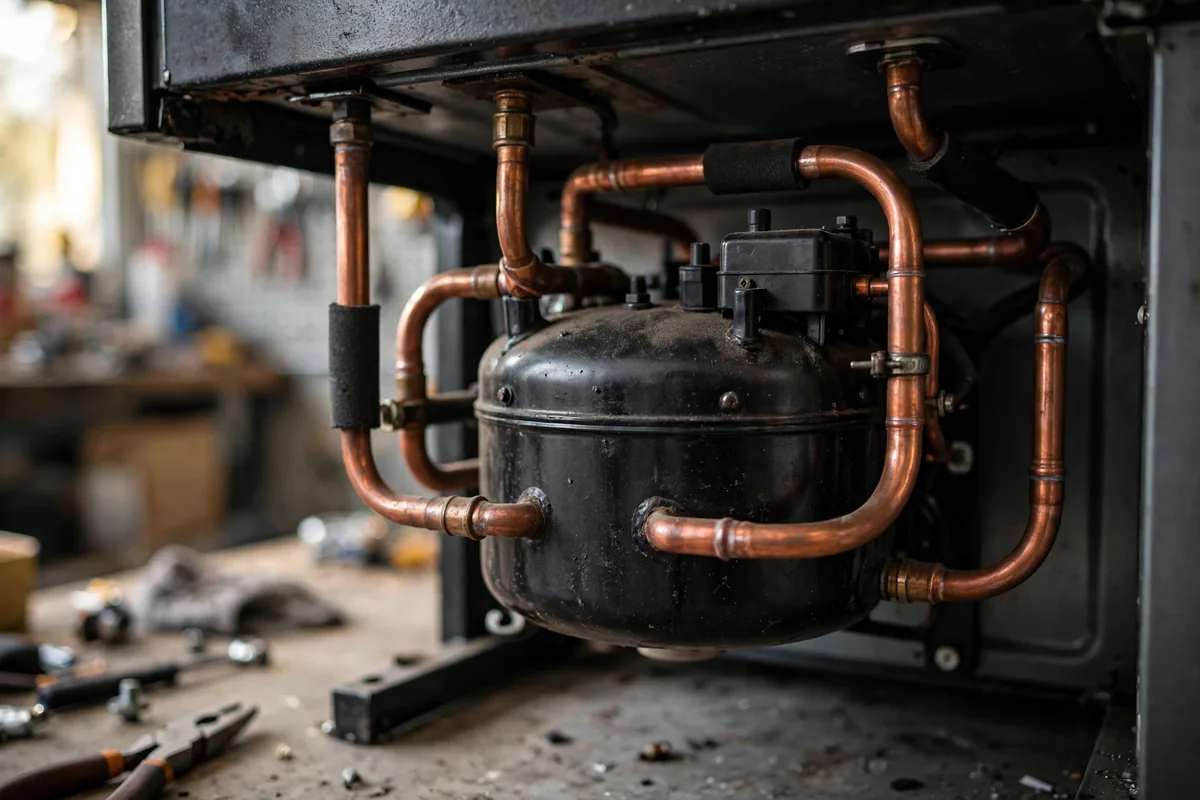
The compressor is the heart of the cooling system — it pumps refrigerant through the sealed system that actually removes heat. It is also one of the most expensive parts to replace. The job requires opening the sealed system and recovering the refrigerant. The technician brazes in the new compressor, evacuates the system, and recharges it precisely. Only licensed technicians with specialized equipment can do this work legally and correctly.
The decision: on a younger refrigerator — roughly under 8 to 10 years — a compressor replacement is often worth it. The sealed system is otherwise healthy. The repair buys many more years. On a unit past 12 to 15 years, the same repair usually fails both tests. It fails the 50%-rule and the age test together. That combination is the classic replacement signal.
Sealed System Leaks
A refrigerant leak in the sealed system — the evaporator, condenser, or the tubing between them — is the other major repair. Finding the leak, repairing it, and recharging the system is skilled, time-consuming work. Like compressor replacement, it makes sense on younger units and rarely makes sense on old ones.
One warning sign deserves attention: a sealed system that has been recharged before and is low again. Refrigerant does not get “used up” — a repeat low charge means a leak that was never properly repaired. Chasing it with another recharge is money lost.
The Main Control Board
Modern refrigerators are run by electronic control boards. Board failures cause some of the most confusing symptoms. These include intermittent cooling, erratic temperatures, or a fridge that works fine for days then misbehaves. The board itself is a moderate-cost part. The real question is availability. Boards for older models get discontinued. A discontinued board on a 12-year-old refrigerator ends the discussion.
The pattern to remember is simple. Minor parts favor repair at almost any reasonable age. Major parts favor repair only on younger units. On older units, major parts favor replacement. When your quote names one of the big three, check the unit’s age first — it usually settles the question.
Energy Efficiency: The Hidden Factor in the Math
Repair quotes and replacement prices are visible. Energy use is not — but it runs 24 hours a day, every day, for the entire life of the appliance. For older refrigerators, efficiency deserves a real seat at the decision table.

Refrigeration technology has improved steadily over the years. Better insulation, more efficient compressors, and smarter defrost controls all help. A modern refrigerator of similar size generally uses noticeably less electricity. The difference is clearest against units built a decade or two earlier. The gap is largest for very old units. Those were built before current efficiency standards. It is smallest for units only a few years old.
How should this affect your decision? Treat efficiency as a tiebreaker and a thumb on the scale, not as the deciding factor by itself. If your refrigerator is 6 years old and needs a minor repair, the efficiency gap is small. Repair wins easily in that case. If it is 18 years old and needs a major repair, the efficiency gap is large. That gap adds one more reason to replace.
When you do shop for a replacement, check the yellow EnergyGuide label. It lets you compare estimated yearly operating costs side by side. Look for the estimated yearly electricity use rather than the marketing claims — the label is standardized, which makes comparisons honest.
Avoid the trap of precision. You will see claims online about exact dollar savings from replacing an old refrigerator. Those figures depend on your electricity rate, your climate, and the specific models compared — treat any precise number with skepticism. The direction is what matters: newer is generally more efficient, and the older your unit, the bigger the gap.
What a Technician Actually Checks During a Diagnosis
A professional diagnosis is more than naming the broken part. A good technician assesses the whole refrigerator. The repair-or-replace decision depends on the unit’s overall health, not just the failed component. Here is what that assessment covers.

Temperature Performance
The technician verifies actual compartment temperatures against accepted targets. The fresh-food section should sit around 37 to 40 degrees Fahrenheit. The freezer should sit near 0 degrees. The technician also checks that temperatures hold steady rather than swinging. A unit that cannot hold temperature even after the failed part is addressed has deeper problems.
Door Seals and Cabinet Condition
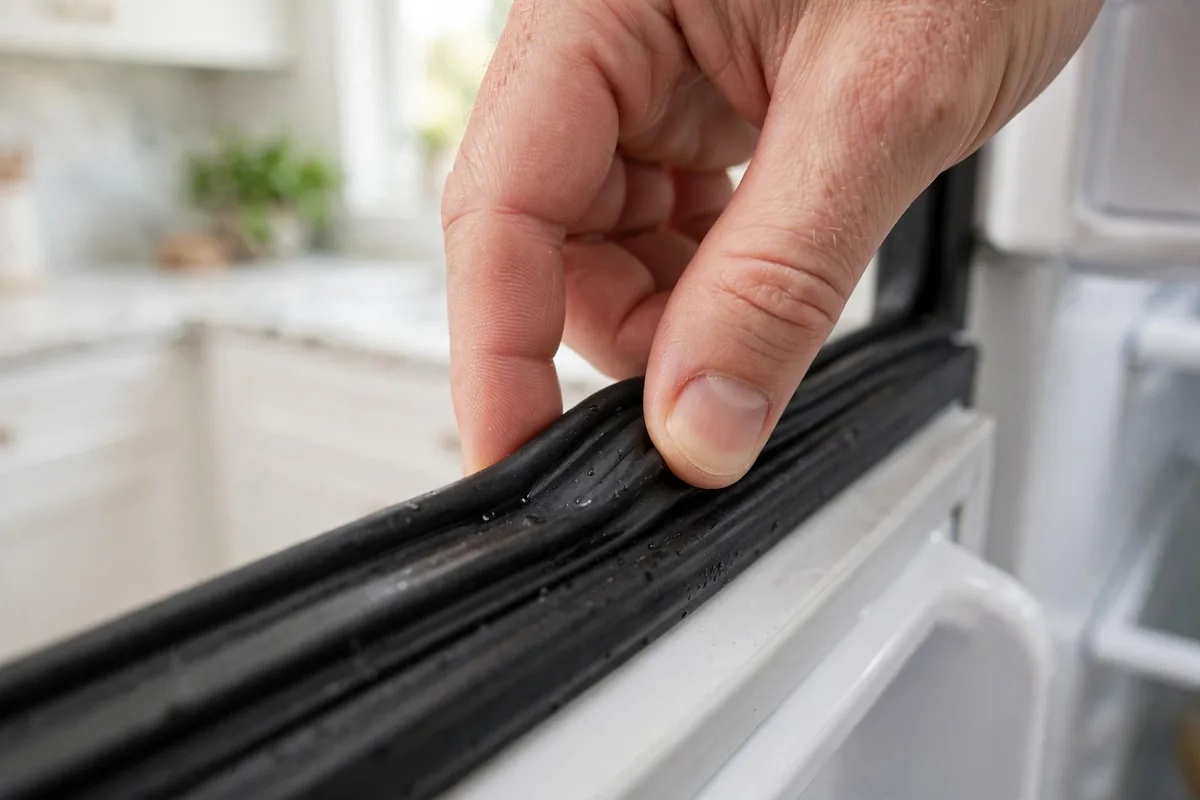
Worn gaskets let cold air escape and force the compressor to overwork, which shortens its life. The technician checks seals all around both doors, looks for interior rust or liner cracks, and inspects the overall cabinet. Structural deterioration is one of the clearest replacement signals, because it cannot be repaired economically.
Sealed System Health
On the back of the unit, the technician listens to the compressor. They check its running current and look for signs of refrigerant issues. Warning signs include oil stains at joints and odd frost patterns on the evaporator. So does a compressor that runs constantly without reaching temperature. Sealed system health is the single biggest factor in how much life a repair buys.
Electrical and Controls
Control boards, sensors, and wiring get tested for correct operation. Intermittent electrical faults are common on aging refrigerators. A technician can tell you whether the electronics are sound. They can also warn you if another board-related failure looks likely.
Condenser Coils and Airflow
Dusty condenser coils are especially common in Central Oregon’s high-desert environment, where fine dust coats everything. The technician checks coil condition and overall airflow. Sometimes poor performance is partly a maintenance issue. That is good news, because it is cheap to fix.
What a Professional Diagnosis Gives You
You cannot apply the 50%-rule without a real repair number, and you cannot judge condition without a trained assessment. A diagnosis visit answers the exact questions behind “should I repair or replace my refrigerator.”
| The Question You Need Answered | What the Diagnosis Tells You |
|---|---|
| What is actually wrong? | The failed part and the root cause — not just the symptom. A correct diagnosis prevents paying for the wrong repair. |
| What will the repair cost, exactly? | A firm, upfront flat quote for parts and labor. This is the number the 50%-rule needs. |
| Is the sealed system healthy? | Compressor condition and refrigerant status. This determines whether the repair buys years or months. |
| Are parts still available? | Whether the manufacturer supports your model, or whether the part is discontinued or backordered. |
| What is the unit’s overall condition? | Seals, cabinet, electronics, and coils assessed together — the full picture, not one part. |
| Is it safe to keep running? | Any electrical, refrigerant, or food-safety concerns that should push the decision one way or the other. |
The diagnosis is the cheapest part of the decision. Knowing exactly what is wrong pays for itself either way. It prevents a wrong repair and a premature replacement. It also prevents repeat visits from a guessed diagnosis.
What Happens to the Old Refrigerator? Disposal and Recycling
If the decision lands on replacement, the old refrigerator still needs a responsible exit. Refrigerators are not ordinary trash. They contain refrigerants and oils that must be handled properly. They are also mostly recyclable steel.

Refrigerant must be recovered by a professional. Federal regulations require that refrigerants be captured, not released into the atmosphere. An old refrigerator should never be cut apart, crushed, or dumped. Appliance recyclers and haul-away services handle this routinely. You do not need to arrange it yourself. You just need to use a service that does it right.
Most of the appliance is recyclable. A refrigerator is largely steel, plus copper, aluminum, and plastics that recyclers separate and process. Recycling keeps hundreds of pounds of material out of the landfill and is the standard end-of-life path for major appliances.
Plan the haul-away before delivery day. Many appliance retailers offer haul-away of the old unit on delivery day. Confirm this when you purchase. Ask specifically that the unit goes to a recycler. If your seller offers no haul-away, check with local waste services. Ask about appliance drop-off options in the Bend and Redmond area. Some municipalities also run periodic appliance collection events.
Never leave it at the curb indefinitely. An old refrigerator sitting outside becomes an eyesore and a hazard for children. With the doors still attached, it is also a genuine entrapment risk. If there will be any delay before pickup, remove the doors or secure them shut.
Repair is also the greener choice when the math supports it. Every year you extend a working refrigerator’s life avoids manufacturing a new one and scrapping an old one. When the 50%-rule and the condition check both favor repair, you make the environmentally sound decision too. It is not just the economical one.
When Should You Call a Refrigerator Repair Technician?
You do not need to finish this guide’s framework alone. In fact, the framework works best with a technician’s input. Two of the five factors require a professional assessment: the real repair cost and the unit’s true condition.
Call for a diagnosis when any major decision is on the table. If you keep asking “should I repair or replace my refrigerator,” a diagnosis breaks the deadlock. A diagnosis gives you the firm number the 50%-rule needs. Guessing at repair costs is how people make the wrong call in both directions.
Call sooner for safety concerns. A burning smell, sparking, a hot power cord, or a refrigerator that trips the breaker should not wait. Unplug the unit if it is safe to do so and call a professional. These symptoms can indicate electrical faults that go beyond the repair-or-replace question.
Call when breakdowns repeat. If this is the second or third service call in a short period, say so when you book. A technician who knows the history can assess the pattern. They can tell you whether it points to systemic decline. You get an honest answer about whether another repair is money well spent.
Call before you shop for a replacement. This surprises people, but it is sound advice. A quick professional assessment can confirm that replacement is truly the right move. A technician can also advise on sizing, configuration, and features. They base that advice on what they see in hundreds of kitchens a year. It is free expertise at exactly the moment you need it.
For homeowners in Bend and Redmond, professional refrigerator repair starts with an honest diagnosis. You learn what failed and what it costs to fix. You also learn whether the unit deserves the investment. That is the information this entire guide is built around — and it is worth getting right.
Frequently Asked Questions: Repair or Replace Your Refrigerator
How do I decide: should I repair or replace my refrigerator?
Use the 50%-rule as your starting point. If the repair quote tops half the price of a comparable new refrigerator, replacement usually makes more sense. Then weigh the other factors — the unit’s age, its repair history, its energy efficiency, and whether parts are still available. When three or more factors lean the same way, the answer is usually clear. A professional diagnosis gives you the firm repair number the rule needs.
What is the 50%-rule for appliance repair?
The 50%-rule is a widely used industry guideline. Repair the appliance if the fix costs less than half the price of a comparable new one. Replace it if the repair costs more than half. It works as a risk adjustment. Above half, you spend most of the price of new. You do not get the lifespan or warranty of new. Compare against a similar size, style, and feature level for the ratio to be meaningful.
How long do refrigerators usually last?
As a broad rule of thumb, refrigerators typically last roughly 10 to 20 years. That is one of the widest ranges of any major appliance. Simple top-freezer models often outlast complex French-door units with ice and water systems, and maintenance matters enormously. Treat the range as context for your decision, not as a prediction. A well-kept 14-year-old refrigerator can outlast a neglected 9-year-old one.
Is it worth repairing a 10-year-old refrigerator?
Often, yes — 10 years sits in the middle of the typical range, so the other factors decide. A minor repair (fan, thermostat, gasket, inlet valve) with a quote well under half the replacement cost is usually worthwhile. A major repair at the same age deserves harder scrutiny. That means compressor or sealed system work. It matters even more if the unit has needed other repairs recently. Check parts availability too, since some components get discontinued around this age.
What refrigerator repairs are almost never worth it?
Compressor or sealed system repairs on refrigerators past roughly 15 years rarely pay back. The repair itself is expensive. The unit is at the end of its expected life. Other original parts are likely to fail next. Repairs are also poor investments when parts are discontinued. The same is true with a rusted cabinet or a cracked liner. It also applies when the unit has already needed multiple repairs in a short span.
Should I repair a refrigerator with a failed compressor?
It depends on age. On a refrigerator under roughly 8 to 10 years old, compressor replacement is often worth it. The sealed system is otherwise healthy. The repair buys many more years. On a unit past 12 to 15 years, the same repair usually fails both tests. It fails the 50%-rule and the age test. That makes replacement the better call. A technician can confirm the sealed system’s overall health before you decide.
Does a new refrigerator really save that much energy?
Newer refrigerators are generally more efficient than older ones of similar size. Better insulation, compressors, and controls make the difference. The gap is largest for very old units. But treat exact savings claims with skepticism, since real savings depend on your electricity rate and the specific models compared. Use efficiency as a supporting factor for replacing a very old unit, not as the sole reason. The yellow EnergyGuide label on new models lets you compare operating costs honestly.
What should I do with my old refrigerator in Bend, OR?
Have it hauled away for recycling. Refrigerants must be recovered by professionals under federal regulations, so never cut apart, crush, or dump an old refrigerator. Many retailers haul away the old unit on delivery day — confirm this when you buy. Otherwise, check with local waste services or the area transfer station for appliance drop-off options. If pickup is delayed, remove or secure the doors to eliminate the entrapment hazard.
Refrigerator Repair and Honest Advice in Bend, OR
The repair-or-replace decision is easier with an honest technician. That means one who will tell you the truth, including when replacement is the better move. That honesty is what local service is for. You get a firm diagnosis and an upfront flat quote. You also get a straight recommendation based on your refrigerator’s actual condition.
We serve homeowners throughout Bend. That includes Northwest Crossing, Awbrey Butte, Boyd Acres, Larkspur, and River West. It also includes Mountain View, Summit West, Orchard District, and Southern Crossing. We handle appliance repair in Redmond, Oregon and surrounding Central Oregon communities too. Tell us the age of your refrigerator and what it is doing. We will give you a clear answer on whether repair makes sense. Every repair we perform is backed by a 90-day warranty.
Final Takeaway
Should I repair or replace my refrigerator? Start with the 50%-rule. A repair under half the price of a comparable new unit usually wins. Over half usually loses. Then check the other four factors — age, condition and repair history, efficiency, and parts availability. Minor parts on a younger, well-kept refrigerator are almost always worth fixing. Major sealed-system repairs on an old, repeatedly serviced unit almost never are.
The single most valuable step is a professional diagnosis. It gives you the firm quote the 50%-rule needs. It also gives an honest assessment of how much life a repair actually buys. With those two pieces of information, the decision stops being a guess — and that is exactly how technicians make it.
Not Sure Whether to Repair or Replace?
Get an honest diagnosis first. Our technicians will tell you exactly what is wrong and what the repair costs. They will also tell you whether your refrigerator deserves the investment. Every repair comes with upfront flat pricing and a 90-day warranty.