Dishwasher Smells Bad? Causes and Deep-Clean Routine for Bend, OR Homes
A dishwasher that smells bad can make the whole kitchen unpleasant — and the odor is usually a sign of buildup, not a broken machine. This guide walks you through the eight most common causes of dishwasher odor, a step-by-step deep-clean routine you can do in about an hour, and how to tell when it is time to call a local technician.

Start Here: Your Dishwasher Should Smell Neutral
Open the dishwasher door. A clean machine smells like … nothing. Not citrus, not detergent, not a faint sourness — just neutral. When a dishwasher smells bad, that neutral baseline is gone, and the odor is telling you something: food debris is trapped somewhere it should not be, moisture is feeding mold or mildew, mineral scale is sheltering bacteria, or dirty water is sitting where clean water should be.
The good news is that a smelly dishwasher is almost never a sign of a dying appliance. In the great majority of cases, the cause is buildup in a spot most homeowners never look at — the filter, the door gasket folds, the spray-arm jets, or the drain connection — and an hour of focused cleaning eliminates the odor completely. No parts, no special tools, and no service call required.
This guide is written for homeowners in Bend, Oregon and the surrounding Central Oregon area. It covers how to identify the cause from the type of smell, the eight most common sources of dishwasher odor, a complete deep-clean routine with Central Oregon’s hard water in mind, and clear guidance on when professional dishwasher repair in Bend is the right move.
Table of Contents — Tap to Jump to a Section
- 01 Introduction
- 02 Why It Smells Bad
- 03 Diagnose by Smell
- 04 8 Common Causes
- 05 Dirty or Clogged Filter
- 06 Food Trapped in Spray Arms
- 07 Mold on the Door Gasket
- 08 Drain Hose Problems
- 09 Hard Water Scale
- 10 Infrequent Use
- 11 Detergent Issues
- 12 Burning Smell Causes
- 13 Deep-Clean Routine
- 14 Prevention Routine
- 15 Central Oregon Factors
- 16 DIY or Pro?
- 17 When to Call a Pro
- 18 FAQ
- 19 Bend & Redmond Service
- 20 Final Takeaway
Why Does My Dishwasher Smell Bad?
The most common reasons a dishwasher develops a bad smell are:
- A dirty or clogged filter at the bottom of the tub, holding rotting food particles.
- Food trapped in the spray-arm jets or in crevices around the racks and door.
- Mold or mildew growing in the folds of the rubber door gasket.
- Standing water or a misconfigured drain hose — a missing high loop or a garbage disposal connection letting dirty water flow back in.
- Hard water scale and mineral film coating the tub interior and sheltering odor-causing bacteria.
- Infrequent use, letting dirty dishes and residual water sit for days.
- Wrong or excessive detergent, leaving soap scum that traps food residue.
- A burning smell, which is different — usually melted plastic on the heating element, and occasionally an electrical or motor fault.
Start with the filter, the gasket, and one hot vinegar cycle — those three steps resolve most odor complaints without any further work.
Smell something burning? Skip the troubleshooting below. Stop the cycle, check the heating element for melted plastic, and do not keep running the dishwasher if the smell persists or smells electrical. That situation is covered separately in the burning-smell section.
Diagnose the Smell: What Each Odor Usually Means
Different smells point to different problems. Match what you are smelling to the likely cause before you start cleaning — it tells you exactly where to look first.
| The Smell | Likely Cause | Check First |
|---|---|---|
| Musty, mildewy, or damp | Mold or mildew in the door gasket folds, on racks, or in a dirty filter | Door gasket and filter |
| Rotten egg or sewage | Standing water, clogged or kinked drain hose, missing drain hose high loop, garbage disposal backflow | Drain hose routing and disposal connection |
| Sour or sour milk | Decaying food particles in the filter or spray arms — especially dairy or egg | Filter, then spray arms |
| General funk or stagnant water | Infrequent use, standing water, greasy film on tub walls | Usage pattern and tub interior |
| Fishy | Bacterial growth on old food residue trapped in seals or the filter | Filter and gasket folds |
| Chemical or plastic | Detergent residue or off-gassing from a new dishwasher (first few cycles) | Detergent amount; fades with use on new units |
| Burning plastic | Utensil or plastic lid fallen onto the heating element | Bottom of the tub and element |
| Burning electrical or rubber | Motor strain, failing pump, or wiring fault | Stop and call a professional |
8 Common Causes of a Dishwasher That Smells Bad
Every cause below is covered in its own section with what to look for and exactly how to fix it. Read the overview, then jump to the causes that match your smell.
Almost every dishwasher odor traces back to one of three ingredients: trapped food, trapped moisture, or trapped minerals. A modern dishwasher is a sealed, warm, wet box — the perfect environment for bacteria, mold, and mildew if any of those ingredients sit around long enough. The eight causes below are ordered roughly from most common to least common, based on what technicians see on real service calls.
Dirty or Clogged Filter
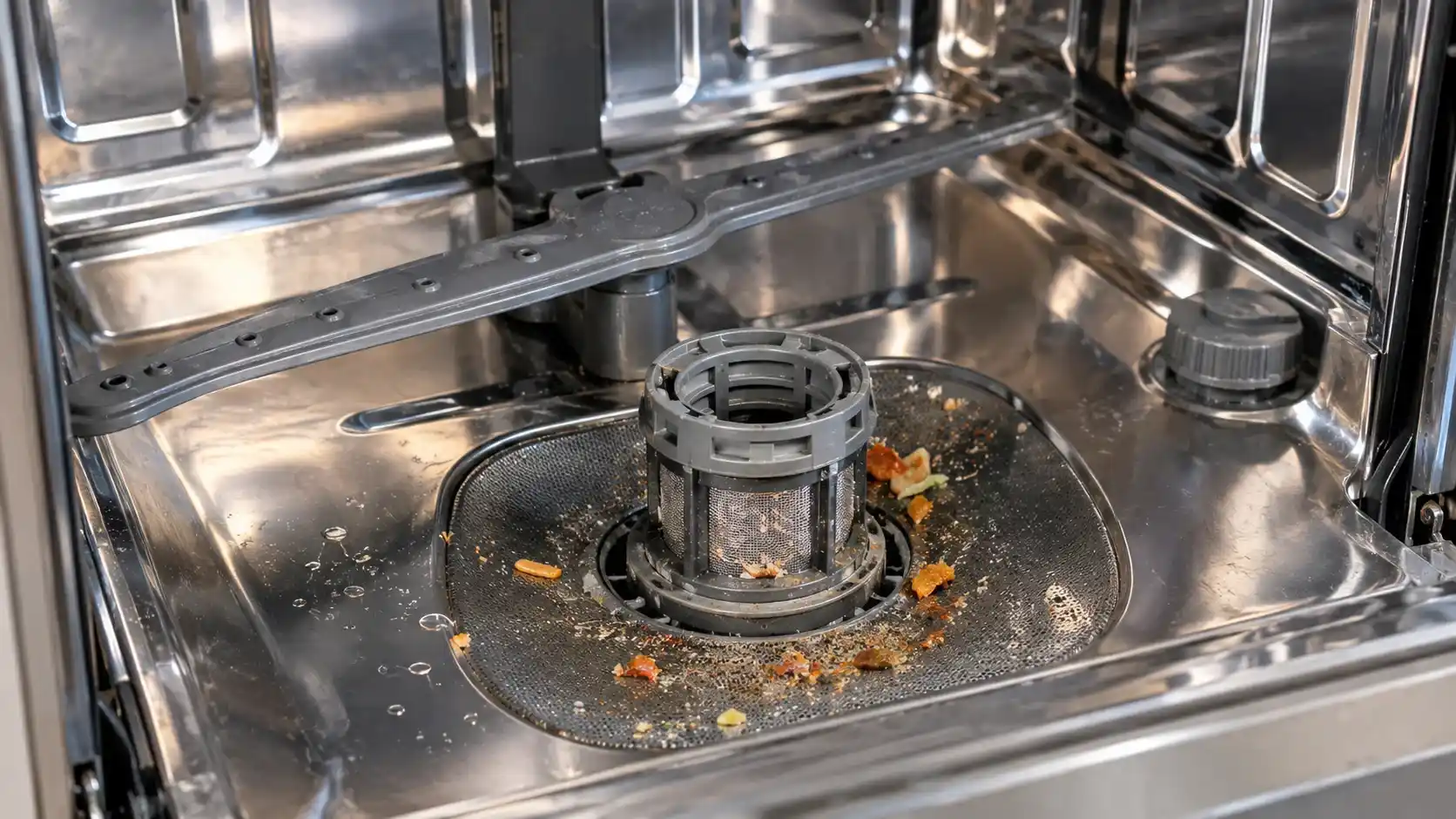
The filter at the bottom of the dishwasher tub is the single most common source of dishwasher odor. Its job is to trap food particles so they do not recirculate onto your dishes. Every cycle deposits grease, starch, dairy, and protein residue in that filter — and if it is not cleaned regularly, the trapped material decomposes. That decomposition is exactly the sour, musty, or rotten smell you notice when you open the door.
Many homeowners have never removed their dishwasher filter. Modern machines with self-cleaning filter systems are the exception rather than the rule; most models sold in the last two decades have a manual filter that the manufacturer expects you to clean. Check your owner’s manual for the exact location and removal method — typically it is a cylindrical assembly at the very bottom of the tub that twists counterclockwise to release.
Cleaning it is straightforward: pull the filter out, rinse it under hot water, and scrub both the mesh and the plastic housing with an old toothbrush or a soft brush and dish soap. Pay attention to the fine mesh, where a paste of grease and particles collects out of sight. If the filter is cracked, warped, or the mesh is torn, replace it rather than continuing to clean it — a damaged filter lets food pass through to the pump and spray arms, creating new problems.
How often? A monthly scrub is a reasonable baseline for most households. If you rarely scrape plates, have hard water, or run the dishwasher less than three times a week, clean it every two to three weeks instead. This one habit prevents more odor complaints than any other maintenance step.
Food Trapped in Spray Arms and Crevices
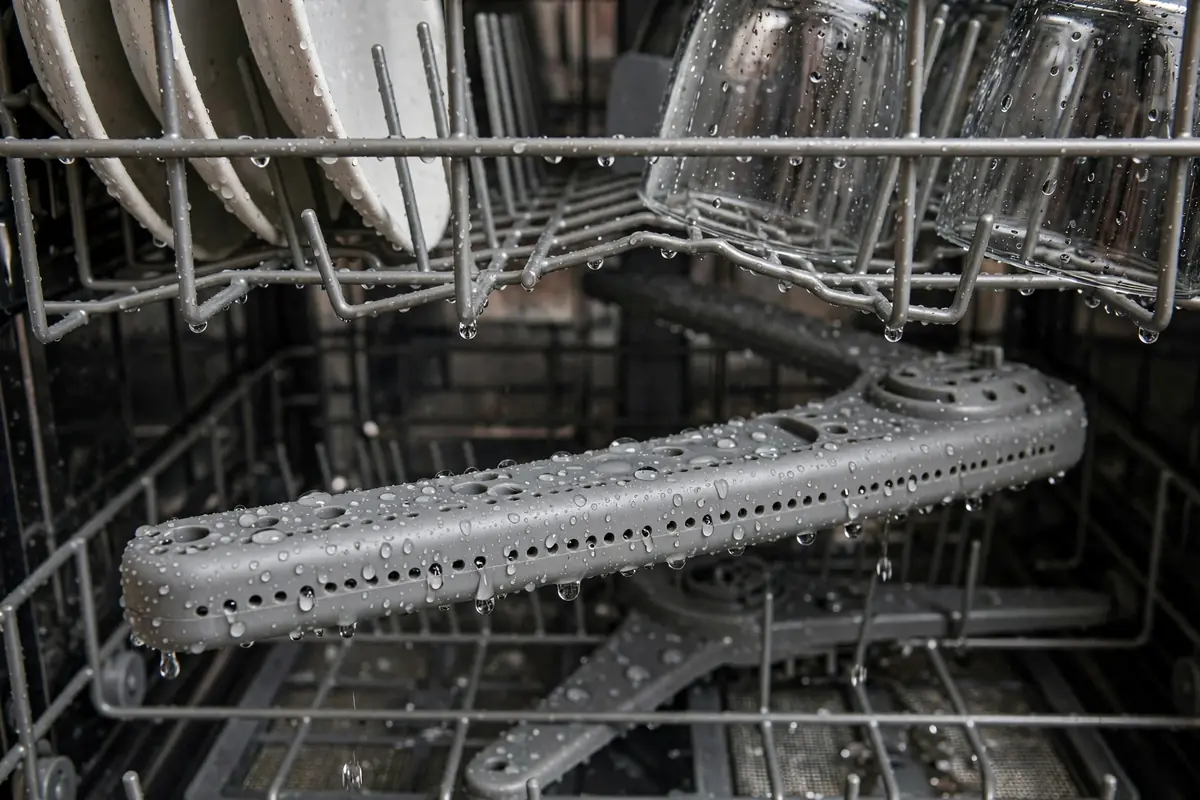
The spray arms — the rotating bars above and below the racks — push water through dozens of small jets. Those jets clog. A seed, a bit of label adhesive, or a rice grain can plug a hole, and the trapped debris then rots in place while the arm keeps spinning around it. Beyond the smell, clogged jets also weaken spray pressure, so dishes come out dirty even though the machine runs a full cycle.
Pull the lower spray arm off its mount — most lift straight up or unscrew with a quarter turn — and hold it under running water while rotating it. For the upper arm, unclip or unscrew it from the top rack. Use a toothpick, a soft wire, or a pipe cleaner to poke out anything lodged in the jet holes, then rinse thoroughly. If you cannot get an arm fully clear, soak it for twenty minutes in a sink of hot water with a cup of white vinegar; the vinegar loosens mineral bonds holding debris in place.
Do not stop at the arms. Check the door sill, the corners where the door meets the tub, the edges of the racks, and the cutlery basket. Food hides in all of these spots, especially if plates are loaded with heavy soil. A quick wipe of these crevices with a vinegar-dampened cloth during your monthly cleaning catches most of it.
One habit makes a bigger difference here than most people expect: scraping — not rinsing — dishes before loading. Modern detergents are formulated to work with some food soil, and a full rinse wastes water and can actually make detergent less effective. Just scrape off the chunks and load the rest.
Mold and Mildew on the Door Gasket
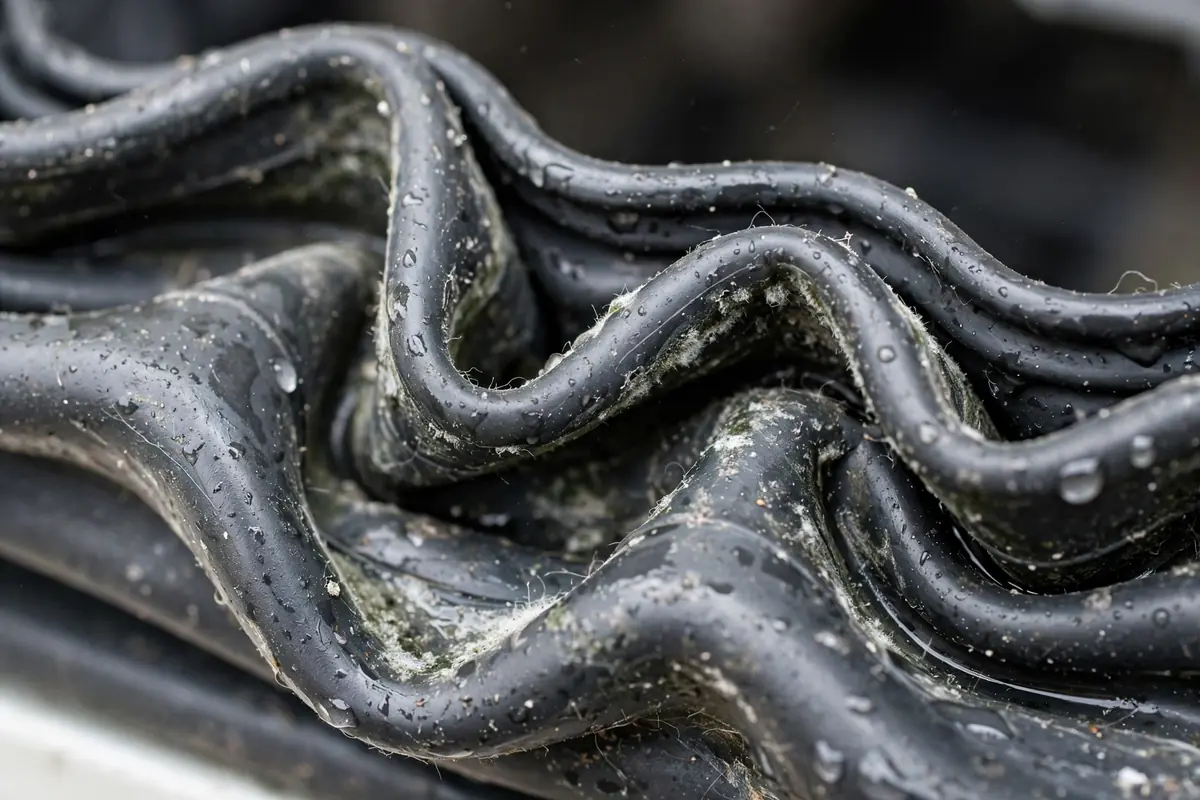
The rubber door gasket stays damp between cycles. Its folds are dark, warm, and rarely cleaned — ideal conditions for mold and mildew. A musty or “wet dog” smell coming from an otherwise clean dishwasher almost always traces back to these seals. Peel the gasket folds back with your fingers and look: black or pinkish spotting confirms it.
Cleaning is simple but needs to be thorough. Mix equal parts white vinegar and warm water, dampen a cloth or an old toothbrush, and scrub every fold of the gasket around the entire door — top, sides, and bottom. For stubborn spotting, let a vinegar-soaked cloth sit on the area for ten minutes before scrubbing. Wipe dry afterward; leaving the gasket wet defeats the purpose.
The habit that matters most here costs nothing: leave the door slightly ajar after every cycle. Even a one-inch gap lets steam escape instead of condensing on the seals and tub walls. If you have small children and a latched door is a safety concern, run the dishwasher right before bed and crack the door once you are up, or use the machine’s fan-dry or vented-dry option if it has one.
Inspect the gasket once a year for cracks, flattening, or loose sections. A damaged gasket does more than harbor mold — it lets water escape during the cycle, and that kind of leak shows up on the floor or in the cabinet below. A gasket that is torn or will not seal flat is a repair, not a cleaning task, and it is a straightforward one for a technician.
Drain Hose and Garbage Disposal Connection Problems
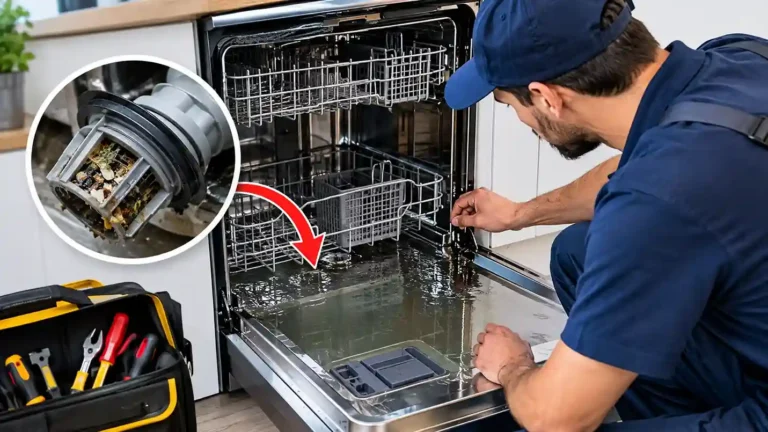
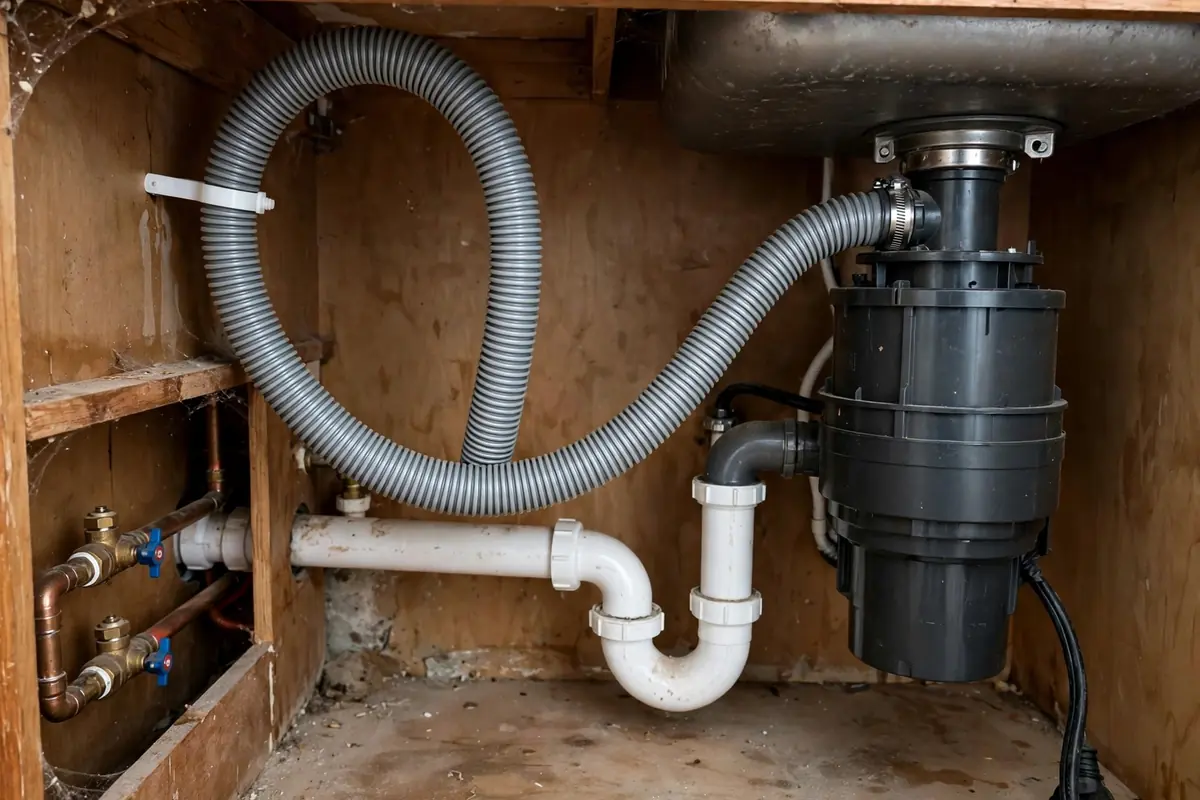
A rotten-egg or sewage smell usually points past the tub and into the drainage. The dishwasher drain hose carries dirty water from the machine to the sink drain or garbage disposal. If that hose is kinked, clogged, or routed incorrectly, dirty water pools in the hose or even flows back into the tub — and the smell of a sink drain ends up inside your dishwasher.
The most common installation error is a missing high loop. The drain hose must rise up and be secured high under the countertop before it drops down to the drain connection. That elevated loop works like a trap: it keeps sink and disposal water from siphoning back into the dishwasher. If the hose runs flat or downhill the whole way, every time the sink drains, dirty water can flow backward into the machine. Look under the sink and check — if there is no high loop, or the hose has sagged, re-secure it with a zip tie or a hose clamp so it arcs up near the underside of the counter.
The second classic culprit is the garbage disposal connection. If your dishwasher drains into the disposal and the disposal is full of old food, that smell travels back up the hose. Run the disposal with cold water for thirty seconds before starting the dishwasher — make it part of the routine. If a new dishwasher was recently installed alongside a new disposal, there is a smaller possibility the installer forgot to knock out the disposal’s dishwasher inlet plug; the symptom there is usually standing water at the bottom of the tub, not just smell.
Finally, look for standing water in the bottom of the tub after a cycle completes. A little dampness is normal; a visible pool that does not drain means the drain path — hose, disposal connection, or the pump — needs attention. Persistent standing water is a good reason to schedule dishwasher service rather than cleaning harder, because a failing drain pump will not fix itself.
Hard Water Scale and Mineral Film
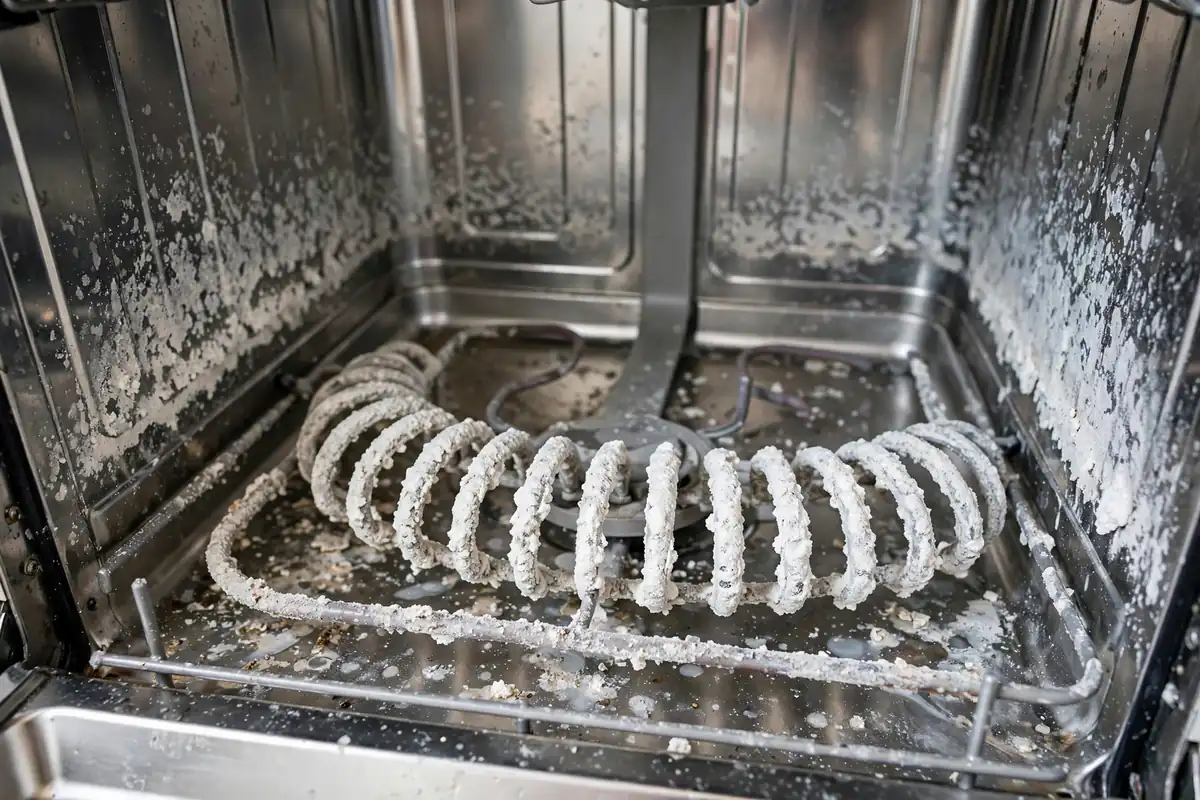
Hard water leaves a chalky mineral film — mostly calcium and magnesium — on the tub walls, the racks, the heating element, and the spray-arm jets. That scale is more than cosmetic: its rough, porous surface traps food particles and grease that would otherwise rinse away, and it shelters odor-causing bacteria through every cycle. If your dishwasher smells faintly funky no matter how well you clean the filter, and the interior looks cloudy or filmed, scale is the likely accomplice.
Central Oregon water tends to run moderately hard, and homes on private wells in the outlying areas often see the heaviest mineral content. If your glasses come out spotty and your faucets crust over with white deposits, your dishwasher is dealing with the same minerals. The cleaning section below includes a descaling step specifically for this — a hot cycle with white vinegar dissolves light scale, and a dedicated dishwasher descaler handles heavy buildup.
For ongoing protection, use a rinse aid every cycle. Rinse aid helps water sheet off surfaces instead of beading and evaporating, which is what leaves minerals behind. If your machine has a water-softener setting or a salt reservoir — common on Bosch and some other European models — keep it filled and set for your local water hardness. For severe well-water scale that returns within weeks, a whole-house water softener is worth discussing with a plumber, since the dishwasher is only one of the appliances the minerals are wearing down.
Do not mistake scale for a cleaning failure: scrubbing a filmed tub with dish soap alone usually makes it worse by adding soap residue to the mineral layer. Acid — vinegar or a purpose-made descaler — is what dissolves mineral deposits.
Infrequent Use and Old Food Residue
Households that take four or five days to fill the dishwasher are especially prone to odor. Dirty dishes sit in a warm, sealed box, and food residue — milk films, egg, meat juices — starts to decompose long before the cycle runs. Add a little residual water in the sump and filter area, and bacteria have everything they need.
The fix is a change in routine, not a repair. If the machine will sit more than two days, run a rinse-only cycle to knock food off the dishes and flush the sump. It uses far less water and energy than a full wash and removes most of the material that would otherwise rot. Alternatively, scrape dishes thoroughly and leave the door cracked so air circulates.
Watch out for the related trap of the “pre-rinse everything” habit. A light rinse of heavily soiled dishes before loading is fine; a full pre-wash is not needed and wastes water. The goal is simply to remove the chunks that will sit and decompose, not to clean the dish twice.
One more angle: if you run the dishwasher rarely because you are a single-person household or a couple, you are not alone — this is one of the most common odor patterns technicians see. The rinse-cycle habit alone usually solves it.
Detergent and Overloading Issues
More detergent does not mean cleaner dishes — it usually means soap scum. Excess detergent leaves a film on the tub walls, the racks, and the door, and that film acts like glue for food particles and grease. The result is a stale, chemical-adjacent funk that survives a normal cleaning cycle because the film itself is the habitat. If the inside of your dishwasher feels slimy or looks filmed even right after a cycle, detergent overuse is a strong suspect.
Measure, do not eyeball. Most households need far less detergent than the cup markings suggest — one tablespoon of powder or a single pod is typically plenty for a normal load with moderately hard water. Soft-water homes need even less. If you switched to pods and the smell started around the same time, try switching back to powder for a month so you can dial the amount down; pods do not let you adjust the dose.
Use only detergent formulated for automatic dishwashers. Regular dish soap creates a suds flood that the machine cannot handle, and it leaves residue everywhere. Likewise, check that you are not combining products that fight each other — some rinse aids and “all-in-one” pods already contain rinse aid, and doubling up contributes to the film.
Overloading plays a supporting role. When dishes are packed so tightly that water cannot reach every surface, food stays on the dishes and redeposits around the tub. Load with space between items, face the dirtiest surfaces toward the spray arms, and keep tall items from blocking the detergent dispenser door. Two half loads that actually get clean beat one overloaded load that leaves residue everywhere.
Burning Smell: Melted Plastic or an Electrical Fault
A burning smell is a different category from the odors above, and it deserves its own handling. The most common scenario is innocent: a lightweight plastic lid, utensil, or piece of packaging slipped through the lower rack and landed on the exposed heating element at the bottom of the tub. The plastic melts, sticks to the element, and produces a sharp burning-plastic smell. Stop the cycle, let the element cool completely, and inspect the bottom of the tub. If you find melted plastic, scrape off what you can once cool — the smell usually fades after a few cycles once the residue burns off.
A milder version of this is normal on a brand-new dishwasher: the first few cycles can produce a light burning odor as factory coatings and manufacturing oils burn off the element. That should disappear quickly and is not a concern.
What is not innocent: a persistent burning smell with no plastic in sight, an acrid electrical or hot-rubber odor, or any smell accompanied by sparking, tripped breakers, or smoke. Those symptoms point to a strained motor, a failing pump, or damaged wiring — and overheating appliances are a genuine fire risk. Shut the dishwasher off at the breaker, do not keep running it, and call a technician. This is not a cleaning task and not a wait-and-see situation.
Prevention is mostly about loading discipline: keep plastics on the top rack only, and keep lightweight items — lids, small containers, silicone pieces — clipped or wedged so they cannot fall through to the element.
The Deep-Clean Routine: Step by Step
Set aside about an hour. Work through these steps in order — each one builds on the last, and together they address every cause above.
What You Will Need
White distilled vinegar, baking soda, dish soap, an old toothbrush or soft brush, a microfiber cloth, and optionally a purpose-made dishwasher cleaner or descaler for heavy mineral buildup. Nothing else is required.
Step 1 — Empty and Inspect
Remove all dishes and racks. Pull the bottom rack out and set it aside. Look at the tub floor: remove any visible food chunks, broken glass, labels, or plastic pieces by hand. Check the heating element for melted debris.
Step 2 — Clean the Filter
Twist out the filter assembly from the bottom of the tub. Rinse it under hot water and scrub the mesh and housing with dish soap and the toothbrush. Soak stubborn filters for fifteen minutes in hot, soapy water. Reinstall it snugly — a loose filter lets food bypass into the pump.
Step 3 — Clean the Spray Arms
Remove the lower and upper spray arms. Rinse them under running water, poke out clogged jet holes with a toothpick or pipe cleaner, and soak them in a sink of hot water with a cup of vinegar for twenty minutes if they are heavily scaled. Reinstall both and spin them by hand to confirm they rotate freely.
Step 4 — Scrub the Gasket and Crevices
Using the vinegar-and-water mix, scrub every fold of the door gasket around the full perimeter, plus the door sill, the corners where the door meets the tub, and the cutlery basket. Wipe everything dry with the microfiber cloth when done.
Step 5 — Check the Drain Area
Look into the sump area around the filter housing for standing water or sludge. Wipe it out with a cloth. Under the sink, confirm the drain hose rises in a high loop secured under the countertop and is not kinked. Run the garbage disposal with cold water for thirty seconds to clear the shared drain path.
Step 6 — The Hot Vinegar Cycle
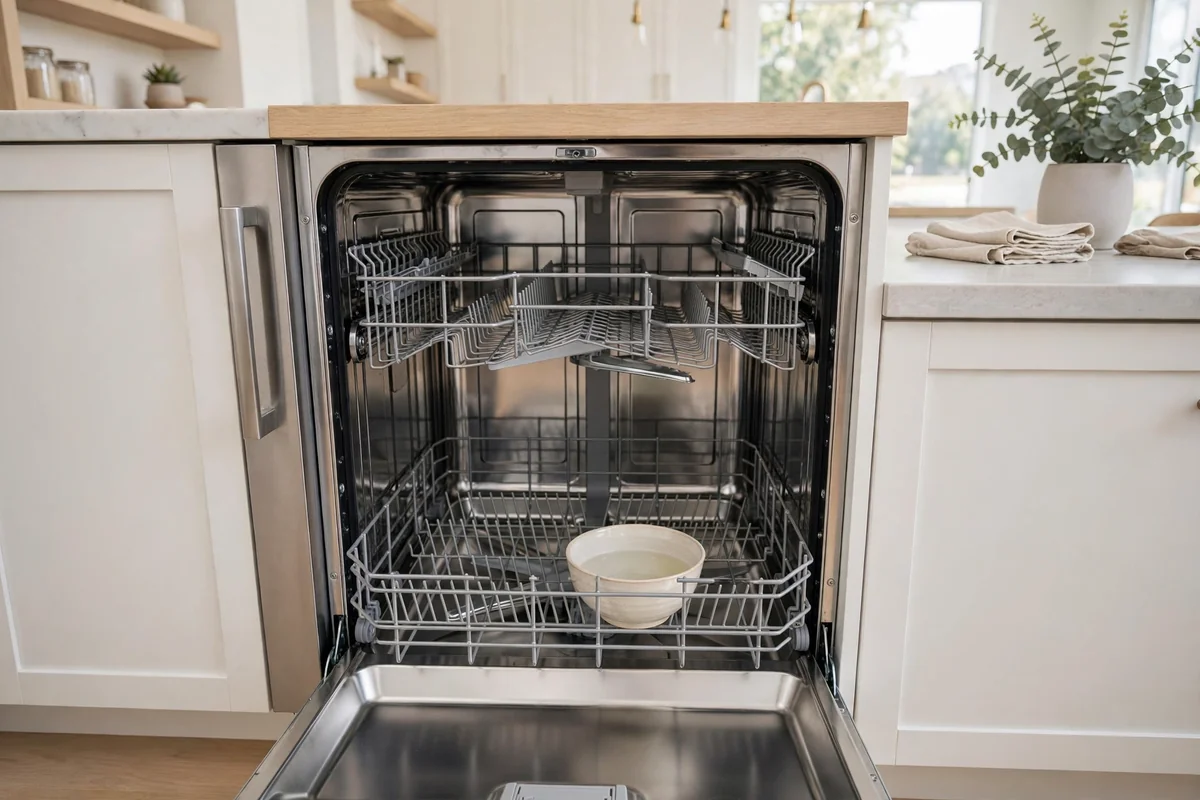
Reinstall the racks. Place a dishwasher-safe bowl or measuring cup with two cups of white distilled vinegar on the bottom rack. Run the hottest, longest cycle the machine offers, with no dishes and no detergent. The hot vinegar loosens grease, dissolves light scale, and kills odor-causing bacteria throughout the tub, arms, and hoses.
Step 7 — The Baking Soda Freshen
When the vinegar cycle finishes, sprinkle a cup of baking soda across the bottom of the empty tub and run a short hot cycle — or the rinse cycle — again with no detergent. The baking soda neutralizes lingering odors and leaves the interior smelling clean rather than vinegary.
Step 8 — Dry and Air Out
When the cycle completes, open the door fully or leave it ajar and let the interior air-dry completely before the next load. Take a final look: the tub should be clean, the filter seated, the arms spinning freely, and the gasket folds dry.
Heavy scale or stubborn film? If the vinegar cycle does not clear chalky mineral deposits, repeat the hot cycle with a purpose-made dishwasher descaler instead of vinegar. For recurring heavy buildup on well water, that descaler step belongs in your quarterly routine, not just the annual one.
Keep the Smell From Coming Back: A Simple Routine
Deep cleaning once is only half the job. This light routine takes minutes and keeps every cause above from returning.
Consistency beats intensity here. Ten minutes a month of maintenance prevents the buildup that would otherwise take an hour to undo — and it keeps the machine washing better in between.
Central Oregon Factors: Hard Water and High-Desert Dust
Two local conditions make dishwasher odor slightly more common around Bend and Redmond than in softer-water regions.
First, the water. Central Oregon’s municipal supplies and private wells tend to carry meaningful levels of dissolved minerals. That mineral content is what leaves the white film on glasses — and the same film inside the dishwasher traps odor-causing residue. If your glasses spot and your faucets crust, your dishwasher is fighting the same minerals. Monthly vinegar cycles and a descaler step each quarter are not optional extras here; they are the maintenance that keeps the machine neutral-smelling. Homes on wells should also keep an eye on sediment, which loads the filter faster than city water does.
Second, the dust. High-desert dust finds its way into everything, including a dishwasher left sitting between uses — particularly in homes where the machine runs only a few times a week. A rinse-only cycle when the machine will sit for several days flushes out both dust and early food decomposition.
Neither factor means anything is wrong with your dishwasher. They just mean the monthly routine matters more here than the manual suggests. Households that keep up with it rarely need a service call for odor.
Dishwasher Odor: DIY or Professional Service?
Use this table to decide what to handle yourself and what to hand to a technician.
| Task | DIY Suitability | Professional Help |
|---|---|---|
| Clean the filter | Good | Usually unnecessary |
| Scrub the door gasket | Good | Usually unnecessary |
| Clear spray-arm jets | Good | Usually unnecessary |
| Run vinegar and baking soda cycles | Good | Usually unnecessary |
| Descale heavy mineral buildup | Good, with care | Helpful if buildup recurs quickly |
| Re-route the drain hose high loop | Good, if accessible | Recommended if plumbing access is tight |
| Replace a damaged door gasket | Moderate | Recommended for most homeowners |
| Standing water that will not drain | No | Yes — likely pump or drain fault |
| Burning or electrical smell | No | Yes — stop using the machine |
| Odor persists after full deep clean | No | Yes — internal issue needs diagnosis |
The key rule is simple: odor from buildup is a cleaning task you own; odor that survives a complete deep clean is a symptom of something internal — a failing drain pump, a degraded hose, or a seal that has failed — and that is a diagnostic task for a technician.
When Should You Call a Dishwasher Repair Technician?
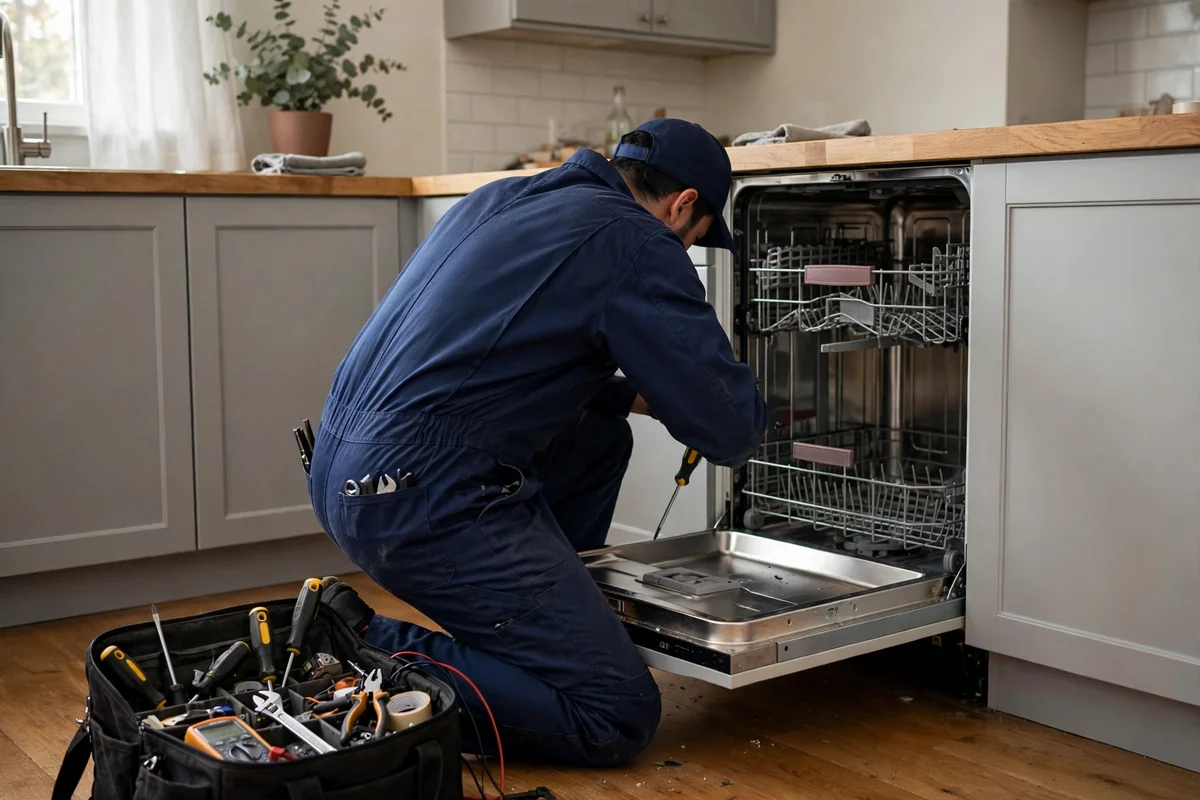
Call a technician when the full deep-clean routine above has not resolved the odor. At that point the likely suspects are internal: a drain pump that is not fully evacuating the tub, a deteriorated or internally clogged drain hose, a failed door seal, or a heating element that no longer reaches sanitizing temperature. None of those respond to more cleaning.
Call sooner — without further DIY attempts — for standing water that remains after a completed cycle, any burning or electrical smell, sparking, tripped breakers, or water leaking from the door or underneath the machine. Shut the dishwasher off at the breaker for anything electrical.
For homeowners in Bend, professional dishwasher repair starts with your symptoms: tell the scheduler what you have already done — for example, “I deep-cleaned the filter, gasket, and arms and the sewage smell is still there.” That detail helps the technician arrive with the right parts and often resolves the problem in a single visit.
Frequently Asked Questions About Dishwashers That Smell Bad
Why does my dishwasher smell bad even though it is brand new?
New dishwashers sometimes smell plasticky or chemical for the first few cycles as factory coatings and oils burn off the heating element — that fades on its own. If the smell is sour or musty rather than plasticky, check whether the installer knocked out the garbage disposal’s dishwasher inlet plug and whether the drain hose has a proper high loop; a new install with a drainage mistake smells from day one.
Is it safe to use bleach to clean a smelly dishwasher?
Bleach can damage stainless steel tubs and rubber seals over time, and it should never be mixed with vinegar or other cleaners. White vinegar and baking soda handle the great majority of dishwasher odors safely. Reserve bleach for extreme cases, use it sparingly in a plastic-tub machine, and never combine it with other cleaning products.
Can I use vinegar in a dishwasher with a stainless steel tub?
Yes — a cup or two of white distilled vinegar in a hot empty cycle is safe for stainless steel tubs and is the standard recommendation for dissolving grease and light mineral scale. What you should avoid is letting undiluted vinegar sit in prolonged contact with rubber seals, which is why the cycle dilutes and rinses it away.
Why does my dishwasher smell like sewage?
A sewage or rotten-egg smell almost always comes from the drain path rather than the tub: a missing or sagged drain-hose high loop letting sink water siphon back in, a clogged or kinked drain hose, or a garbage disposal full of old food connected to the same drain. Check the hose routing under the sink and run the disposal before each dishwasher cycle.
How do I stop hard water film from making my dishwasher smell?
Run a hot empty cycle with white vinegar monthly to dissolve the mineral film that shelters odor-causing bacteria, use rinse aid every cycle so water sheets off instead of evaporating into deposits, and add a quarterly descaler cycle if your water is very hard. Homes on private wells in Central Oregon should also clean the filter more often, since sediment loads it faster.
My dishes come out clean but the dishwasher itself smells — is that normal?
It is common but not something to ignore. Clean dishes with a smelly tub usually mean the filter or gasket is holding decomposing residue that the spray never reaches, or mineral film is sheltering bacteria on surfaces the water sheets past. The odor will eventually transfer to dishes, so clean the filter and gasket and run the vinegar cycle now.
How often should I clean my dishwasher filter?
Monthly scrubbing is the right baseline for most households. Clean it every two to three weeks if you rarely scrape plates, have hard or well water, or run the dishwasher less than three times a week. A filter you have never removed is the most likely source of the smell — start there.
What should I do if my dishwasher smells like burning plastic?
Stop the cycle and check the bottom of the tub for a melted utensil or lid on the heating element — that is the usual cause, and the smell fades after a few cycles once the residue is gone. If you find no melted plastic, or the smell is electrical, acrid, or accompanied by sparking or a tripped breaker, shut the machine off at the breaker and call a technician instead of running it again.
Dishwasher Repair in Bend, OR
A dishwasher that smells bad is usually asking for a deep clean, not a replacement — but when cleaning does not resolve it, an internal fault like a failing drain pump or a degraded hose is the next place to look.
We serve homeowners throughout Bend — including Northwest Crossing, Awbrey Butte, Boyd Acres, Larkspur, River West, Mountain View, Summit West, Orchard District, and Southern Crossing — as well as appliance repair in Redmond, Oregon and surrounding Central Oregon communities. Describe what you have already cleaned using the steps above; it helps the technician diagnose the problem faster, often in a single visit.
Final Takeaway
A dishwasher that smells bad is almost always a buildup problem, not a broken machine. Trapped food in the filter, mold in the gasket folds, clogged spray arms, and hard water scale account for the great majority of odor complaints — and the deep-clean routine above resolves all of them in about an hour.
Keep the monthly maintenance habit afterward, leave the door ajar after every cycle, and treat a burning or electrical smell as a stop-and-call-a-professional situation. When the simple causes are ruled out and the odor persists, professional diagnosis is the sensible next step.
Dishwasher Still Smells Bad?
If the deep-clean routine hasn’t solved the problem, our technicians can diagnose the actual cause — drain pump, hose, seal, or heating element — and give you a clear, upfront repair estimate before any work begins.