Dishwasher Won’t Start? Troubleshooting Guide for Bend, OR Homes
A dishwasher not starting is stressful — especially with a sink full of dirty dishes. This guide covers the eight most common reasons a dishwasher will not start. You will get safe step-by-step checks you can do yourself. You will also learn when it is time to call a local technician.
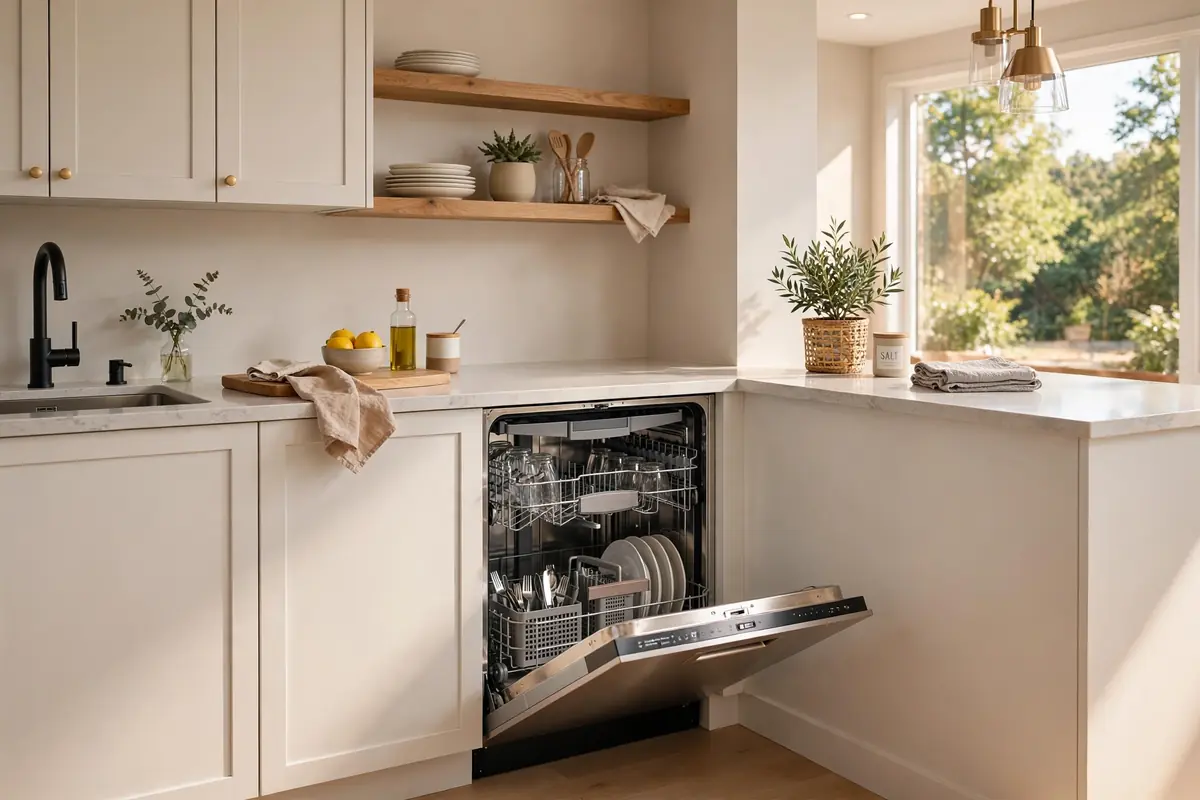
Start Here: Why Your Dishwasher Will Not Start
When the dishwasher will not start at all, the problem is almost never the dishes themselves. It is a power, safety, or control problem. The door safety system, the control lock, the breaker, or the start circuit is blocking the cycle.
The good news is that most no-start problems have simple explanations. A door that is not fully latched stops many dishwashers. A control lock turned on by accident does the same. A tripped breaker is another common cause. These checks take minutes and need no tools.
This guide is written for homeowners in Bend, Oregon and the surrounding Central Oregon area. It covers the eight most common reasons a dishwasher not starting happens. It includes a step-by-step checklist to follow in order. It also explains when professional dishwasher repair in Bend is the right move.
Bend homeowners face a specific mix of causes. Storm-related power trips, aging panels, and busy family kitchens all play a role. This guide addresses each one in plain language.
Table of Contents — Tap to Jump to a Section
- 01 Introduction
- 02 Why It Won’t Start
- 03 How a Start Cycle Works
- 04 Match Symptom to Cause
- 05 8 Common Causes
- 06 Door Won’t Latch
- 07 Control Lock Engaged
- 08 Tripped Breaker
- 09 Start Button Not Responding
- 10 Faulty Door Switch
- 11 Failed Thermal Fuse
- 12 Water Supply Issue
- 13 Control Board Failure
- 14 Blinking Lights & Error Codes
- 15 What You Need
- 16 No-Start Checklist
- 17 Prevention Tips
- 18 Central Oregon Factors
- 19 DIY or Pro?
- 20 When to Call a Pro
- 21 FAQ
- 22 Bend & Redmond Service
- 23 Final Takeaway
Why Is My Dishwasher Not Starting?
The most common reasons a dishwasher will not start are:
- The door is not fully closed or latched — the safety switch blocks every cycle until it is
- Control lock or child lock is engaged and disables the buttons
- A tripped circuit breaker or blown fuse cut power to the unit
- The start button or touchpad is not responding, often from residue or moisture
- A faulty door switch fails to signal that the door is shut
- A failed thermal fuse cut power after overheating — the dishwasher looks completely dead
- The water supply valve is closed, so the machine refuses to begin filling
- A failed control board cannot process the start command
Always start with the simplest checks: the door latch, the control lock setting, and the breaker. These three take less than five minutes.
Most no-start calls we see involve one of these eight. The checklist below finds yours in minutes.
Safety first: turn off the breaker before removing any access panel. Do not touch wiring or test live electrical parts yourself. When in doubt, stop and call a professional.
What Happens When You Press Start: The Normal Sequence
Knowing the normal start sequence makes diagnosis easier. Every no-start failure interrupts this chain at one specific point.
First, the door switch confirms the door is shut and latched. Then the control board checks that the lock is off and no delay is set. Next, it opens the water inlet valve to fill the tub. Only then does the wash pump start.
This sequence explains why a dishwasher not starting can have so many different causes. A failure at the door switch looks like a dead machine. A failure at the control board can look identical. The checklist later in this guide works through the chain in order, from the door to the board.
A dishwasher that fills but never drains has a separate problem. No-start means the cycle never begins at all.
Most dishwashers also run a short drain at the very start of the cycle. You may hear the pump run for a few seconds before the fill begins. That sound is normal — it clears leftover water from the last cycle. If you hear nothing at all, the failure is earlier in the chain.
| Start Step | What Happens | Failure Sign |
|---|---|---|
| Door signal | Latch engages the door switch | Nothing at all when you press start |
| Lock check | Board confirms the control lock is off | Padlock icon lit, buttons dead |
| Settings check | Board confirms no delay is set | Countdown shown on the display |
| Water fill | Inlet valve opens, tub fills | Starts, then stops before washing |
| Wash | Pump circulates water through spray arms | Fills with water, then goes silent |
Match What Happens When You Press Start to the Cause
Watch what the dishwasher does when you press start. Then match the behavior to the table. Begin with the easiest fix in each row.
| What Happens | Most Likely Causes | Check First |
|---|---|---|
| Nothing at all: no lights, no sounds | Tripped breaker, failed thermal fuse, loose power connection | Breaker panel, then power connection |
| Lights on, but nothing happens when you press start | Door not latched, faulty door switch, control lock | Door latch, then lock setting |
| Start button does nothing, other buttons work | Worn start button, dirty or damp touchpad | Clean panel, test button response |
| Beeps or flashes, then goes quiet | Control lock engaged, error code, delay start set | Clear lock, cancel delay |
| Hums briefly, then goes silent | Motor or pump jam, control board issue | Professional diagnosis |
| Panel lights flicker or the display stays blank | Loose power connection, failing control board | Breaker first, then a pro |
| Fills with water, then stops before washing | Water supply interruption, float switch stuck | Supply valve and float |
| Worked yesterday, dead today after a storm | Surge damage, tripped breaker or GFCI | Breaker and GFCI reset |
When a dishwasher not starting follows a power outage or storm, check the breaker first. Reset any GFCI outlet on the same circuit next. Surges often trip protection devices before they damage parts. Work from the top of the table down — the first rows cover the most common causes.
8 Common Reasons a Dishwasher Will Not Start
The sections below explain each cause in detail. They run from the simplest checks to the problems most likely to need a technician. Work through them in order — do not jump to part replacement before ruling out the easy causes.
| Common Cause | Main Symptom | Difficulty |
|---|---|---|
| Door not fully latched | Lights on, nothing happens at start | Easy — 2 minutes |
| Control lock engaged | Buttons unresponsive, padlock icon lit | Easy — 1 minute |
| Tripped breaker or blown fuse | Completely dead, no lights | Easy — 5 minutes |
| Start button or control panel issue | Start does nothing, other buttons work | Easy — 5 minutes |
| Faulty door switch | Only starts if you push the door hard | Professional |
| Failed thermal fuse | Completely dead despite power | Professional |
| Water supply issue | Refuses to begin filling | Easy to moderate |
| Control board failure | Frozen lights, random behavior | Professional |
1. The Door Is Not Fully Latched
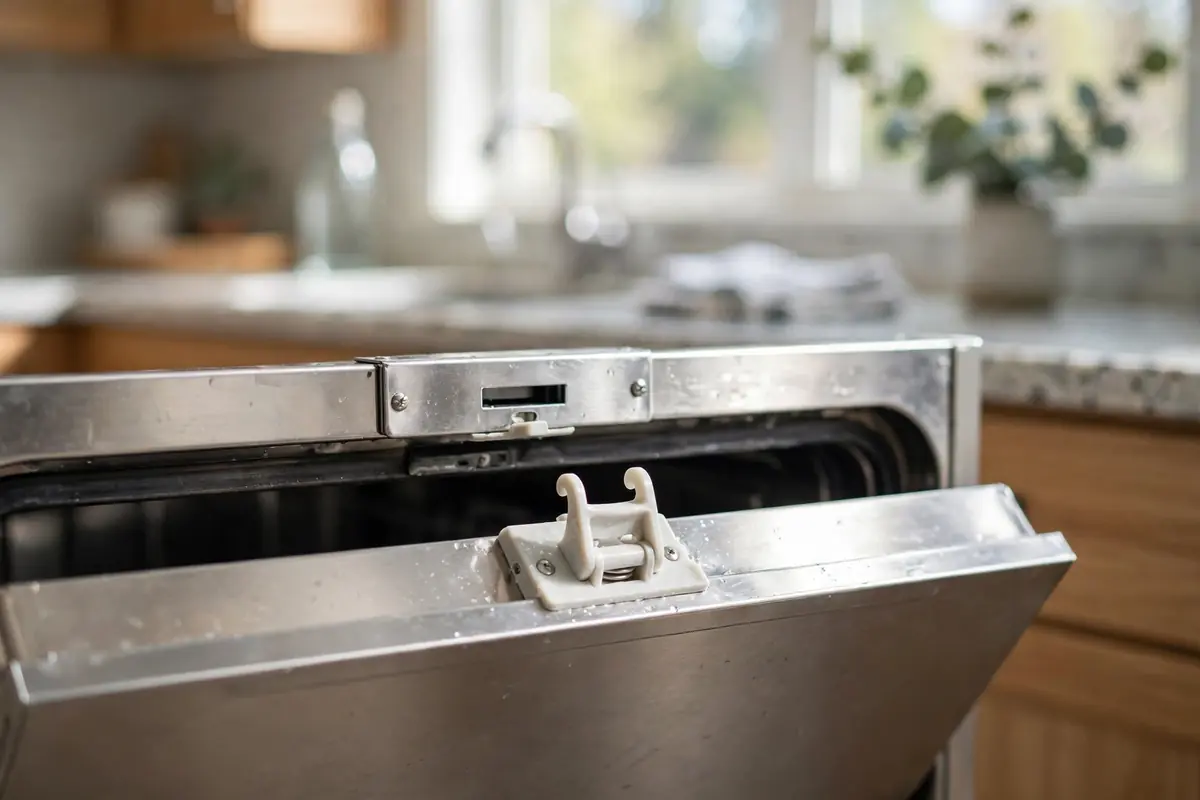
A dishwasher will not start unless the door is completely shut and latched. A small safety switch inside the latch assembly must engage before power reaches the controls. A door that looks closed but is not fully seated will keep the whole machine dead.
Open the door and check for anything blocking it. A cutting board or tall utensil can hold the door open slightly. A rack that is not pushed in can do the same. Push racks fully in, close the door firmly with your palm, and listen for a clear click.
If the door closes but the latch feels loose, the latch assembly may be worn. A broken catch will not engage at all. The plastic catch can crack, and the metal strike can bend over years of use. A latch that will not engage needs replacement before the dishwasher can run.
Check the door gasket too. A gasket that is swollen, torn, or coated with debris can stop the door from seating fully. Wipe the gasket with a damp cloth and look for damage. Also check that the dishwasher sits level. A unit that rocks can twist the door frame just enough to prevent latching. In Bend rentals and busy family kitchens, this is the single most common no-start cause we encounter.
2. The Control Lock or Child Lock Is Engaged
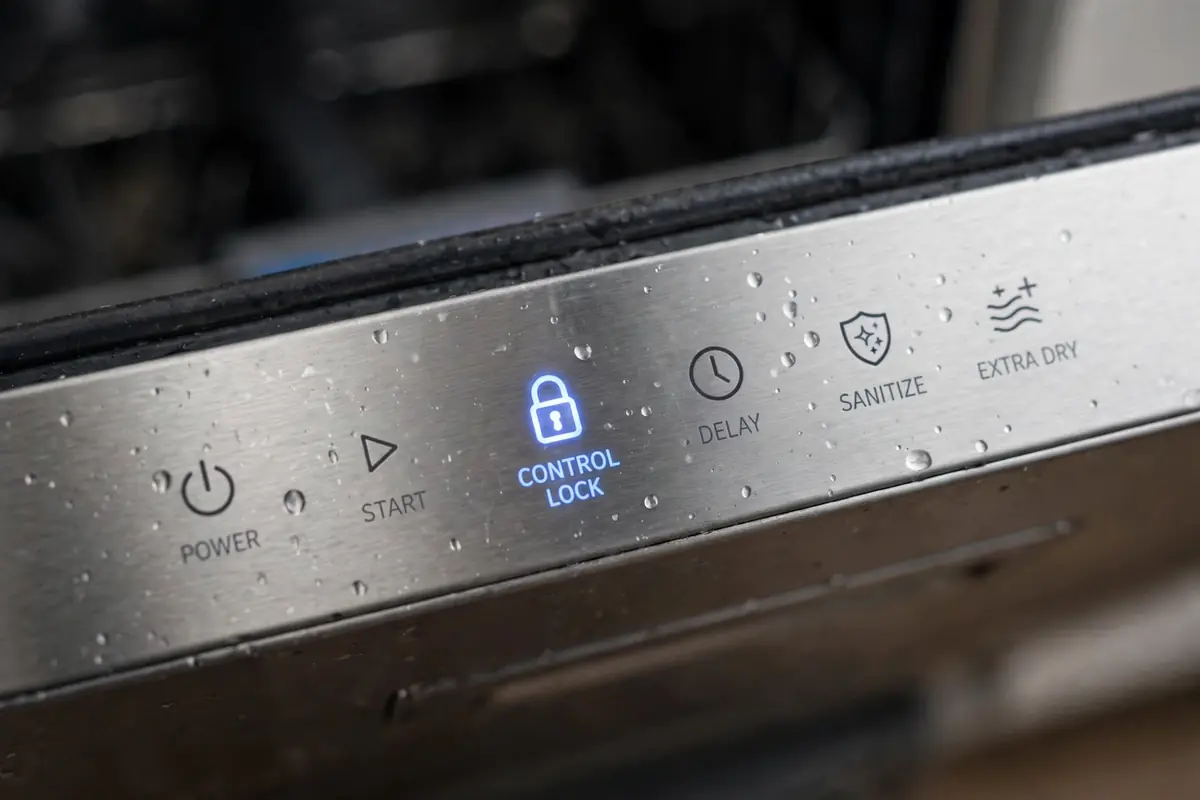
The control lock disables the buttons so settings cannot change by accident. When it is on, the dishwasher will not start no matter how firmly you press. A small padlock icon on the display usually shows the lock is active.
The lock often gets turned on by accident. A child leaning on the panel can engage it. So can a cloth wiping across the controls or a long press during cleaning. Most brands clear the lock when you press and hold the lock button for three seconds.
Check your owner’s manual for the exact button combination, since it varies by brand. Look for a button labeled with a padlock, or two buttons joined by a small line. If the lock clears but the dishwasher still will not start, move on to the power checks below.
Some dishwashers also have a sleep or standby mode that looks like a lockout. The panel goes dark and the buttons do nothing. Pressing any button once usually wakes the machine. If the panel stays dark after that, check the breaker — sleep mode and a power loss look similar.
3. A Tripped Breaker or Blown Fuse Cut the Power
A dishwasher with no lights and no sounds is usually a power problem. The circuit breaker in your electrical panel may have tripped. Older homes with fuses may have a blown fuse instead.
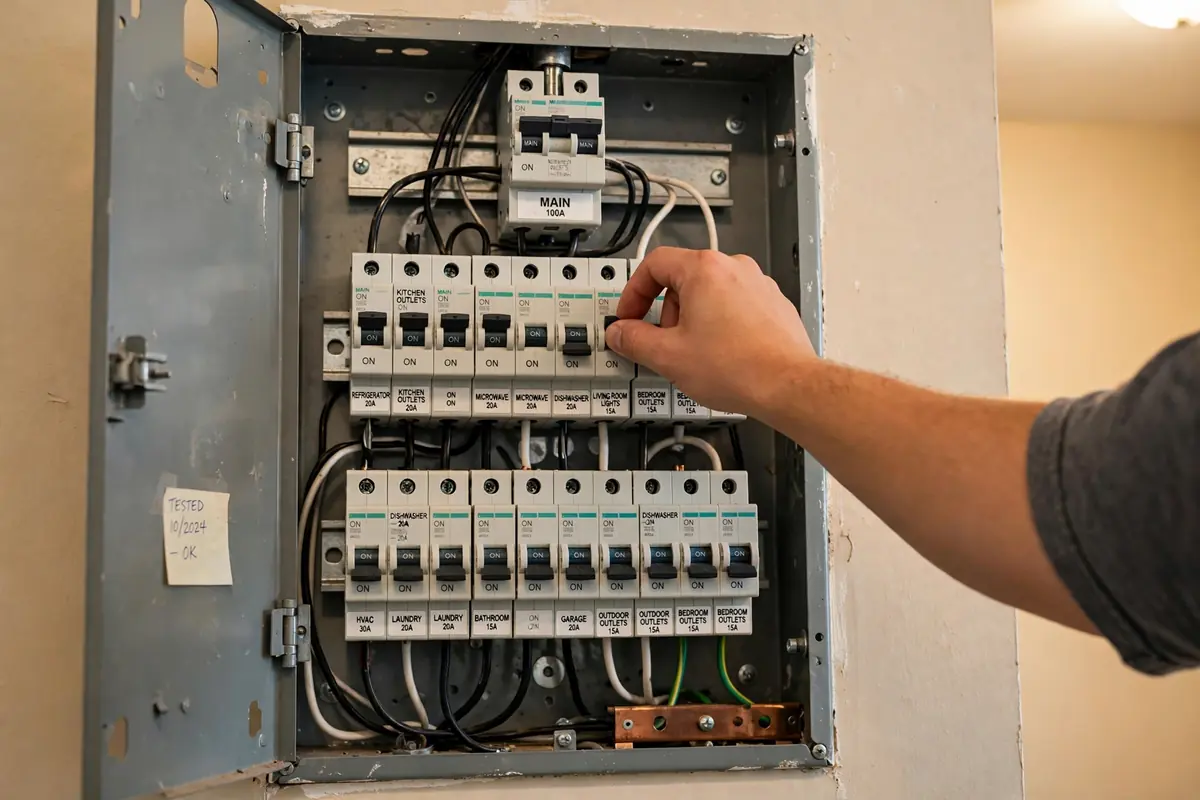
Open your electrical panel and find the breaker labeled for the dishwasher. A tripped breaker sits in the middle position, between on and off. Push it fully to off, then firmly back to on.
If the dishwasher starts and the breaker trips again, stop resetting it. A breaker that trips repeatedly points to a short or an overloaded circuit. Leave it off and call a professional — repeated resets can make electrical damage worse.
Also check for a GFCI outlet on the circuit. Some dishwasher installations share a GFCI-protected circuit with nearby outlets. A tripped GFCI cuts power just like a tripped breaker. Press the reset button on the outlet firmly. If it will not reset, leave it alone and call an electrician. Label your dishwasher breaker with a marker so you can find it fast next time.
4. The Start Button or Control Panel Is Not Responding
Touch-sensitive panels can stop responding when the surface is dirty or damp. Detergent residue, steam, and food splatter build up on the panel over time. That film can block the touch sensors under the surface.
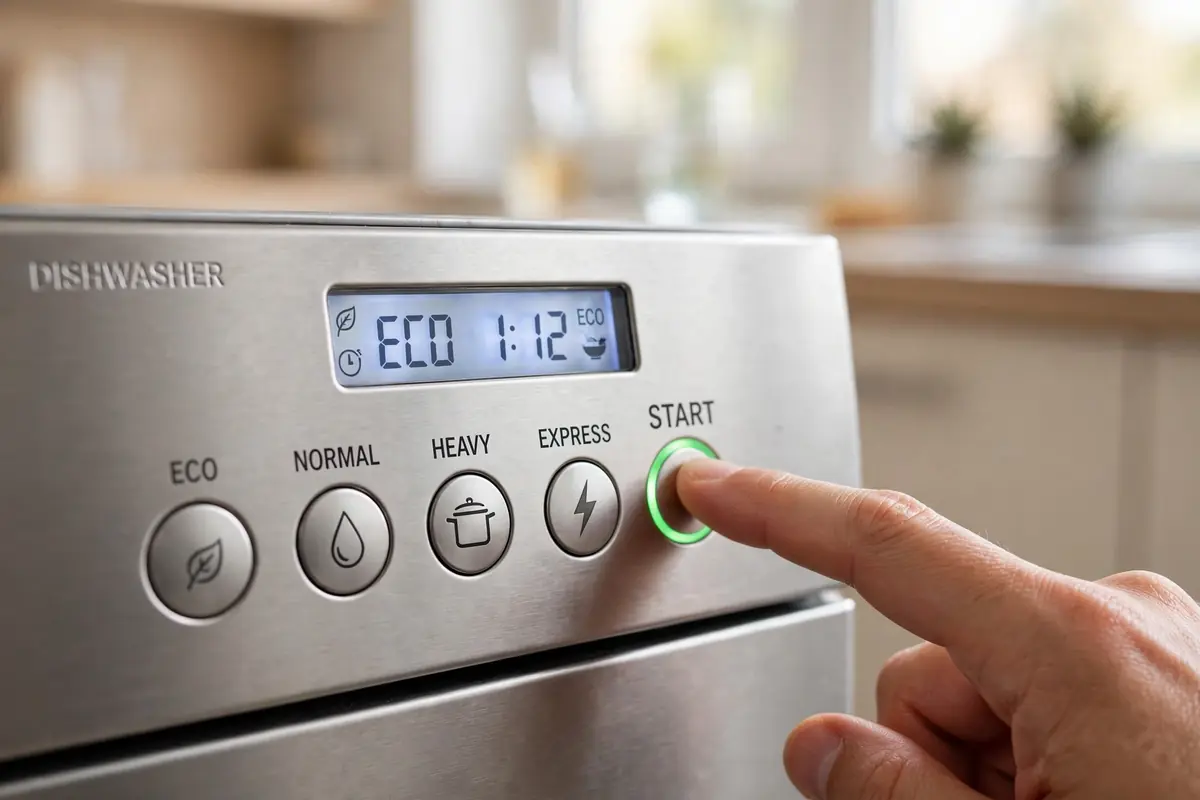
Wipe the panel with a soft, dry cloth or a slightly damp microfiber towel. Never spray cleaner directly onto the controls, since moisture can seep inside. Press the start button firmly and release it quickly.
Holding the start button too long can cancel the cycle on some models. A quick press is the correct motion. If other buttons respond but start does not, the button itself is likely worn. The touchpad behind it may also need replacement.
Moisture damage goes deeper than surface film. Steam from a nearby stove can corrode the panel’s internal contacts. A slow leak under the sink can do the same over time. If the panel works on dry days and fails on steamy ones, moisture intrusion is likely. A technician can confirm whether the panel or its seal needs replacement. Clean the panel gently — aggressive scrubbing can wear the printed labels off.
5. The Door Switch Has Failed
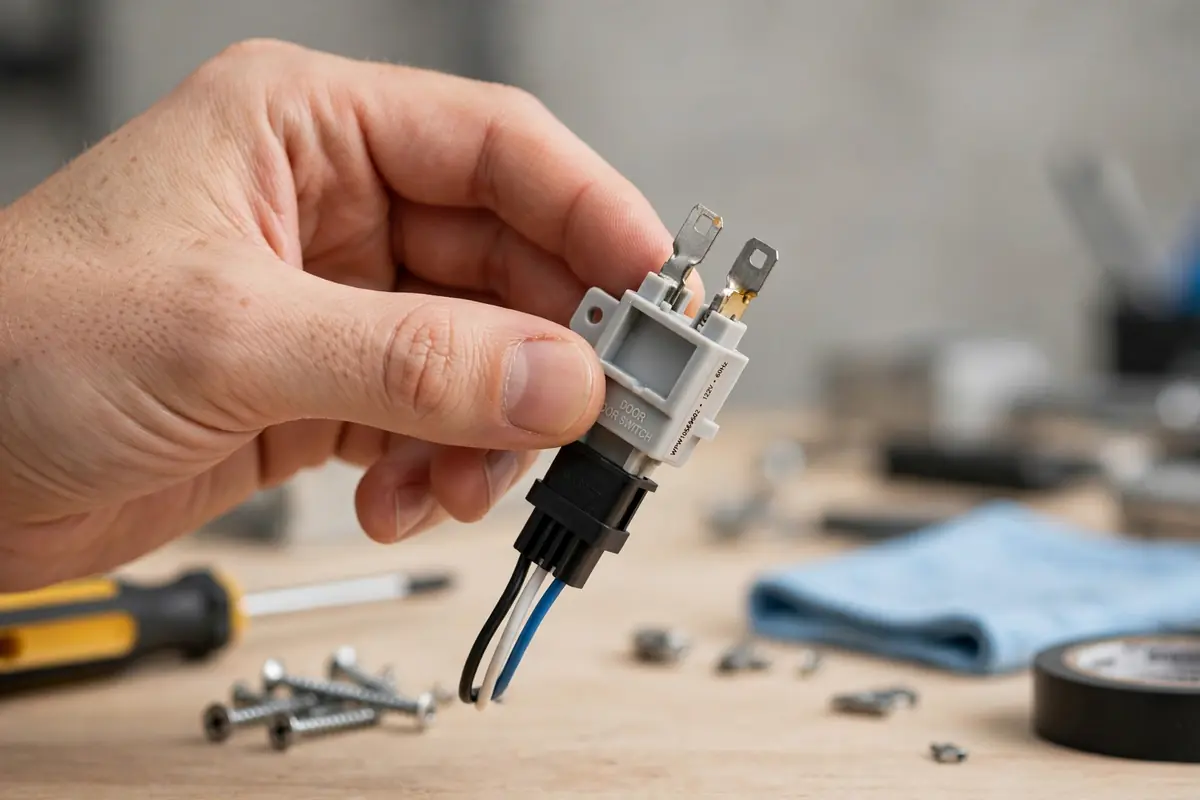
Behind the latch sits the door switch, a small electrical part that tells the controls the door is shut. When the latch is fine but the switch is worn or broken, the signal never arrives. The dishwasher behaves as if the door is open.
This failure can be intermittent at first. The dishwasher may start if you push the door extra hard, then refuse the next time. That pattern — working only with force — points strongly to a failing door switch.
Replacing a door switch means opening the door panel and handling wiring. Most homeowners should leave this repair to a technician. The part is small, but the access work and electrical testing are not beginner tasks.
Door switches wear out from simple repetition. Every cycle opens and closes the switch, and thousands of cycles add up over the years. Heat and steam inside the door accelerate the wear. When a switch fails completely, the dishwasher will not start no matter what you press. A perfect latch changes nothing at that point.
6. The Thermal Fuse Has Blown
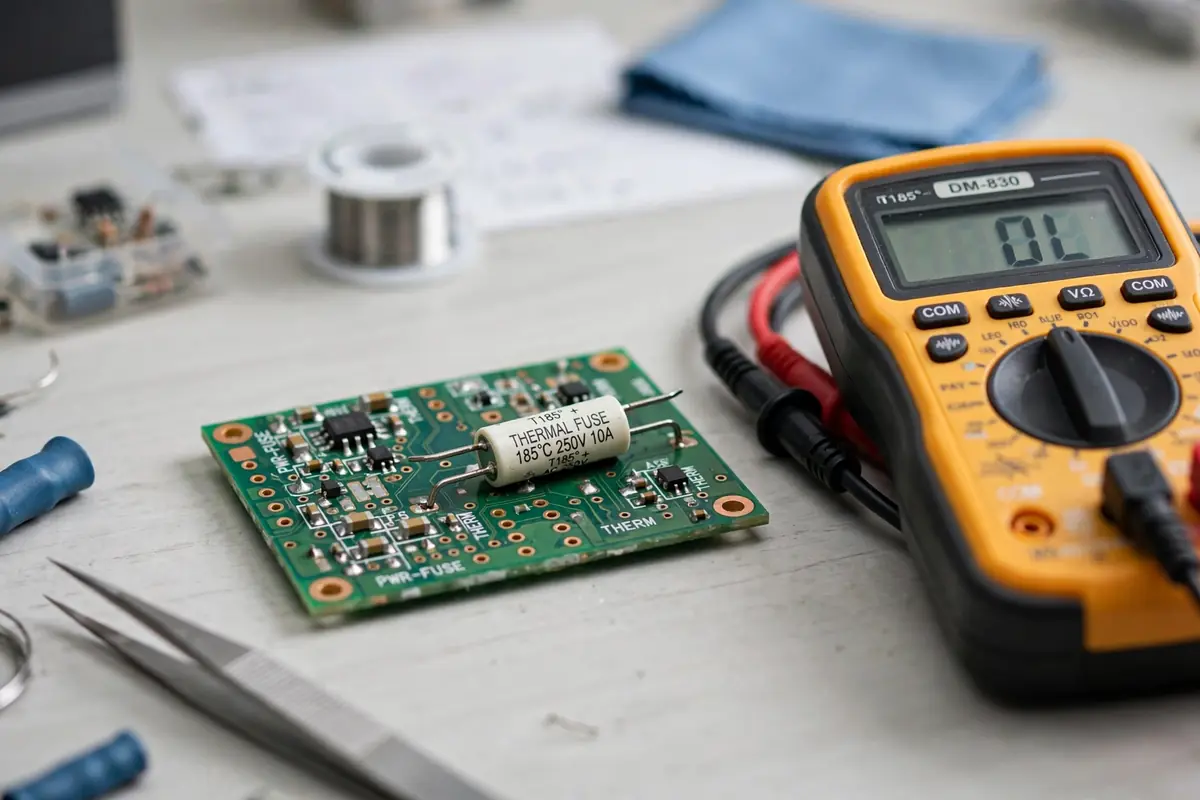
The thermal fuse is a one-time safety device that cuts power if the dishwasher overheats. When it blows, the dishwasher goes completely dead — no lights, no beeps, no response at all. This is the classic signature of a dishwasher not starting with zero power.
A blown fuse is often a symptom, not the root cause. Loose wire connections, a failing control board, or a motor drawing too much current can all trip it. Simply replacing the fuse without finding the cause usually leads to another blown fuse.
Testing and replacing the thermal fuse requires opening the control area and using a multimeter. It also demands finding what overheated in the first place. This repair belongs with a professional in most cases.
The thermal fuse sits near the control board, usually inside the door. It is a small cylindrical part wired in series with the power supply. Because it is a one-time device, it cannot be reset — only replaced. Always replace it with the exact part for your model, and always find the overheating cause first.
7. The Water Supply Is Off or Blocked
Most dishwashers check for water before they begin the cycle. If the supply valve under the sink is closed, the machine may refuse to start at all. The same happens when the inlet hose is kinked or the inlet screen is clogged.
Confirm the hot water supply valve to the dishwasher is fully open. This valve gets closed during kitchen remodels and is sometimes only reopened halfway. Also check that the float inside the tub moves freely — a stuck float can falsely signal a full tub.
Note that this is different from a draining problem. If your dishwasher runs but leaves water behind, that is a separate issue. This section is only about a dishwasher that will not begin its cycle.
The inlet valve screen is a fine mesh filter where the supply line connects. Sediment from well water or old pipes can clog it over time. Low water pressure can also prevent the fill check from passing. If other faucets in the house run weakly too, the problem is household-wide. A plumber is the right call.
8. The Control Board Has Failed
The control board is the dishwasher’s brain. It reads the buttons, checks the door switch, and sends power to the pump and heater. When the board fails, the dishwasher may show no response, frozen lights, or random behavior.
Board failure is the least common cause on this list. It should only be suspected after the breaker, latch, switch, lock, and fuse have all been ruled out. Power surges are the most common killer of control boards.
Diagnosing a control board needs electrical testing and model-specific knowledge. Replacement boards must match your exact model, and installation involves live-voltage areas. Call a professional for this one.
Control boards sometimes fail partially rather than completely. The display may work while the start relay is dead, or the board may reboot in a loop. These partial failures are confusing because the dishwasher seems half alive. Board-level diagnosis needs a multimeter, a wiring diagram, and experience — this is professional work.
What Blinking Lights and Error Codes Mean
A dishwasher that will not start often tells you why through its panel. Blinking lights, beeping patterns, and error codes are the machine’s way of pointing at the problem. Do not ignore these signals.
A padlock icon means the control lock is engaged — hold the lock button for three seconds to clear it. A flashing start light often means the door was opened mid-selection — close the door firmly and press start again. A countdown or clock icon means delay start is active — cancel it to begin now.
Letter-and-number codes like E1 or F2 vary by brand, so check your owner’s manual for the exact meaning. Write the code down before you clear it — that code helps a technician diagnose the problem faster. Never clear a code repeatedly without addressing the cause.
Some brands flash all lights at once when the control board detects a fault. Note the pattern — steady versus blinking matters. A steady padlock means the lock is on. A blinking padlock can mean the lock circuit itself has failed. When in doubt, write down exactly what you see and describe it to the technician.
| Panel Signal | What It Means | Your Next Step |
|---|---|---|
| Padlock icon lit | Control lock engaged | Hold the lock button for three seconds |
| Start light flashing | Door opened mid-selection | Close the door, press start again |
| Clock or timer icon | Delay start is active | Cancel the delay |
| Letter-number code (E1, F2) | Brand-specific fault | Note the code, check the manual |
| Blank panel | No power reaching the controls | Check the breaker and GFCI |
Dead panel? If the panel shows nothing at all, skip this section and go back to the power checks. Dead panels point to the breaker, the thermal fuse, or the power connection — not to settings.
What You Need for the DIY Checks
The safe checks in this guide need almost nothing. A flashlight helps you see the latch and the breaker labels. A dry microfiber cloth is all you need for the control panel. Keep your owner’s manual nearby for lock combinations and error codes. That is the complete toolkit — anything beyond this list means the repair has crossed into professional territory.
The No-Start Checklist: Follow This Routine in Order
Work through these steps in order. Each one rules out a cause before you move to the next. A dishwasher not starting is usually fixed by one of the first five steps.
- Close the door firmly: Push racks in, shut the door with your palm, and listen for the click.
- Check the control lock: Look for a padlock icon on the display. Press and hold the lock button for three seconds.
- Check the breaker: Find the dishwasher breaker in your electrical panel. Reset it fully off, then back on.
- Try the start button: Wipe the panel with a dry cloth. Press start quickly and release it at once.
- Cancel delay settings: Look for a delay or timer icon on the display. Cancel it and press start again.
- Check the water supply: Make sure the hot water valve under the sink is fully open. Check that the tub float moves freely.
- Power-cycle the dishwasher: Turn the breaker off for five minutes, then turn it back on. This resets the control board.
- Check the GFCI outlet: Some dishwasher circuits share a GFCI outlet. Press its reset button firmly.
- Look for error codes: Write down any code on the display. Check the manual before clearing it.
- Call for help: If it still will not start, the cause is likely one of three parts. The door switch, thermal fuse, or control board needs testing. Get a free estimate from our team.
Keep it safe: you can do every step above without opening a panel or touching wiring. The moment a fix requires tools and electrical access, stop and hand it to a technician.
Work through the list in a single session. Jumping between steps out of order wastes time. If you get stuck at any step, note where you stopped — that detail helps the technician.
How to Keep Your Dishwasher Starting Reliably
A few simple habits prevent most no-start problems.
Each item below takes less than a minute. Together they prevent the majority of no-start service calls we see in Bend homes.
These steps take seconds and address the root causes behind most no-start service calls.
Central Oregon Factors That Affect Dishwasher Starts
Dishwashers fail for the same reasons everywhere. Still, a few local conditions in the Bend area make no-start problems more common here. Understanding these local patterns helps you check the right thing first. A storm-night failure and a gradual latch failure need different first steps.
Power Fluctuations During Central Oregon Storms
Winter storms and summer lightning bring brief outages and surges to Central Oregon. These events trip breakers and GFCI outlets, and strong surges can damage control boards. When a dishwasher not starting follows a storm, always check the breaker first. A whole-home surge protector is worth discussing with an electrician.
Older Electrical Panels in Established Neighborhoods
Homes in older parts of Bend and Redmond sometimes still run on aging panels or fuse boxes. Weak breakers trip more easily under normal loads. If your dishwasher breaker trips often, the panel itself may need an electrician’s attention — not the dishwasher.
Hard Water and Control Panel Care
Hard water is less of a factor for no-start problems than for cleaning problems. Still, mineral-heavy steam can leave film on touch panels over time. Wiping the panel regularly keeps the start button responsive.
Dishwasher No-Start: DIY or Professional Service?
Use this table to decide what to handle yourself and what to hand to a technician. The table below is conservative on purpose — electrical work is never worth the risk.
| Repair Task | DIY Suitability | Professional Help |
|---|---|---|
| Close and latch the door firmly | Good | Usually unnecessary |
| Turn off the control lock | Good | Usually unnecessary |
| Reset a tripped breaker | Good | Call a pro if it trips again |
| Clean the control panel and retry start | Good | Usually unnecessary |
| Cancel delay start and reset settings | Good | Usually unnecessary |
| Check water supply valve and float | Good, with care | Helpful if parts need replacing |
| Power-cycle at the breaker | Good | Usually unnecessary |
| Replace the door switch | Moderate | Recommended for most homeowners |
| Replace the thermal fuse | No | Yes — the cause must be found |
| Diagnose or replace the control board | No | Yes |
The key rule is simple: DIY the diagnosis and the simple fixes. Let a professional handle electrical testing and part replacement. Your own troubleshooting makes the service visit faster and cheaper.
When in doubt, choose the professional column. A wrong guess on electrical parts costs more than a service visit.
When Should You Call a Dishwasher Repair Technician?
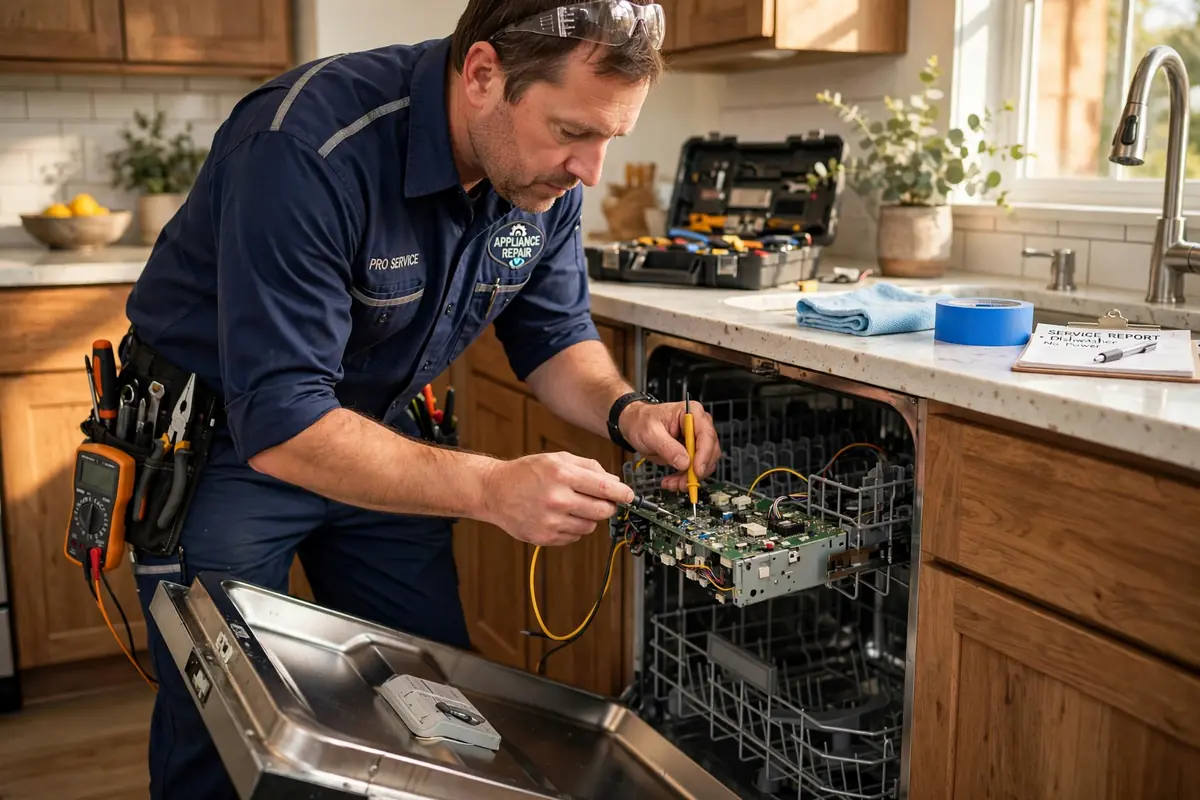
Call a technician after you have ruled out the door latch, the control lock, and the breaker. Add the water supply check to that list before you call. The remaining suspects are the door switch, the thermal fuse, and the control board. All three need electrical testing and correct part sourcing. Same-day appointments mean you will not wait long for help.
Call sooner — without further DIY attempts — for a burning smell or scorch marks. Sparking or a breaker that trips the moment you reset it also needs a pro now. Turn the breaker off and leave it off.
For homeowners in Bend, professional dishwasher repair starts with your symptoms. Tell the scheduler what you have already checked. For example: lights are on but start does nothing. Or: completely dead after last night’s storm. That detail helps the technician arrive with the right parts.
Bring your owner’s manual to the appointment if you have it. The model number inside helps the technician confirm parts before arriving. You can usually find it on a sticker inside the door frame.
Frequently Asked Questions About a Dishwasher That Won’t Start
Why is my dishwasher not starting but the lights are on?
Lights with no start usually mean a safety or control issue, not a power failure. Check the door latch first, then the control lock setting. A faulty door switch can also cause this exact pattern. Cancel any delay-start setting as well. If these checks do not help, the door switch may need professional testing. This pattern rarely means the dishwasher is beyond repair.
How do I turn off the control lock on my dishwasher?
Press and hold the lock button for about three seconds until the padlock icon disappears. Some models use two buttons pressed together — check your owner’s manual for the exact combination. If the lock will not clear, the touchpad may need service. Keep the manual in a kitchen drawer for fast reference. The combination is usually printed in the manual’s troubleshooting section.
My dishwasher is completely dead — no lights at all. What should I check?
Zero power usually means a tripped breaker or a loose power connection. A blown thermal fuse can also cause total silence. Check the breaker first, then confirm the unit has power. If power is present but nothing responds, call a technician — the thermal fuse or control board needs testing. Never open electrical compartments yourself to investigate. A technician can test the fuse and find the overheating cause in one visit.
Where is the dishwasher breaker and how do I reset it?
Find your home’s electrical panel, usually in the garage, utility room, or hallway. Look for the breaker labeled dishwasher or kitchen. Push it fully to the off position, then firmly back to on. If it trips again right away, stop and call a professional. Label the breaker with a marker for next time. If the panel is unlabeled, an electrician can map the circuits for you.
Can I replace a dishwasher door switch myself?
It is possible, but most homeowners should not. The job requires opening the door panel, handling wiring, and testing with a multimeter. A wrong connection can damage the control board. Professional replacement is quick and usually done in one visit. Most replacements take a technician under an hour. The part itself is inexpensive on most models.
Why won’t my dishwasher start after a power outage?
Outages and surges trip breakers and GFCI outlets, which cuts power to the dishwasher. Reset the breaker and any GFCI on the circuit first. If the dishwasher is still dead after the reset, the outage may have damaged a part. The thermal fuse or control board then needs professional testing. A surge protector reduces the risk of repeat damage. Document the outage date in case you need warranty service later.
Should I repair my dishwasher or replace it?
Repair usually makes sense when the dishwasher is under ten years old. Single-part problems like a latch or switch are good candidates. Consider replacement when repairs stack up or the tub itself is damaged. A dishwasher not starting because of a latch, switch, or fuse is almost always worth repairing. Get an upfront estimate before deciding. Upfront flat pricing makes the comparison simple. Most no-start repairs cost far less than a new dishwasher.
Do you service dishwashers in Redmond, OR too?
Yes. We serve Bend and Redmond, plus surrounding Central Oregon communities. Same-day appointments and upfront flat pricing apply in both cities. Describe your no-start symptoms when you book so the technician arrives prepared. Book online or request a free estimate to get started. We back every repair with our 90-day warranty.
Dishwasher Repair in Bend and Redmond, OR
A dishwasher that will not start is often a simple fix — but only with the right diagnosis. Guessing at parts wastes money and time. Our technicians test the actual cause first, then give you an upfront flat price before any work begins. Every visit ends with a test cycle so you see the dishwasher start before we leave.
We serve homeowners throughout Bend. That includes Northwest Crossing, Awbrey Butte, Boyd Acres, Larkspur, River West, Mountain View, Summit West, and Orchard District. We also provide appliance repair in Redmond, Oregon and serve surrounding Central Oregon communities. When a dishwasher not starting ruins your evening, same-day service gets your kitchen back fast. Describe what you have already checked using the steps above. It helps the technician diagnose the problem faster, often in a single visit.
Final Takeaway
A dishwasher not starting is usually a door, lock, or power problem — not a dead appliance. Check the latch, the control lock, and the breaker before anything else. These three checks solve most no-start cases in minutes.
Work through the checklist in order and respect the electrical warnings. Stop when you reach live wiring or internal parts. When the simple fixes do not work, professional testing finds the real cause fast.
Bookmark this guide for the next time the dishwasher goes quiet.
Dishwasher Still Won’t Start?
If the checklist did not solve it, our technicians can find the real cause. We test the door switch, thermal fuse, and control board. Then you get a clear, upfront repair estimate before any work begins.